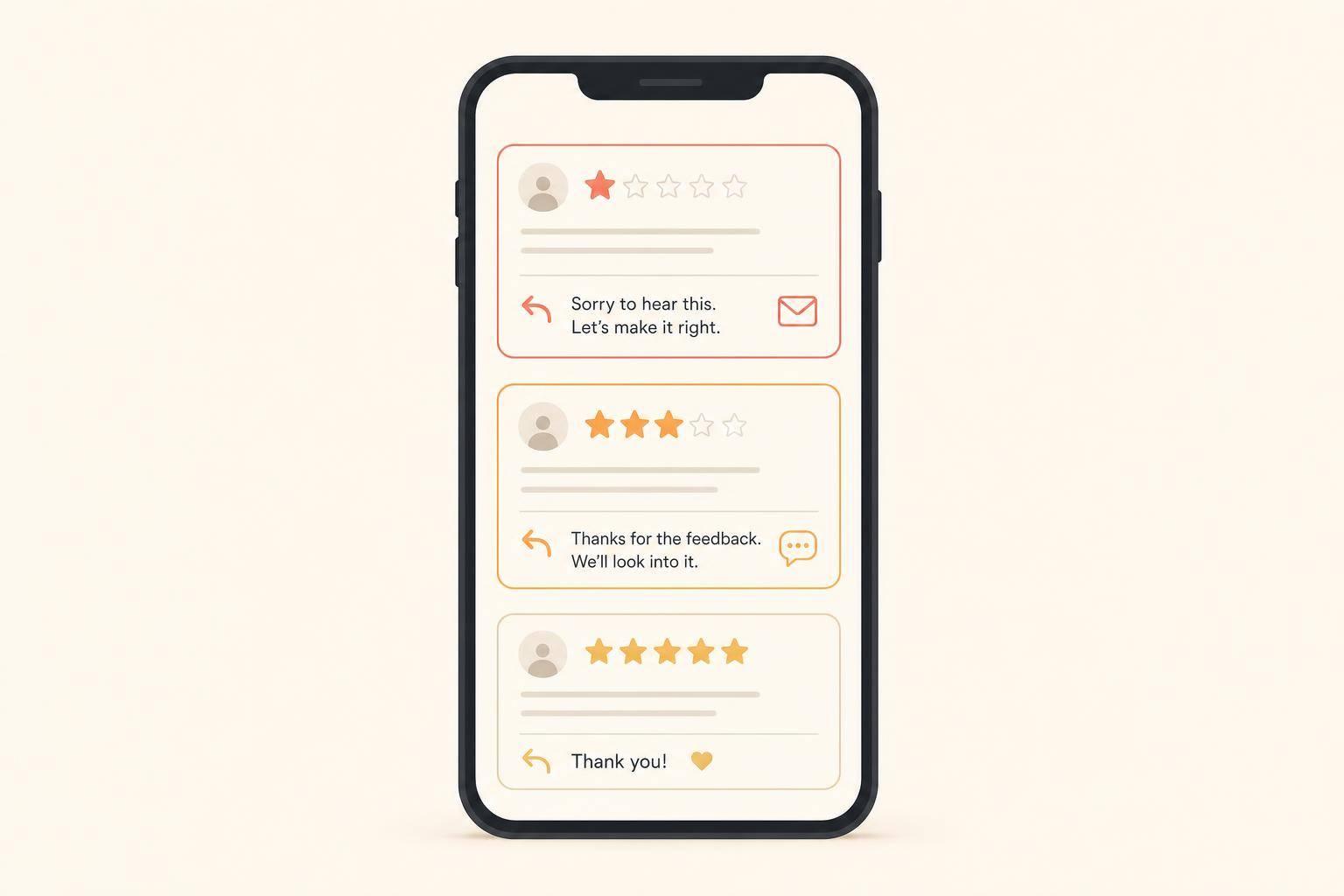
If I never reply to reviews, I make my business look absent, uncaring, or hard to reach. That can mean fewer calls, fewer bookings, weaker repeat business, and less trust before anyone even contacts me.
Here’s the short version:
What do unanswered reviews say to a customer? Usually this: “If I have a problem, this business may not answer me either.” That’s the core risk, and it shows up on Google Business Profile, Yelp, and Facebook fast.
| Review habit | What people may think | Likely result |
|---|---|---|
| No replies | “They don’t pay attention.” | Lost trust, lost leads |
| Replies only to bad reviews | “They only show up when there’s a problem.” | Missed goodwill from happy customers |
| Replies to all reviews | “They’re active and they care.” | Better trust and more conversions |
If I want a simple takeaway, it’s this: a short reply now costs less than staying quiet later.
![The Real Cost of Ignoring Online Reviews [Key Stats]](https://cdn.prod.website-files.com/670ebcd48215317398a7116a/6a8a4c3ee1fc7cdb75a469b9_6a8a3b4fdc1e9c396e6c9e57-1787446188239.jpg)
The Real Cost of Ignoring Online Reviews [Key Stats]
Once people read your review replies, no reply says something too. Reviews don't just share facts. They shape how people feel about your business. And when a business says nothing, customers usually fill in the blanks with the worst-case story.
Here’s a common scene: a homeowner looks for a plumber, lands on your Google Business Profile, and sees a 2-star review that says, "Technician left a mess in my kitchen and never called back to fix it." There’s no reply from the owner. No note. No sign that anyone saw it.
To that homeowner, your silence can make the complaint seem true and still unresolved. It feels current. It feels unanswered. And that matters. One unanswered negative review can turn away about 30 potential customers [7][1].
For high-trust services like plumbing, dentistry, or legal work, the damage can be even worse. Silence suggests that if something goes wrong, the business may be hard to reach. That’s a bad signal to send. In fact, 59% of customers will never give a business a second chance if their negative review is ignored [3].
Silence doesn’t just hurt when the review is bad. It also throws away goodwill when the review is good.
A positive review is a customer handing you trust in public. If that gets no reply, it can come off as indifference. You miss a simple chance to strengthen the relationship and encourage the next visit, referral, or booking. Businesses that ignore complaints see a 37% drop in customer advocacy, while businesses that respond get a 16% lift [7].
Think about a dental patient who praises your front desk and hears nothing back. They may feel less inclined to recommend you. Or a retail shopper leaves a detailed compliment and gets silence. That person may not come back. The numbers back this up: 88% of consumers will hire a business that responds to all reviews, compared with just 47% who will hire one that ignores them [6]. That 41-point gap is what staying quiet can cost.
Over time, that silence shows up where it hurts most: fewer calls, fewer bookings, and less repeat business.
Silence does more than shape perception. It changes what people do next.
When people see reviews sitting there with no reply, many don't stick around. They move to another option. That cost shows up fast: missed calls, lost bookings, and fewer repeat visits. Businesses that respond to reviews earn 35% more average revenue than businesses that don't [1].
Once that impression turns into action, the impact is hard to miss. Fewer people call. Fewer people book. And customers are less likely to come back. The table below shows how different reply habits can influence customer reactions and business results.
| Review Response Behavior | Likely Customer Reaction | Business Effect |
|---|---|---|
| Never responding | Sees the business as inactive or indifferent | 20%–40% of prospects skip the business for a competitor; around 35% lower average revenue [1][2] |
| Responding to negatives only | Sees the business as defensive or focused only on damage control | Misses loyalty-building with satisfied customers and can reduce repeat business [8] |
| Responding to all reviews | Views the business as professional, accountable, and customer-focused | 16.4% conversion lift [1][6] |
On Google Business Profile, review replies shape both trust and discovery. Google treats owner responses as a relevance signal, and profiles that stay active can show up more often in the Local Pack and Maps. If a profile stays quiet, it can seem inactive and less relevant. That means fewer people may find you at all.
There’s another layer here. Steady replies can strengthen local relevance by reinforcing keyword themes in a natural way. Those engagement signals add up over time. So staying silent doesn't just cost you the person reading a review today. It can also chip away at your visibility in future searches.
Next, look for the warning signs that silence has already started hurting your profile.
Silence stops being just a reputation issue when it starts costing you calls and bookings. Once people can see that silence on your profile, the hit becomes measurable.
The clearest red flag is simple: a 1-star to 3-star review sitting near the top of your profile with no owner reply. That’s often one of the first things a prospect sees. And when there’s no response, people tend to fill in the blanks in the worst way. They may assume the complaint is accurate or that the business just doesn’t care [2][5].
Another warning sign is your star rating slipping below 4.0. At that point, click-through rates from Google’s Local Pack tend to drop [2].
Two more signs are easy to overlook. If your newest reviews are more than 30 days old and there are no replies from the business, the profile can start to feel abandoned. That matters because 73% of consumers only trust reviews from the last 30 days [9].
Once you notice those patterns, the next problem is timing.
A good rule is to reply within 24 to 72 hours, starting with negative reviews. More than half of consumers expect a response to a negative review within one week [7], and 36% expect one within 2–3 days [5]. Wait a week or longer, and you’ve already missed the window for a big chunk of potential customers.
Small businesses take an average of 19.5 days to respond to a one-star review - if they respond at all [4].
| Response Time | What It Signals to Prospects |
|---|---|
| Under 24 hours | Active, accountable business; 33% higher chance of a rating upgrade [7] |
| 24–72 hours | Professional standard; meets the expectations of about 58% of consumers [5] |
| 1 week | Trust starts to erode; beyond the cutoff for half of consumers [7] |
| 19.5 days | Signals neglect; the average small business delay [4] |
Speed matters more than polish. A short, clear reply sent on time does more for you than a perfect response sent too late.
If silence is already costing you trust, the fix can be simple: a short weekly routine. Only about 5% of businesses respond to their Google reviews consistently [10], while 89% of consumers expect a reply [10]. That gap gives you a clear opening. You do not need perfect responses. You need responses that show up soon enough to matter.
Set a recurring 15-minute block each week. Monday morning is a good place to start. Look at the newest feedback first. Check reviews daily, answer negative reviews fast, and respond to positive ones twice a week.
For a 1- to 3-star review, keep it short and calm. Acknowledge the issue, apologize for the experience, and move the conversation to phone or email.
For positive reviews, use a simple formula:
If it fits naturally, mention the service once. Start with detailed reviews first, then leave star-only ratings for later.
If you want the routine to stick, make it easier on yourself. Use one dashboard that pulls reviews from Google Business Profile, Facebook, and Yelp into a single inbox. Keep a few response templates ready for common situations. You can also use AI for a first draft, then add a personal touch before posting.
Every unanswered review can chip away at trust before a prospect ever calls. A steady reply habit - just a few minutes a few times each week - can help protect trust and keep leads moving. The reviews are already there. Show up.
Yes. There’s no time limit. Old unanswered reviews stay visible, and future customers may read that silence as a lack of attention. Over time, that can hurt trust, conversions, and local visibility.
Start with the most recent reviews and any negative or 3-star reviews first. Those tend to shape how people judge a business at a glance.
For older positive reviews, a brief thank-you is enough.
Then reply to every new review as soon as possible, ideally within 24–48 hours.
Focus on reassuring future customers, not winning an argument. A good reply should:
Keep it brief, professional, and empathetic.
The goal isn't to debate in public. It's to show other readers that you take feedback seriously and handle problems with care.
Avoid:
Yes. Google’s guidance and ranking-factor writeups say that responding to Google reviews can help improve visibility in local search and may support stronger rankings in Google Maps and the local pack. Why? Because replies show that your Google Business Profile is active and being managed.
There’s another upside too. When people compare businesses, they often read reviews before they call, book, or visit. Replies make your listing look more engaged, which can build trust and lead to more clicks.
Discover strategies to elevate your business.