
A 1-star bump in your Google rating can mean more money. For many local service businesses, the article points to a 5% to 9% revenue lift, with 7% used as the middle estimate.
If I boil it down, here’s the answer:
The article also shows why this happens:
And it covers the part most owners care about: cost versus return.
Here’s the core point: your Google rating is not just a public score. It affects clicks, calls, bookings, and sales. The article walks through the revenue math, the 4-star tipping point, the lead formula, cost payback, and simple ways to ask for more reviews and track results.
| Topic | What the article says |
|---|---|
| Revenue impact | 5% to 9% more revenue per 1-star gain |
| Best rule of thumb | Use 7% as a mid-range estimate |
| Most important rating line | 4.0 stars |
| Why it matters | More clicks, calls, and booked jobs |
| Best fit | Plumbers, dentists, salons, and other local service businesses |
| Cost check | Compare monthly tool cost to profit from one extra job |
If I were reading this to make a decision fast, my takeaway would be simple: if your rating is under 4.0, fixing it may be worth far more than it costs.
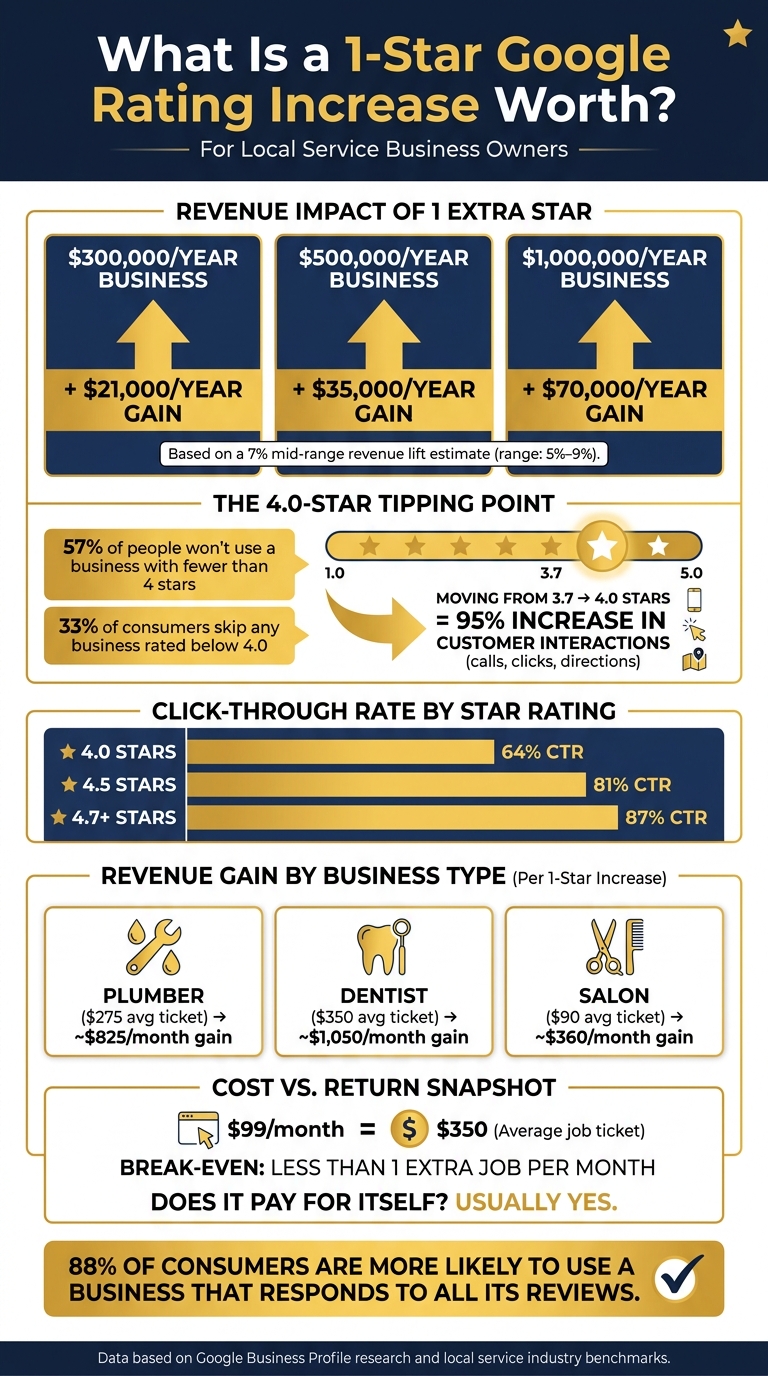
What Is a 1-Star Google Rating Increase Worth? Key Stats & Revenue Impact
Google Business Profile visibility only matters if it leads to clicks, calls, and bookings. Your rating plays a big part in that. A better rating tends to drive more action. The big question is simple: what is that lift worth in dollars?
Eye-tracking research shows that searchers look at the business name and then almost right away at the star rating, so the rating often works like a first-pass filter before the rest of the listing is fully read [3].
The move from 3.9 to 4.0 stars isn't small in the mind of a buyer. It acts like a line in the sand. Businesses under 4.0 are often seen as risky or unreliable, and 33% of consumers skip any business rated below 4.0 stars [5]. The behavior data backs that up: moving from 3.7 to 4.0 stars leads to a 95% increase in customer interactions, including calls, clicks, and direction requests [9].
That matters because a small shift in trust can lead to a much bigger shift in revenue.
Consumer reaction changes fast across rating bands:
| Rating Band | How Customers React |
|---|---|
| 3.0–3.9 | Suspicious; customers often choose competitors with higher ratings even if they have fewer reviews [3] |
| 4.0–4.4 | Good enough to consider; most consumers will evaluate the business [3] |
| 4.5–4.9 | Highest-trust range; high trust and perceived authenticity [3] |
| 5.0 | Often viewed with skepticism if the review count is low [3] |
Those behavior shifts are what the next section turns into revenue math.
A higher rating changes what people do, not just what they think. Click-through rates climb as ratings go up: a 4.0-star listing sees a 64% CTR, a 4.5-star listing reaches 81%, and businesses at 4.7 or above hit 87% [8].
More clicks usually mean more calls, more direction requests, and more website visits. The reverse is true too. If a business drops from 4.5 to 4.2 stars, calls and direction requests can fall by 12% [2].
The same rating change won't lead to the same revenue gain for every business. The dollar impact changes by business type. High-ticket services like plumbers, dentists, and lawyers often gain more because buyers check ratings before they spend. Lower-ticket businesses like cafés may still see a lift, but it may show up across many visits instead of one big sale [1].
That's why the same one-star gain can end up being worth very different dollar amounts.
Now that you’ve seen the revenue impact, you can estimate your own number with a pretty simple approach.
Use the already established 5% to 9% range to estimate the lift for your business:
Annual Revenue × 0.05Annual Revenue × 0.07Annual Revenue × 0.09If your business brings in $500,000 per year, that works out to $25,000 to $45,000.
If revenue feels a bit abstract, there’s another way to look at it: turn that same lift into leads and booked jobs.
Use this formula:
Additional monthly revenue = current monthly profile views × click lift × lead rate × close rate × average ticket
Here’s what that can look like for a few common service businesses:
| Business Type | Avg. Ticket | Est. Monthly Revenue Gain (per 1-star) |
|---|---|---|
| Plumber | $275 | $825 [4] |
| Dentist | $350 | $1,050 [4] |
| Salon | $90 | $360 [4] |
This makes the math feel more concrete. A star gain isn’t just a nicer-looking profile. It can mean more calls, more booked work, and more dollars coming in each month.
If you run a business with repeat customers, swap out average ticket for lifetime customer value:
average ticket × average visits per year × average years as a customer
Then use that long-term number when you compare the upside against what you spend to get more reviews.
A half-star gain usually delivers about half the return of a full star. But the biggest gains tend to show up when you move past 4.0 [1] [10].
So if your rating is sitting below 4.0, that’s usually where the upside is highest.
Next, compare that upside with the cost of improving your review flow.
If one more star can be worth tens of thousands per year, the question becomes pretty simple: does review improvement pay for itself?
In many cases, yes. And the math is often less intimidating than people expect.
A simple way to check payback is to divide your monthly cost by the gross profit from one average job. That tells you how many extra jobs you need each month to break even. So if a tool costs $99/month and your average ticket is $350, you need less than one new job per month to cover the cost [4].
Here’s how the three main approaches compare [7][11]:
| Approach | Monthly Cost | Best For |
|---|---|---|
| DIY | $0 (software) / ~$216 (time) | New businesses, very low volume |
| Software-Assisted | $29–$150 | Higher-volume local businesses |
| Managed Service | $300–$1,000+ | High-ticket businesses |
That range matters. A small shop with low lead flow may do fine with a DIY setup. But once review requests, follow-ups, and response tracking start eating up staff time, software can make a lot more sense.
The payoff is easiest to see in a few common cases.
Average ticket size changes the math too. For a plumber, dentist, or HVAC contractor, one extra customer per month can often cover the full annual cost of reputation software [4]. And if your business gets repeat customers, the case gets stronger when you look at customer lifetime value instead of only the first sale.
Review volume matters too. A strong rating backed by a healthy number of reviews will usually beat a near-perfect score with only a handful of reviews.
If the revenue math makes sense, the next move is to make review growth repeatable. A simple system beats trying to remember to ask every time.
Ask for the review right after a job or appointment is finished, when customer satisfaction is usually at its peak [3]. Send a direct Google review link by text, and add a QR code to invoices or receipts [7][3][12]. Text works especially well: SMS review requests often beat email by about 3-to-1, and waiting three or more days after service can cut response rates by 40% [1].
Keep it easy. Send people straight to the review form. Then reply to every review, good or bad, within 24 to 48 hours [1][6]. That step matters more than many owners think. 88% of consumers are more likely to use a business that responds to all of its reviews [1].
It also helps to check for patterns once a month. If the same complaint keeps showing up, fix the root issue before your rating slips again [2][7].
Once this system is in place, the next step is simple: see whether the higher rating is leading to more leads.
Track your Google Business Profile numbers before and after your rating improves. Your GBP dashboard shows website clicks, phone calls, and direction requests - the signals that show whether more people are moving from seeing your listing to taking action [4][2].
To see the full picture, track two conversion points:
Here’s a useful benchmark: responding to 100% of reviews can increase Google Business Profile conversion by 16.4% compared with not replying at all [13]. That kind of lift can add up fast when your rating moves into a stronger trust range.
A better Google rating can change how many people click your listing, how many of those clicks turn into calls, and how many of those calls turn into paying customers. Moving above the 4.0-star mark often brings the biggest jump in trust, and smaller gains after that can still stack up over time.
The systems behind this - simple review requests, steady responses, and basic tracking - don’t take much time once they’re set up.
If a higher rating changes lead flow, it should sit on the same scorecard as any other marketing cost. Review management makes sense when the measured revenue gain is higher than the cost.
There’s no fixed number. The answer depends on three things:
If your profile has only a small batch of reviews, the average can shift fast. If you already have a large review count, it takes more new reviews to move the number.
Use this formula: New Rating = (Current Rating × Current Reviews + New Review Total) / (Current Reviews + New Reviews).
Here’s a simple example. If you have 50 reviews at 4.2 stars, you’d usually need 15 new 5-star reviews to get to 4.5 stars.
Yes. Review count matters at least as much as star rating when it comes to trust and clicks.
A star rating gives people a fast read on quality. But review volume does something just as important: it tells them the rating has weight behind it. A 4.9 from 12 reviews and a 4.7 from 1,200 reviews do not feel the same. Most people see the second one as more dependable.
That’s how people tend to read ratings in the wild. They don’t just look at the score. They look at how many people left that score. More reviews can make a business seem more established, more tested, and less likely to be riding on a tiny sample.
Google looks at both signals too. Review count and review score can both feed into local prominence. So this isn’t just about human behavior. It can shape visibility as well.
In day-to-day search results, a business with a slightly lower rating but a much larger review count will often beat one with a higher rating and only a handful of reviews.
Usually, a higher Google rating affects revenue over time, not all at once. If you stick with it, you’ll often start to see results within 60 to 90 days.
The timeline also depends on how many reviews you already have. If your profile has only a small number of reviews, your rating may shift by half a star in 4 to 8 weeks. If you already have hundreds of reviews, that same half-star change can take 4 to 6 months.
Discover strategies to elevate your business.