If your business has too few reviews, an old batch of reviews, or a low star rating, you can lose customers before they even click. In this article, I show the main numbers that matter most: star rating, review count, review age, review details, Google visibility, clicks, calls, and sales.
Here’s the short version:
I also break down the review range that tends to win the most trust - usually 4.2 to 4.7 stars, not a perfect 5.0 - plus a simple system you can use to ask for reviews by text or QR code, follow up once, and track calls, clicks, and direction requests in Google Business Profile.
If you want more people to find you, click, and call, this article shows where reviews have the biggest effect - and what to do next.
How Online Reviews Impact Local Business Revenue, Clicks & Rankings
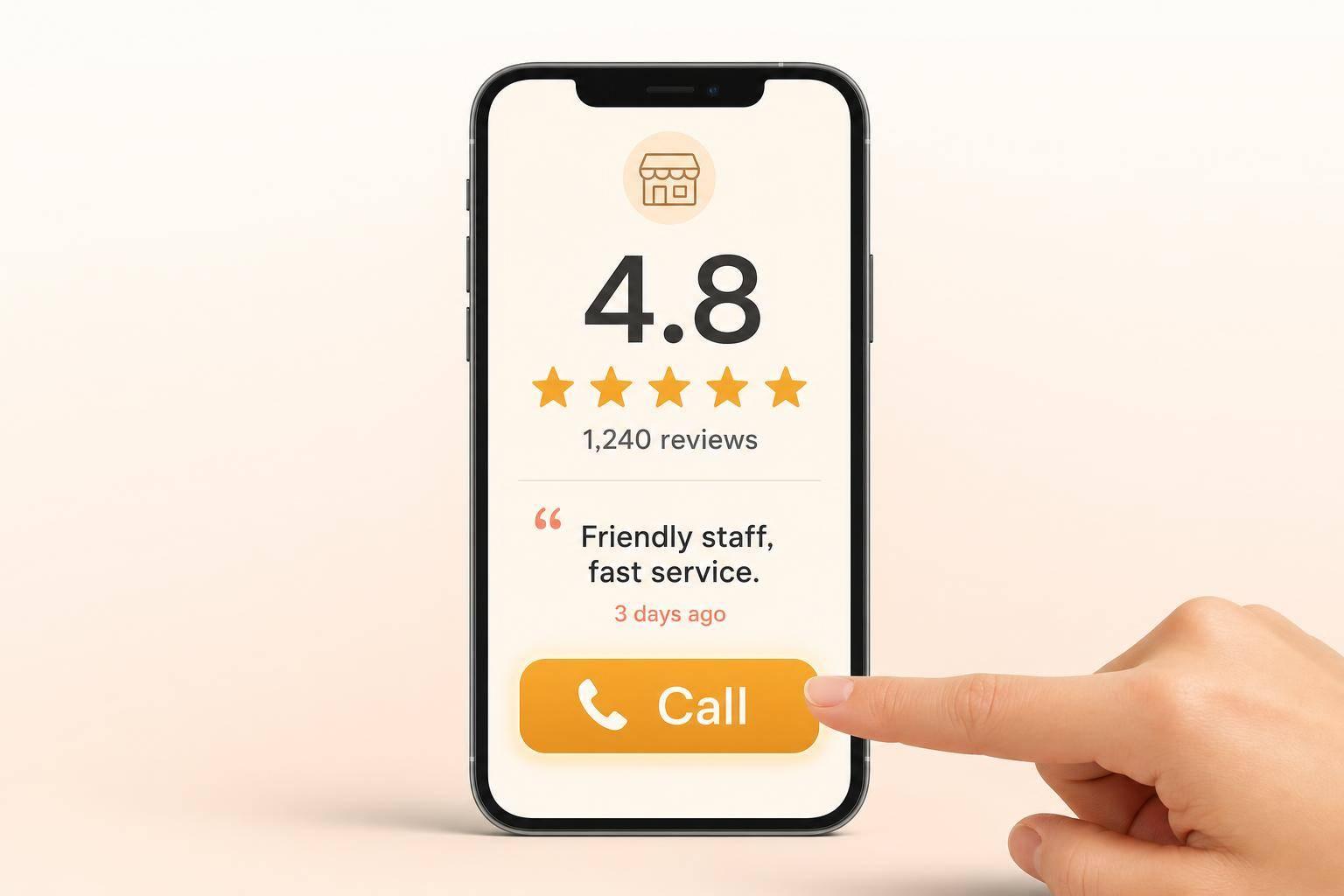
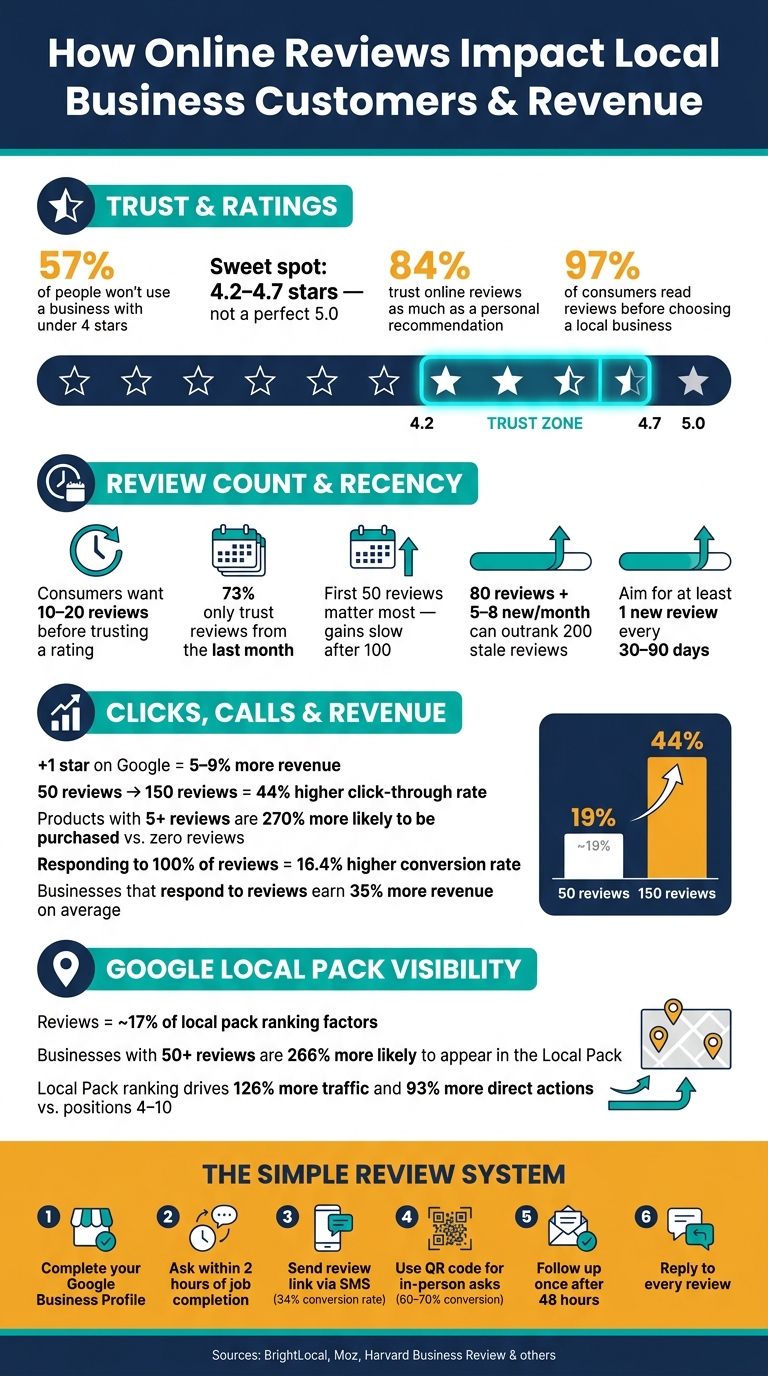
When people pick a local plumber, dentist, or restaurant, reviews work like proof. They show that the business does what it says it does. That helps explain why 97% of consumers read online reviews before choosing a local business [12], and 84% trust them as much as a personal recommendation [3].
Written reviews do more than star ratings on their own. A few clear details can calm doubt and make a buyer feel safer, especially when the service costs more [12]. And that trust doesn’t just feel nice on paper. It shows up in revenue.
The numbers are hard to ignore. A one-star increase on Google can lift revenue 5–9% for independent local businesses [5]. And products or services with at least five reviews are 270% more likely to be purchased than those with zero reviews [5].
More reviews can also mean more clicks. Moving from 50 to 150 reviews increases click-through rate by 44% [3]:
| Metric | Low-Review Business | Strong-Review Business |
|---|---|---|
| Review Count | 50 reviews | 150 reviews |
| Click-Through Rate | ~19% | ~44% [11] |
That’s the part many businesses miss. Reviews don’t just shape opinion after someone finds you. They help more people choose to click in the first place.
Those same review signals can also shape where your business shows up in local search.
Review signals make up an estimated 17% of local pack ranking factors [10]. That’s a big share. Businesses with 50+ Google reviews are 266% more likely to appear in the Local Pack than businesses with fewer than 10 [11].
And placement matters. Ranking in the Local Pack - the top three map results - drives 126% more traffic and 93% more direct actions like calls, directions, and website visits, compared to positions 4–10 [9].
Review text helps in another way too. It gives Google more context about what a business offers. If customers mention services like "emergency plumbing" or "roof installation," those phrases help Google connect the business with those searches, which can improve visibility for those exact terms [1].
The next step is figuring out which review signals matter most: star rating, count, recency, or content.
Four signals do most of the work: star rating, review count, recency, and review detail.
A lot of people think a perfect 5.0 is the target. It's not. The trust sweet spot sits around 4.2 to 4.7 stars. A 5.0 can look less believable, especially if the business only has a small number of reviews [1][5].
Conversion tends to peak around 4.0 to 4.7 stars, not at a perfect 5.0. Why? Because that range looks believable. It feels like feedback from actual customers, not a polished profile.
Here's how those ranges tend to play out:
| Rating Range | Customer Perception |
|---|---|
| 3.0 – 3.9 | High risk / poor quality; trust drops sharply below 4.0 [7] |
| 4.0 – 4.4 | Believable / established; conversion starts to improve [5] |
| 4.5 – 4.9 | Highest trust; sweet spot for click-through and conversion [1][5] |
| 5.0 (Perfect) | May look fake, especially when review volume is low [1][5] |
Star rating gets attention first. But review volume and recency decide whether that rating feels believable.
A simple benchmark works well: match the top three Google Business Profile competitors in your main service search.
The first 50 reviews matter most. After 100, the gains slow down a lot [6]. Going from 0 to 30 reviews does far more than going from 200 to 230.
Recency can matter even more than total volume. A business with 80 total reviews and 5 to 8 new reviews per month can often outrank a competitor with 200 reviews and no activity in the last six months [6][1]. A good minimum target is one new review every 30 to 90 days [1].
Once a profile has enough fresh reviews, people start looking past the stars and asking a plain question: What do these reviews actually say?
Specific reviews lower uncertainty [13]. When someone reads details like the service provided, the problem solved, and the location, it answers the questions already bouncing around in their head. That makes it easier to pick up the phone and call.
Those details also help on the search side. Specific comments give Google more context about the service [1][2]. If several customers mention phrases like "roof installation" or "emergency dental appointment," those phrases strengthen the business's relevance for those exact searches. It helps relevance without stuffing keywords where they don't belong.
When you ask for a review, ask customers to mention:
It's one of the simplest ways to improve trust and search visibility at the same time [1][2].
Use these benchmarks to build a simple review request system that keeps new reviews coming in.
Here’s the good news: you don’t need a fancy setup to get more reviews. You just need a system you can run every week without dropping the ball.
If you want more calls, start with the basics. Your Google Business Profile should be claimed, verified, and fully filled out. That matters because incomplete profiles lead to fewer review requests turning into results [1][2].
Timing does a lot of the heavy lifting here.
The best moment to ask is when the job is still fresh in the customer’s mind. Asking within 2 hours of finishing a job leads to a 42% response rate. Wait two days, and that drops to 6% [3].
For most service businesses, text works best. Send the review link by SMS 1–2 hours after the job. SMS converts at about 34%, compared with just 4.2% for email [14][15].
If you run an in-person business, a simple verbal ask paired with a QR code can convert at 60–70% [14]. Keep the wording short and natural:
"If you're happy with the work, would you leave us an honest Google review?"
If the customer doesn’t reply, send one follow-up text 48 hours later. After that, leave it alone.
A couple of rules matter here. Don’t send unhappy customers to one place while steering happy customers to Google. And don’t offer rewards for reviews. Either one can get your profile suspended [1][14].
Once reviews start coming in, the job shifts from getting reviews to getting more out of them.
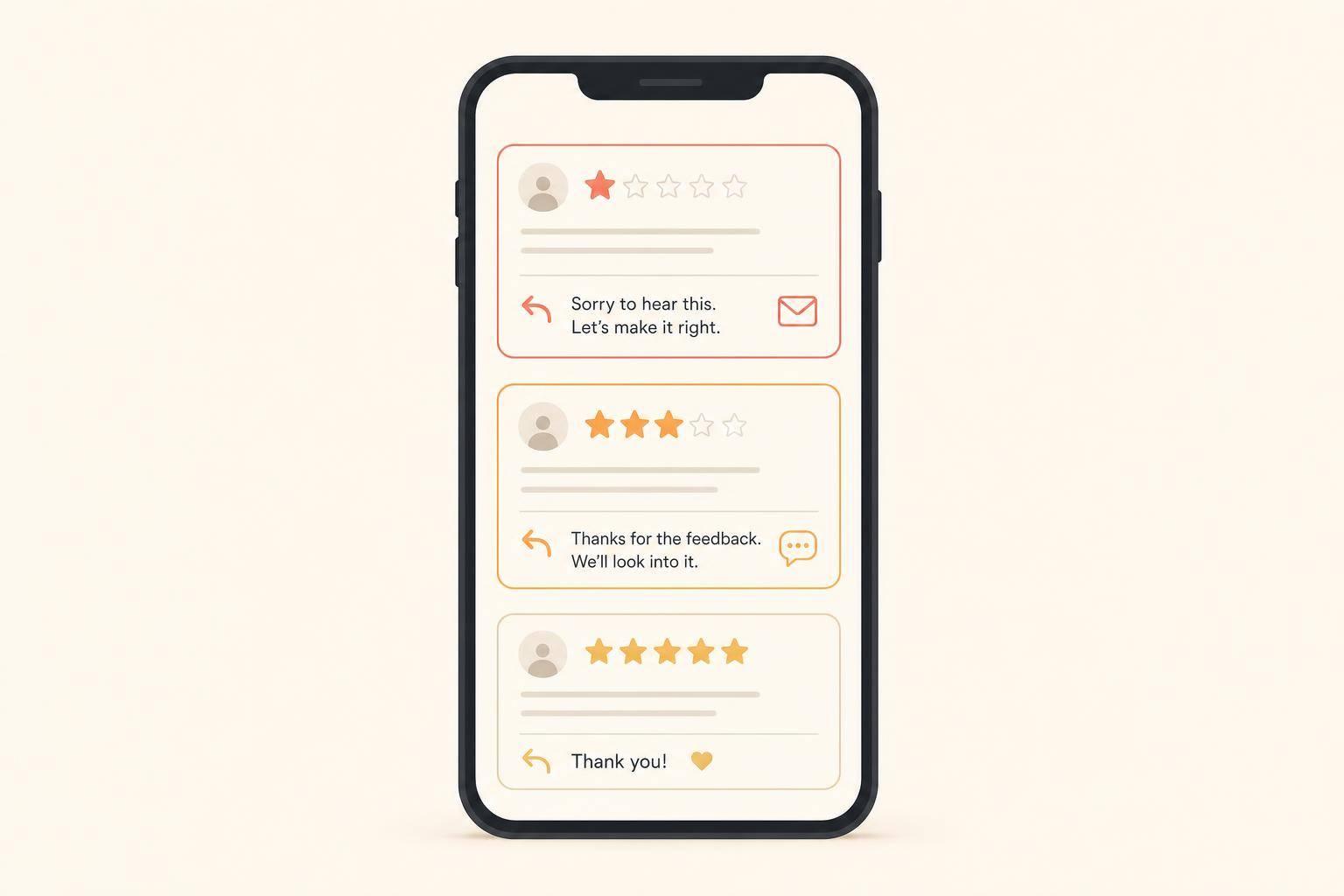
Replying to reviews can lift conversion. Businesses that respond to 100% of reviews see a 16.4% higher conversion rate than businesses that don’t respond [18].
For negative reviews, acknowledge the issue and offer to fix it offline. For positive reviews, thank the customer by name and mention the exact service. That helps add service terms people search for and keeps the profile active [17][18].
You should also keep an eye on results inside the GBP Performance tab. It shows website clicks, direction requests, and calls [4].
Done well, this becomes a simple rhythm:
That’s the kind of process a small business can stick with, and it can turn your Google Business Profile into a steady source of calls and clicks.
The debate is over. Reviews matter. What matters now is how much business they bring in.
They shape trust, clicks, and sales. And the data covered earlier in this article points in the same direction.
Here’s the practical target:
Google says review count and review score affect local ranking [1][2].
One stat is hard to ignore: businesses that respond to reviews earn 35% more revenue on average than businesses that don’t [16]. Strip it down, and the playbook is simple: ask, respond, and stay recent.
There’s no set number that works for everyone. Your target depends on the top three competitors in your Google Local Pack.
Search for your primary keyword plus your location. Then look at the review counts for the top three businesses and aim to match or beat them.
For most service businesses, review velocity matters just as much as total review count. In plain English: getting 8 to 15 new reviews per month on a steady basis often helps more than piling up a big total and then going quiet.
Yes. Recent reviews usually matter more than total volume. Google puts more weight on newer reviews, especially those from the last 90 days, because they point to an active business people still use and talk about.
Total review count still helps. But a steady stream of new reviews is a stronger ranking signal. It also shapes how people feel when they find you. Fresh feedback builds more trust, while older reviews can make a business look lower quality or even inactive.
A good customer review should be specific and detailed. In most cases, 75 to 150 words is a solid range.
Why does that matter? Because longer reviews tend to do more work for you than short one-liners. They can help Google understand and index your services, answer common questions from future customers, and show clear customer satisfaction.
When you ask for a review, guide people a bit. Encourage them to mention:
Photos add visual proof of your work, which can make the review feel much more convincing.
Discover strategies to elevate your business.