If your reviews are weak, stale, or thin, you can lose leads even if your service is strong. In 2026, Google, Google Maps, and AI tools like ChatGPT use reviews to decide who shows up, who gets named, and who gets skipped.
I’d boil the whole article down to this:
A few numbers make the point fast:
What should you do first?
Here’s the simple idea: Google and AI tools can only judge what they can see. If your review profile gives them little to work with, they may send buyers to someone else.
That’s what this article explains, and I think the message is clear: reviews now work like a local ranking signal, a trust signal, and a lead source at the same time.
Good work alone doesn't guarantee visibility anymore. Google and AI tools don't know your business from firsthand experience. They judge it by public signals.
If those signals are weak, you're harder to find and harder to trust. And that usually means fewer calls, fewer clicks, and fewer bookings. Here are the signals that shape whether you show up.
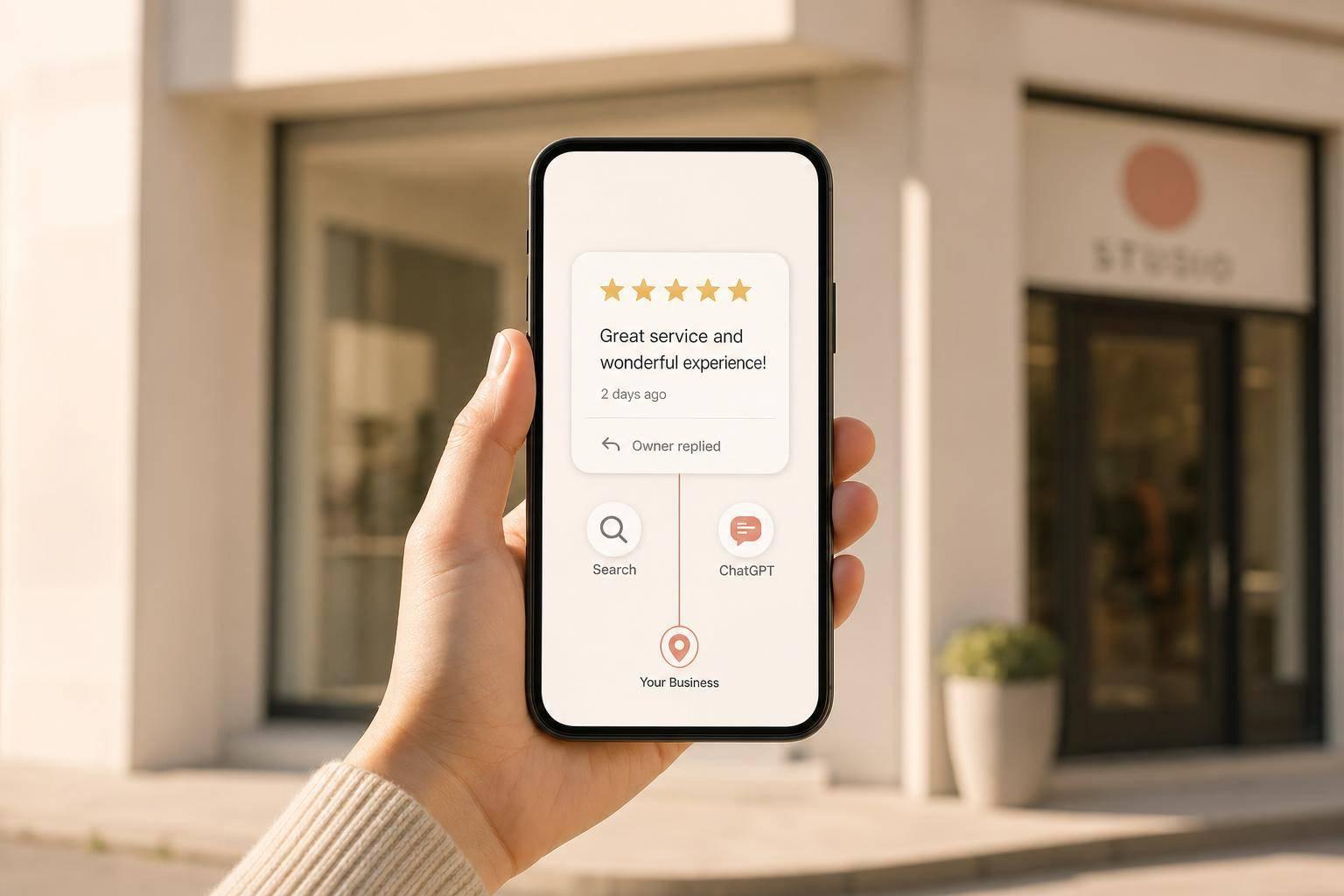
Google, Maps, ChatGPT, and similar tools compare your GBP, reviews, and web mentions to check whether your business looks consistent across the web [1][3]. When your business information and reputation line up across those sources, you're more likely to get recommended. If the signals are thin or don't match, it's easier for those systems to skip you.
A few signals carry a lot of weight.
That's how reviews stop being just social proof and start acting like lead data.
When those signals are weak, the cracks tend to show fast.
One of the clearest signs is simple: nearby competitors show up in Google or AI results, and you don't. If a business offering similar services lands in the Local Pack or gets mentioned in an AI answer while yours stays invisible, your review profile may be part of the reason.
Other warning signs are harder to miss once you look for them. Maybe there's a big gap since your last review. Maybe most of your reviews say nice things but never mention the service, the job, or the outcome. Maybe negative reviews are sitting there with no reply at all.
About 74% of consumers care most about reviews written in the last three months [8]. So if your most recent review came in six months ago, both people and algorithms are likely reading your profile as stale.
The next move is to rebuild those signals around recency, detail, and consistency.
Ads can buy attention. They can't buy trust.
You can send more traffic to your business, but that doesn't fix weak public signals. AI tools pull from public listings and review data [8][4]. So even after the click, a weak profile can still cost you the customer.
If your reviews are thin, generic, or inconsistent across platforms, the system has less to work with. And when that happens, it's more likely to point people toward a competitor with a cleaner profile [3][8].
No ad budget changes that math.
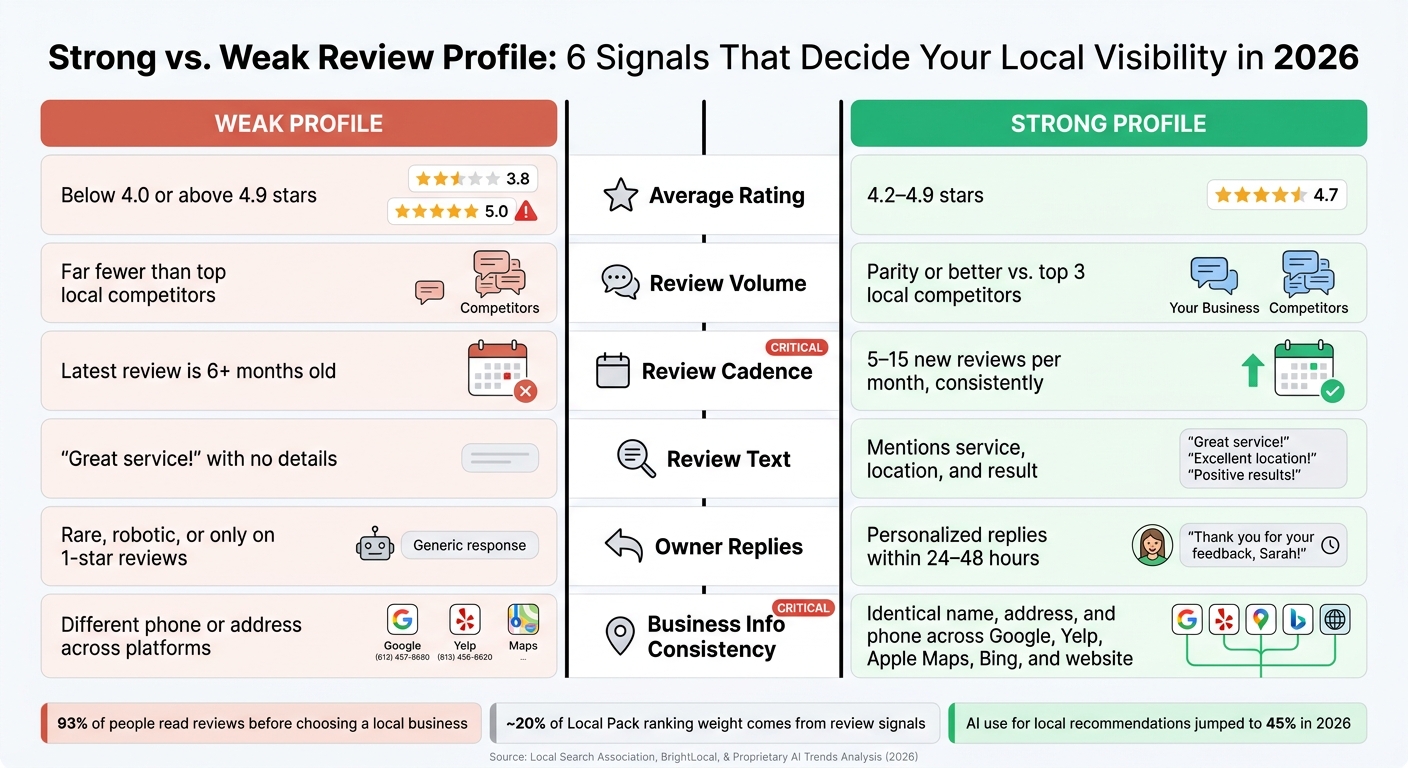
Strong vs. Weak Review Profile: 6 Signals That Decide Your Local Visibility in 2026
If your review profile is weak, start here. These six signals have the biggest effect on how often you show up.
Average rating sets the trust baseline. For most local businesses, the sweet spot is 4.2 to 4.9 stars [5][11].
Review volume helps prove you’re a legit choice. A simple benchmark: match or beat the top three competitors in your category and area [5][1].
Review cadence is where many small businesses slip. A big total doesn’t help much if your last review is old. A steady stream of 5 to 15 new reviews per month carries more weight than a pile of stale ones [5][11].
Review text gives AI something to read and match to search intent. “Great job!” sounds nice, but it tells the system almost nothing. Reviews that mention the service, location, and result make it easier for your business to appear for the searches people actually make [3].
Owner replies show that your business is active and paying attention. Reply to 100% of negative reviews and at least 50% of positive reviews within 24 to 48 hours [5][11].
Business info consistency is easy to miss, and it can hurt more than people think. AI tools check your business data across Google, Yelp, Apple Maps, Facebook, Bing, and industry-specific directories. If your phone number or address doesn’t match from one platform to another, AI may pass you over [2][3].
Use this table as a quick gut check against local competitors.
| Signal | Weak | Strong | Impact |
|---|---|---|---|
| Average Rating | Below 4.0 or above 4.9 | 4.2–4.9 stars | High |
| Review Volume | Far fewer than top local competitors | Parity or better vs. top 3 local competitors | High |
| Review Cadence | Latest review is 6+ months old | 5–15 new reviews per month, consistently | Critical |
| Review Text | "Great service!" with no details | Mentions service, location, and result | High |
| Owner Replies | Rare, robotic, or only on 1-star reviews | Personalized replies within 24–48 hours | High |
| Business Info Consistency | Different phone or address across platforms | Identical name, address, and phone number across Google, Yelp, Apple Maps, Bing, and your website | Critical |
Use these signals to audit your profile before you build a review system.
Start with Google Business Profile. Then check Yelp, Facebook, and the main directories in your space.
For each platform, track four numbers:
Then repeat the same audit for your top three local competitors. That side-by-side view makes the weak spot easy to see.
Use this template:
| Platform | Star Rating | Total Reviews | Last Review Date | Response Rate |
|---|---|---|---|---|
| Google Business Profile | ||||
| Yelp | ||||
| Industry-specific site |
Treat your Google Business Profile and review flow like part of day-to-day business, not a one-and-done project. Then pick the biggest gap and fix that first. In most cases, the issue comes down to one of three things: not enough reviews, slow replies, or uneven activity across platforms.
Go for a steady pace of 5 to 15 new reviews per month instead of a sudden surge that can look forced [11][13]. New, detailed reviews give Google and AI more language to connect with buyer searches.
Timing plays a big part here. Send the review request 30 to 120 minutes after the service is done, while the experience is still top of mind [11][13]. SMS usually works best, with conversion rates around 18% to 25%, compared with 4% to 8% for email [11].
Keep the request short. Use the customer’s first name and add a direct link to your Google review page. If you run a walk-in business, a QR code on a receipt or counter card is a simple, low-friction option [12][14].
Check new reviews often in Google Business Profile and reply within 24 to 48 hours [3][7]. Once the request flow is in place, the next move is simple: turn every public reply into content that helps people feel good about choosing you.
88% of consumers are more likely to use a business that responds to all reviews [2]. That means replies do more than show good manners. They can help shape how buyers see your business before they ever call or visit.
A weak reply and a strong one don’t land the same way:
| Response Type | Impact on Customer Trust | Google/AI Perception |
|---|---|---|
| No Response | Low; signals the business may be inactive or indifferent. | Negative; lacks engagement signals. |
| Poor/Defensive | Very low; can turn one bad review into a bigger reputation problem. | Neutral; adds content but not trust. |
| Professional | High; demonstrates accountability and care. | Positive; signals active management and provides useful keywords. |
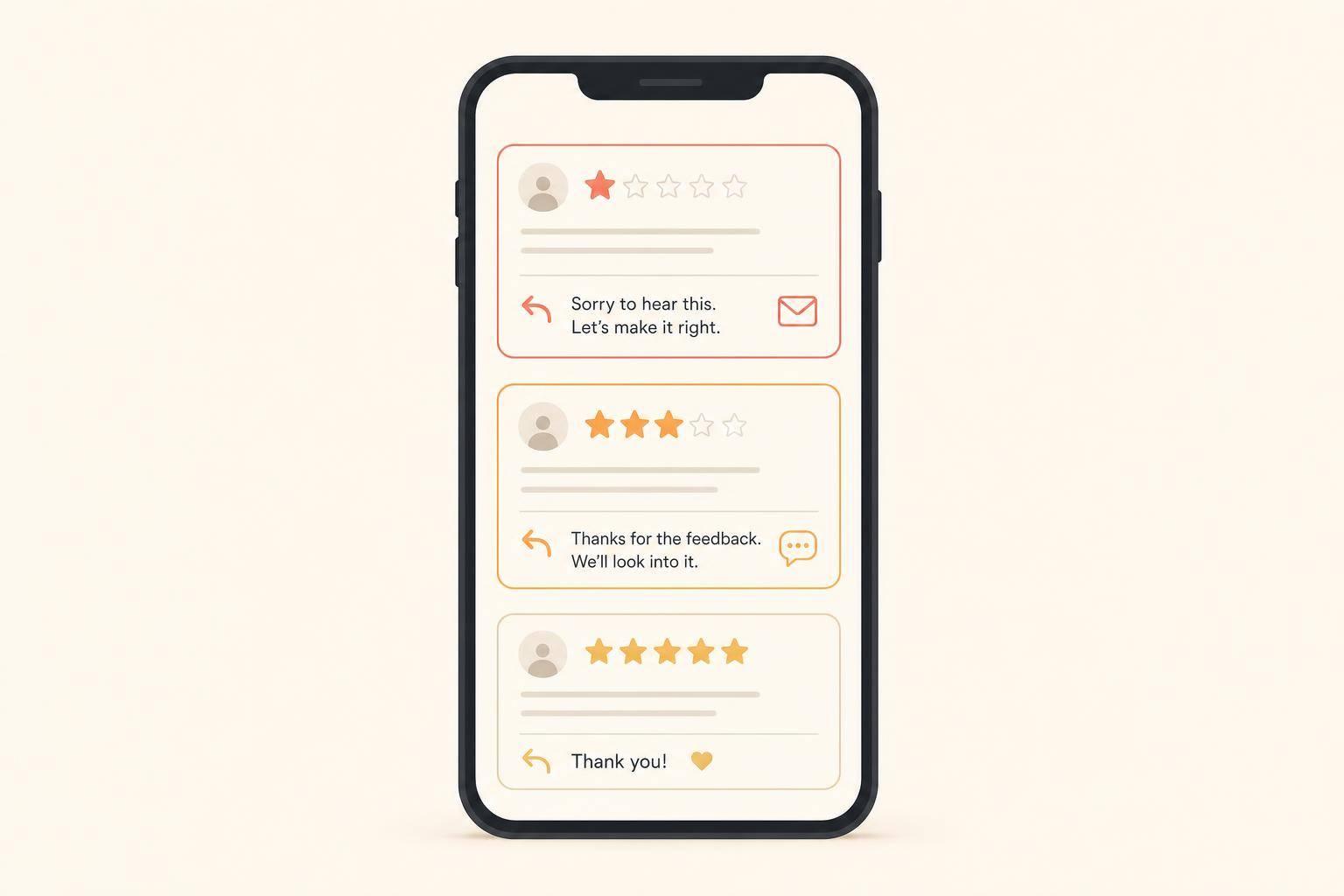
For positive reviews, thank the customer by name, mention the exact service, and work in the location in a natural way. For negative reviews, acknowledge the issue, stick to the facts, and take the fix offline.
"The businesses winning AI recommendations treat responses as publishing, not customer service paperwork." - Emulent Strategy Team [8]
AI use for local business recommendations jumped from 6% in 2025 to 45% in 2026 [8]. That’s a big shift in a short time. Reviews don’t just shape reputation now. They help decide whether Google, Maps, and ChatGPT show your business in the first place.
The businesses that come out ahead tend to do three simple things over and over: ask for reviews, reply fast, and keep their profiles up to date. It’s not about being perfect. It’s about showing up consistently. That’s what Google and AI tools tend to reward.
If you want the shortest path from reviews to steady visibility, focus on these five moves this month:
When you do this month after month, reviews stop being a passive reputation score and start working like a steady source of leads.
There’s no fixed number here. Google tends to care more about how you stack up against nearby competitors and whether reviews come in at a steady pace, not whether you hit some magic total.
A smart target is to match or outpace your top three local competitors. For most local service businesses, 5 to 15 new reviews per month is a solid range, and 8 to 12 is a strong baseline.
The big thing? Don’t chase sharp spikes. Steady month-by-month growth usually works better.
Respond within 24 to 48 hours with a calm, specific reply that focuses on the fix. This is a public message, so future customers - and AI tools - may use it to judge your business.
Don’t ignore negative feedback. When you reply to reviews, you show that someone is paying attention, that your business is active, and that you take problems seriously. That can go a long way with people reading the complaint.
And whatever you do, don’t fake or buy reviews to bury the issue. That can lead to profile suspensions.
Yes. AI tools use natural language processing to read review text and figure out context, sentiment, and specific details.
They can pull out details like services, locations, and qualifiers such as “same-day” availability or accepted insurance, then match that information to what a user is looking for. That’s why descriptive, natural-sounding reviews tend to be more helpful than a generic 5-star rating.
Discover strategies to elevate your business.