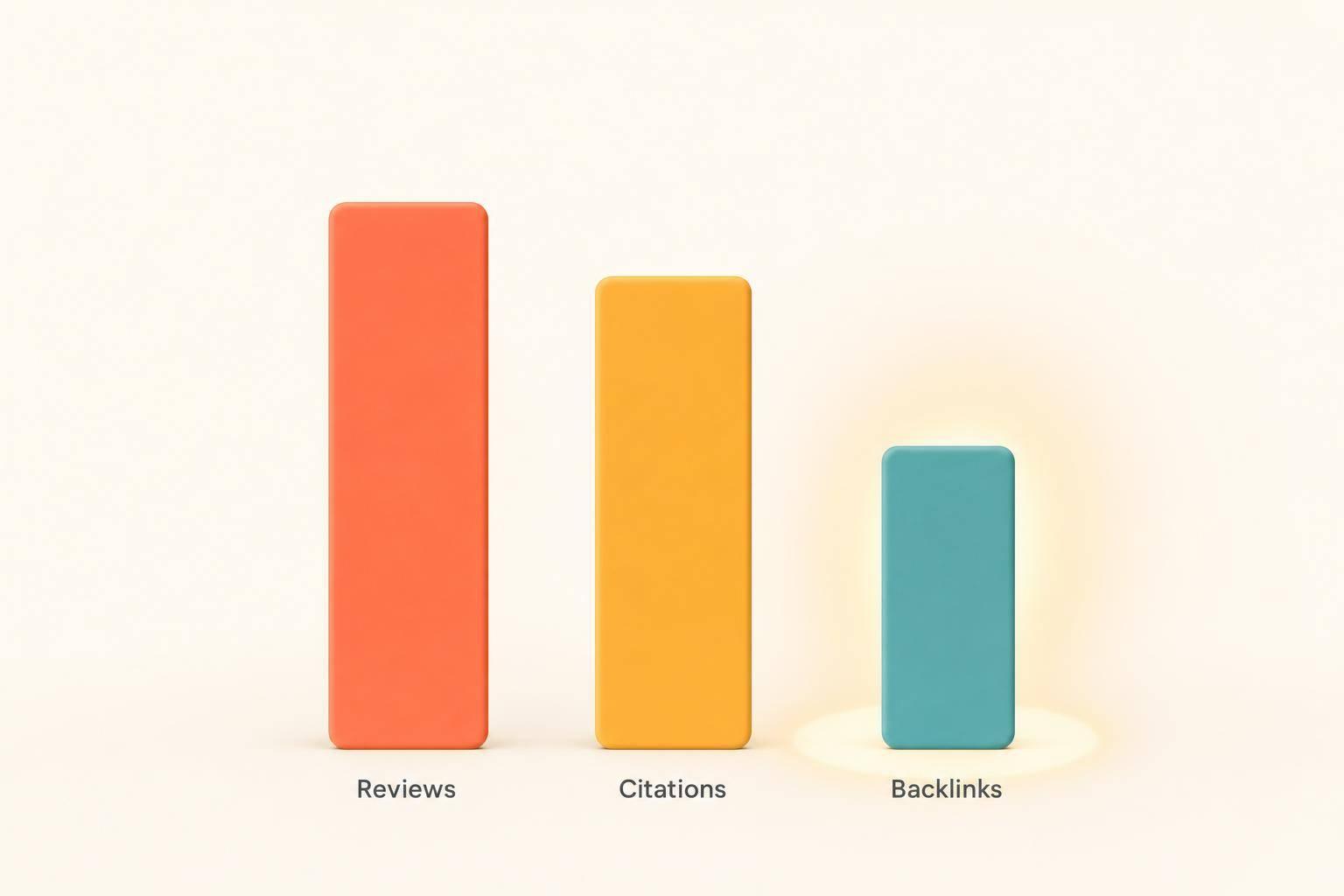
If I had to pick one rule, it’s this: fix the weakest signal first. Reviews often help most when trust and clicks are low. Citations matter most when your business info is inconsistent. Backlinks usually help most when you need more authority in a tough local market.
Here’s the short version:
A few numbers stand out:
So if you’re asking, “Which one should I work on first?” my answer is simple:
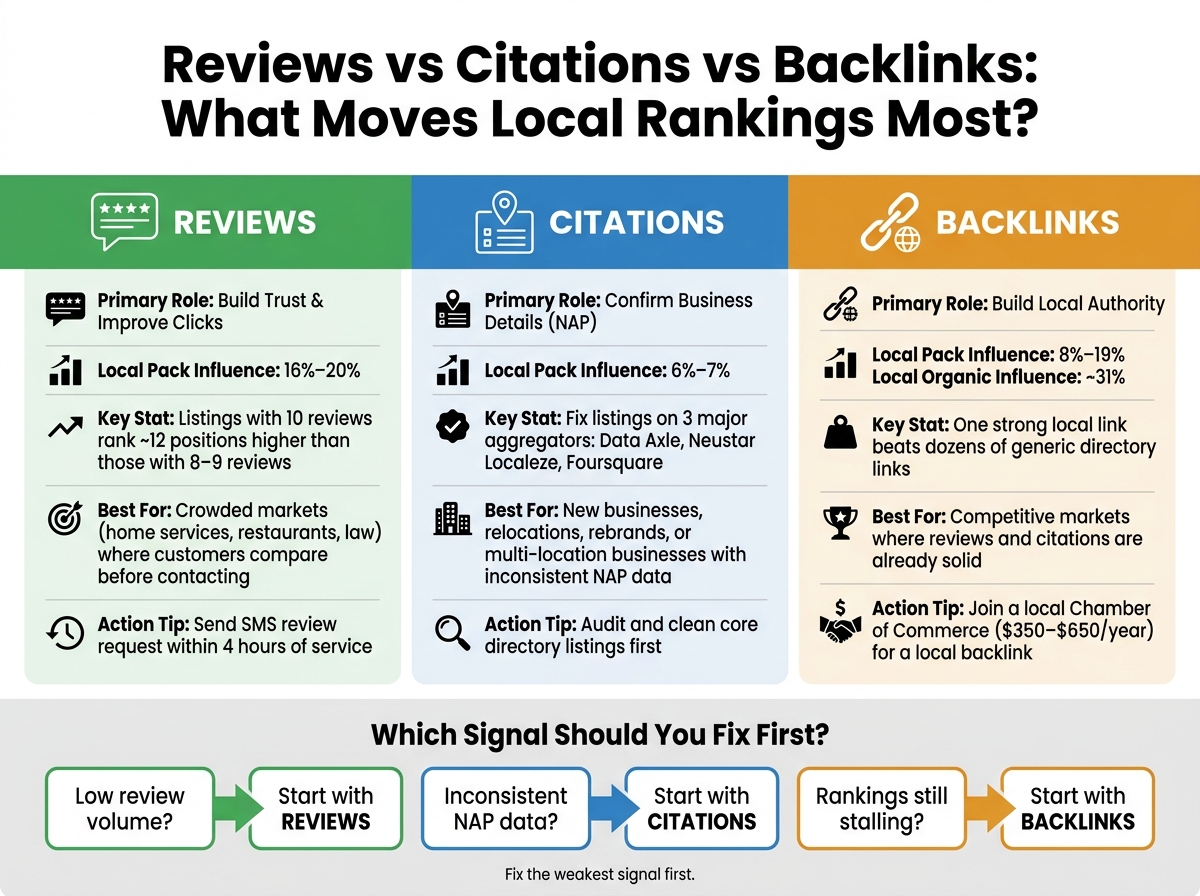
Reviews vs Citations vs Backlinks: Local SEO Ranking Impact Compared
| Signal | Main job | Usually matters most when | Rank impact |
|---|---|---|---|
| Reviews | Build trust and improve clicks | People compare many local options | 16%–20% local pack |
| Citations | Confirm business details | You moved, rebranded, or have duplicate listings | 6%–7% local pack |
| Backlinks | Build local authority | You’re stuck in a competitive market | 8%–19% local pack, 31% local organic |
I look at these three signals as different tools. Reviews help persuade. Citations help verify. Backlinks help rank. The best move depends on which one is holding you back right now.
Google’s local rankings still come down to three things: relevance, distance, and prominence. In this part, the focus is on prominence - and more specifically, how reviews, citations, and backlinks shape it.
| Signal | Local Pack Influence | Primary Role |
|---|---|---|
| Reviews | ~16–20% [1][9] | Trust, clicks, and AI Overview citations |
| Citations | ~6–7% [4][9] | Data consistency and validation |
| Backlinks | ~8–19% [1][4] | Local authority and organic visibility |
Reviews help people trust your business. They also affect whether someone clicks your listing instead of the one sitting right above or below it. That alone makes them a big deal.
Google also seems to care more about recent review velocity than old review volume [9][3][8]. In plain English: getting new reviews on a steady basis can matter more than piling up a large total from years ago. Review text plays a part too, because the words customers use give Google more context about what your business does and which searches it matches [5][8].
One stat stands out: listings with 10 reviews rank an average of 12 positions higher than those with 8 or 9 [7].
Citations matter most when trust isn’t the issue, but your business data is messy.
A citation is any mention of your business name, address, and phone number on another site. Structured citations are directory listings like Yelp, Apple Maps, or Bing Places. Unstructured citations show up in places like articles, blog posts, or event pages [4].
Citations don’t move rankings as much as they once did, but they still matter because they help confirm your business details across the web [4][9]. If Google sees the same NAP data in the same places again and again, that sends a cleaner signal.
Start at the source. Fix your NAP on the three major data aggregators - Data Axle, Neustar Localeze, and Foursquare - so correct information can spread to smaller directories [1][4].
Once that data is clean, the next weak spot is often authority.
A backlink is a link from another website to yours. For local SEO, links from chambers, neighborhood blogs, local news sites, or sponsorship pages carry extra weight because they tie your business to a place [4].
Backlinks account for about 8% to 19% of local pack influence and around 31% of local organic results [4]. That makes them useful for both map rankings and standard organic search visibility. And here’s the part many businesses miss: one strong local link can beat dozens of generic directory links, because geographic relevance matters [4][8].
A common example is a chamber of commerce membership. These often cost $350 to $650 per year and usually come with a local directory listing plus a backlink [1].
That tradeoff makes more sense when you look at actual business situations.
Now that the basics are out of the way, here’s the part most business owners care about: which signal makes the biggest difference in practice.
The short answer is simple. The signal that matters most is usually the one that’s weakest right now.
If trust is the weak spot, reviews tend to matter most. If your business data is messy, citations matter most. If everything else looks solid but you still can’t climb for tougher terms, backlinks usually become the main lever.
| Signal | Best use case |
|---|---|
| Reviews | Crowded markets where customers compare businesses before contacting them |
| Citations | New businesses, relocations, rebrands, and multi-location businesses with inconsistent NAP data |
| Backlinks | Competitive terms when reviews and listings are already in good shape |
Reviews tend to have the biggest effect in crowded, comparison-heavy markets like home services, restaurants, and law.
Why? Because people don’t just scan the map pack and pick at random. They compare. They look at star ratings, review count, and how recent those reviews are. That affects trust, click-through, and calls.
One detail gets missed all the time: fresh review volume matters more than a stale total. A business with a steady stream of recent reviews often looks stronger than one sitting on an old pile of feedback from years ago.
Citations matter most when your business name, address, and phone number are inconsistent or have changed recently.
This shows up a lot with new businesses, moves, rebrands, and companies with more than one location. If Google keeps finding mixed details across listings, that can hold rankings back. Clean, consistent listings remove that drag.
After data consistency is fixed, the bottleneck usually shifts. At that point, authority becomes the next limit.
Backlinks matter most when reviews and citations are already in good shape, but your local organic rankings still lag.
That’s usually the sign that trust and listing accuracy aren’t the main issue anymore. You need more authority. In that case, relevant local links, like a chamber or neighborhood blog, tend to help more than piling on extra directory listings.
Most small businesses can’t tackle all three signals at the same time. So don’t try to boil the ocean. Start with the weakest signal, then move to the next thing that’s holding you back.
Your first move should match the signal that’s hurting rankings right now.
| Business Situation | Best First Move | Primary Goal |
|---|---|---|
| New business | Build 15–20 core citations + submit to data aggregators [2][4] | Establish baseline trust |
| Inconsistent listings | Manual cleanup of top-tier directories | Fix listing inconsistencies |
| Low review volume | Start a steady review-ask process | Build trust and clicks |
| Limited local authority | Earn a local backlink from a community site | Improve organic rankings |
For most single-location businesses, the first problem is listing accuracy. If your listings are messy or brand new, start with citations, then move to reviews, then backlinks.
Fix your core listings and aggregators first. Then keep review requests moving at a steady pace. A business that gets consistent new Google reviews tends to beat one with a big but stale total [9][3]. After that, local backlinks can help you edge past similar businesses that may have stronger review profiles.
Multi-location businesses usually need a different starting point. They often lose rankings because of duplicate or inconsistent listings across branches, like different phone numbers, old addresses, or duplicate listings on smaller directories [4][6].
The first step is a full citation audit across all locations. After that, each branch should have its own dedicated landing page and its own review flow tied to that location.
You only need one focused action to get started with each signal:
The rule is simple: fix the weakest signal first.
If your listings are inconsistent, start with citations. If trust is low and clicks are lagging, work on reviews. If you're in a tough market and competitors keep beating you, focus on backlinks.
The biggest mistake is pouring money into the website or trying to fix all three signals at the same time before dealing with the weakest local ranking factor. That’s where people get stuck. It’s not that they chose the wrong signal. It’s that they spread effort too thin before fixing the bottleneck.
Start there. Fix listings if your NAP is inconsistent across directories, rebuild your review flow if new reviews have slowed, or earn a local link if competitors still outrank you. Pick the weakest signal, fix it first, then move to the next constraint.
Compare your performance across GBP, reviews, on-page signals, and link signals.
Start with GBP. If it’s incomplete, or your categories don’t match what you actually offer, that’s often the main weak spot.
Then look at reviews. Pay close attention to recency and velocity. If you haven’t had a steady stream of reviews over the last 90 days, that can weaken authority.
If your GBP and reviews look strong but rankings still lag, shift to your local on-page content and local backlinks.
Yes. Reviews still matter, even if your rankings look decent.
Google pays attention to review velocity. That just means how often new reviews come in over time. If your profile goes quiet, nearby competitors who keep getting fresh reviews can start to pull ahead.
Reviews can also shape both rankings and conversions. A steady stream of recent, specific feedback can help your visibility, build trust, and improve your prominence against local competitors.
Backlinks usually take 2 to 6 months to make a measurable difference in local rankings after Google indexes them.
In markets with less competition, you might see movement a bit sooner. But in most cases, backlinks move more slowly than Google Business Profile updates or new reviews, which can shift rankings within days or weeks.
Discover strategies to elevate your business.