Reviews are one of the most important factors for improving your Google Business Profile (GBP) rankings. They influence whether your business appears in the Local Pack (top 3 map results) and help potential customers decide to trust and choose your business.
By consistently managing reviews, you can improve visibility, build trust, and drive more business. Start with simple steps like asking for reviews during positive customer interactions and setting up automated reminders via email or text.
How Google Reviews Impact Local Search Rankings and Customer Trust
If your Google Business Profile (GBP) isn’t showing up in local searches, it’s practically invisible to potential customers. The Local Pack - the top three map results - is where most local search clicks happen. Miss out on this spot, and you’re likely losing business to competitors who are more visible.
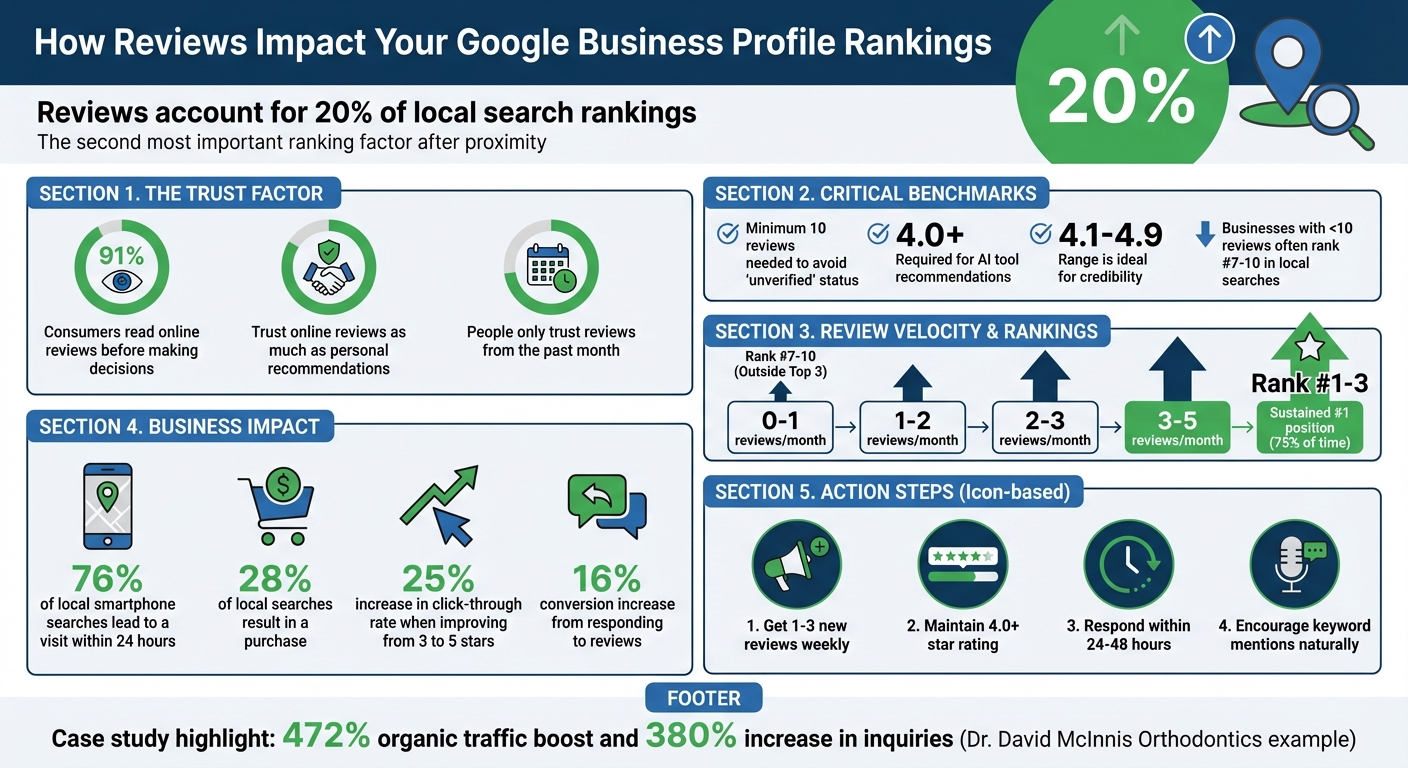
Distance plays a huge role in rankings, accounting for about 55% of a business’s visibility power [8][5]. Even so, being close to customers isn’t always enough. Around 72% of Map Pack listings fall within a two-mile radius [7], but poor reviews can still keep your business out of sight. If your location is ideal but your profile isn’t showing up, there’s a good chance your reviews - or lack thereof - are the issue.
Businesses with fewer than 10 reviews are often flagged by the algorithm as "unverified" [3]. This creates a tough cycle: low visibility leads to fewer clicks, which signals to Google that your profile isn’t relevant, pushing it even further down the rankings. On top of that, modern AI search tools like Gemini use a 4.0-star rating as a baseline [3]. Fall below this threshold, and your business might not even make it into AI-generated recommendations. This lack of visibility is a critical gap - but one that reviews can help close.
Low visibility leaves a trail of warning signs. For example, if you’re getting only 0–1 reviews per month, your profile is likely ranking somewhere between #7 and #10 in local searches [9]. Other red flags include having fewer than 10 total reviews, no reviews in the past 30 days, or an average rating below 4.0. These factors matter because 73% of consumers only pay attention to reviews written within the last month [3]. If your reviews are outdated, it signals "quality decay", which hurts your rankings - even if your total review count is high [3]. In fact, a business with 50 recent reviews can often outrank one with 500 older reviews [3].
Visibility isn’t just about rankings; it directly impacts customer engagement and revenue. Here’s why. When people find your business, they act: 76% of local smartphone searches lead to a visit within 24 hours, and 28% result in a purchase [10]. If your business isn’t visible, it’s not even in the running when customers are making decisions.
A strong GBP also builds trust. With 91% of consumers reading online reviews and 84% trusting them as much as personal recommendations [7][1], a profile with a solid rating and recent reviews sends a clear message of credibility. Take Dr. David McInnis Orthodontics as an example. In 2025, they revamped their local SEO strategy and optimized their GBP, leading to a 472% boost in organic traffic and a 380% jump in patient inquiries and conversions within six months [8]. This case shows how better visibility can lead to dramatic business growth.
Reviews play a major role in improving your Google Business Profile (GBP) rankings by signaling prominence and trust to Google. In fact, they rank as the second most important factor after proximity, forming a key part of Google’s "Prominence" pillar[3][12]. Google’s natural language processing (NLP) technology scans review content for keywords and context. For example, if a customer mentions "emergency plumbing service", Google may interpret this as a reason to rank your business higher for related searches[3]. Let’s break down how Google evaluates reviews to determine your profile’s ranking.
Google assesses reviews based on four main factors: quantity, quality, recency, and engagement. Each plays a unique role in shaping your GBP performance:
Here’s a quick overview of these factors and actionable goals:
| Factor | Why It Matters | Actionable Benchmark |
|---|---|---|
| Quantity | Builds trust and legitimacy | Reach 10+ reviews to avoid "unverified" status[3] |
| Recency | Reflects ongoing activity and relevance | 73% of consumers read recent reviews (within a month)[3] |
| Velocity | Signals consistency, avoids spam filters | Aim for 1–3 new reviews per week[3] |
| Rating | Affects AI recommendations and clicks | Maintain at least a 4.0-star average[3] |
| Response Rate | Shows engagement and customer care | Respond to all reviews[3] |
By focusing on these areas, you not only improve your rankings but also build credibility with potential customers.
Reviews don’t just help your rankings - they also turn searchers into paying customers. A profile with a 4.5+ star rating and numerous recent, detailed reviews sends a strong trust signal. Studies show that over 80% of people trust online reviews as much as personal recommendations[1]. Interestingly, businesses with ratings between 4.5 and 4.8 often feel more authentic to users compared to a perfect 5.0, which can sometimes raise doubts[4].
Google’s review justifications feature takes this a step further. By displaying snippets of frequently mentioned keywords directly in search results, Google pre-qualifies your business for specific customer needs. This not only grabs attention but also boosts click-through rates - another factor Google uses to measure your relevance[2].
"Google Business Profile is no longer just a listing. It is a live trust signal." - LocalMighty[13]
Consistency across platforms is also critical. If your business has a stellar 4.9 rating on Google but only a 2.5 on another platform, AI tools might exclude you from recommendations due to conflicting data. A well-rounded review strategy across all platforms ensures you maintain trust and visibility wherever potential customers are looking. By leveraging these strategies, you can address visibility challenges and create a stronger online presence.
Reviews don't just build trust - they directly impact your visibility on Google. So, knowing how to gather and manage them effectively is a game-changer for your business.
Asking for reviews isn’t about pressuring customers; it’s about timing and making it easy. Experts suggest requesting feedback during "delight moments" - those times when a customer is especially happy with your service, like right after you’ve resolved an issue or when they’ve expressed their satisfaction verbally[14][15]. These moments naturally encourage positive responses.
The simpler you make it for customers to leave a review, the more likely they are to do it. A direct Google review link sent via email or text can make the process effortless - no need for logins, just a single click to share their feedback. You can also use QR codes on receipts, business cards, or at checkout, allowing customers to scan and review on the spot[14][16][17]. Some businesses are even using NFC "tap and go" technology, which instantly redirects customers to the review page[17].
A combination of email (15%) and SMS (20%) requests can increase response rates to 26%[18]. Automating these requests through your CRM saves time, but personalizing them with the customer’s name and details about their experience makes them more effective[15][18]. For in-person interactions, train your staff to use friendly, natural scripts like, “We’d love your feedback to help other customers find us.” This keeps the request genuine and approachable[18]. Remember: offering discounts or gifts for reviews is against Google’s rules and could lead to your profile being suspended[11][18].
Once you’ve collected reviews, the next step is to actively manage them to maintain trust and improve your profile.
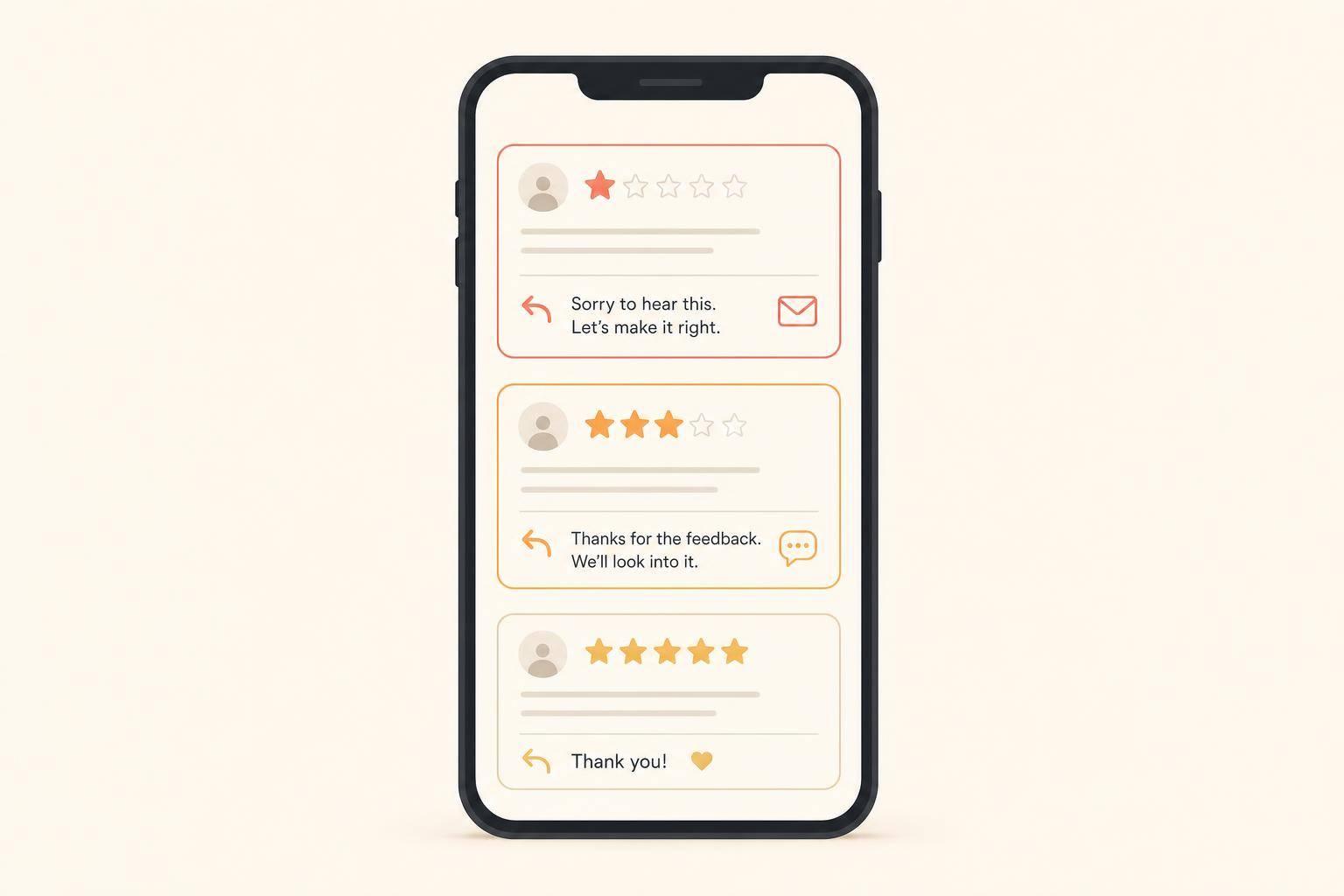
Collecting reviews is only half the battle - responding to them is just as important. Google considers review replies a ranking signal, so actively engaging with feedback shows your business is trustworthy and involved[20]. Aim to respond to negative reviews within 12–24 hours and positive ones within 24–48 hours[22]. For example, a Utah-based automotive repair shop with multiple locations adopted a strict 24–48 hour response policy in early 2025. By tailoring replies for each location, they saw a 34% increase in local visibility, a 22% jump in calls from Google Maps, and a 44% boost in appearing in Google's AI Overviews within 90 days[22].
Make every response personal. Use the customer’s name and reference specific details from their review[21][23]. For negative reviews, publicly apologize to show transparency, then offer a direct way to resolve the issue privately, like providing a phone number or email[21][23]. This approach works: 73% of unhappy customers are willing to give a business a second chance if their concerns are addressed well, and 54% will even update their review after a successful resolution[19].
Strategically incorporating keywords into reviews can enhance your local search relevance. You can guide customers to mention specific services or locations naturally. For instance, when asking for feedback, you might say, “We’d love to hear about your experience with our emergency plumbing service.” This subtly prompts customers to include those keywords in their reviews[18]. Similarly, when responding to reviews, you can weave in phrases like “our downtown Seattle location” or “HVAC repair services” to reinforce your local relevance for Google’s algorithm[20][23]. Just keep it conversational - authenticity is key to making these mentions work.
Small businesses aiming to improve their online presence can also explore tools like Humble Help (https://humblehelp.studio), which offers practical solutions to simplify review management and optimize your Google Business Profile performance.
To understand how reviews impact your Google Business Profile (GBP) performance, it’s crucial to track specific metrics. These insights can help you fine-tune your strategy and address challenges like low visibility. Here’s what you need to know.
One key metric is review velocity, which measures how many new reviews your business receives each month. This accounts for about 40–45% of Google’s review ranking factor [9]. Businesses that consistently generate 3–5 new reviews monthly often secure higher rankings than competitors with fewer updates [9]. Hitting this range regularly is a proven way to climb into top positions in the Map Pack.
Another factor is review recency. Reviews posted within the last 30 days carry the most weight, as 73% of consumers prioritize recent feedback [3]. On the other hand, reviews older than a year have minimal influence on rankings [9].
Keep an eye on your average star rating as well. A rating between 4.1 and 4.9 is ideal [9][7]. Interestingly, a perfect 5.0 rating can sometimes seem less credible to both Google and potential customers. Additionally, AI search tools like Gemini often use 4.0 stars as a baseline for recommending businesses [3].
Your response rate and response time also matter. Responding to reviews within 24–48 hours can improve your rankings by 5–10% [9]. Beyond that, engagement metrics such as clicks-to-call, direction requests, and website visits can confirm that better visibility is driving real customer actions [24].
Monthly review velocity compared to Map Pack rankings:
| Monthly Review Velocity | Average Map Pack Position |
|---|---|
| 0–1 reviews/month | #7–10 (Outside Top 3) |
| 1–2 reviews/month | #4–6 |
| 2–3 reviews/month | #2–4 |
| 3–5 reviews/month | #1–3 |
| 5+ reviews/month | Sustained #1 (75% of the time) |
Once you’ve identified the key metrics, you’ll need tools to track them effectively. Start with the free Google Business Profile Performance dashboard. Its "Performance" tab lets you monitor unique visitor views, search terms, and customer actions like calls and direction requests [25]. You can even set custom date ranges to align review campaigns with activity spikes.
For more advanced tracking, platforms like BrightLocal (starting at $99 per month) allow you to monitor reviews across multiple platforms [9]. If you want to compare your performance against industry averages, tools like Local Falcon can provide benchmarks. For instance, the median plumber has 215 reviews, while the average dentist has 346 [6].
If you prefer an all-in-one solution, Humble Help (https://humblehelp.studio) offers tools to track reviews alongside other local marketing metrics.
Regularly review your performance, compare it to local competitors, and adjust your strategy to stay ahead [9].
Reviews play a major role in boosting your Local Pack rankings and turning searchers into customers. In fact, 91% of people read reviews before making a decision [7], and 84% trust online reviews as much as personal recommendations [7]. That’s a huge opportunity for businesses looking to stand out locally.
The key to success? Treat reviews as an ongoing process [28]. Consistently earning 1–3 reviews per week signals to Google that your business is active and reliable [3]. When customers mention specific services in their reviews, it helps Google connect your business to relevant searches - even if those keywords aren’t on your website [3][26]. A steady review flow can make all the difference.
And the results speak for themselves. Improving your rating from 3 stars to 5 stars can boost your click-through rate by 25% [27], while responding to reviews can increase conversions by 16% [3]. Even crossing the 10-review mark can lead to a noticeable ranking boost, as it helps Google recognize your business as trustworthy [3].
If managing reviews feels overwhelming, tools like Humble Help provide simple solutions to keep your reviews - and other marketing efforts - on track. Whether you handle it on your own or seek professional support, the most important step is to begin and stay consistent.
A well-executed review strategy can transform your local visibility, build trust, and drive revenue. The rewards are too great to ignore. Start today.
There's no magic number of reviews required to secure a spot in the Local Pack. Instead, what really counts are factors like how often you get reviews, how recent they are, and their overall quality. Businesses that consistently gather 3–5 new reviews each month tend to notice improvements in their rankings. The key is to aim for steady, genuine reviews to enhance both your visibility and customer trust.
If your rating has dipped below 4.0, the key is to focus on improving the quality of your service. Make sure your customers have a positive experience and encourage those who are happy with your service to leave honest feedback. Responding to all reviews - both positive and negative - shows that you care about your customers and helps build trust.
Avoid the temptation to offer incentives or filter reviews, as these actions violate Google’s guidelines. Sticking to ethical practices not only helps improve your reputation but also ensures you stay compliant with the rules, which can positively impact your rankings.
Reaching out to customers for reviews works best when their experience is still top of mind. For example, after completing a service, you could say something like, "We’d love to hear about your experience with our plumbing services." This not only feels personal but also encourages them to share specific details.
Make the process as simple as possible by providing direct links to review platforms or using friendly reminders. A conversational, approachable tone can go a long way in inspiring honest and detailed feedback.
Discover strategies to elevate your business.