Want to stand out in the competitive Bay Area market? Building local links is your key to better search rankings and stronger community connections. Here’s a quick look at seven effective strategies to boost your online presence:
Why does this matter? Local links not only improve SEO but also help AI tools like ChatGPT and Google’s AI Overviews accurately represent your business. With 50% of local searches leading to store visits within 24 hours, these strategies can directly impact your bottom line.
Want to dive deeper? Keep reading for actionable tips to implement these strategies today.
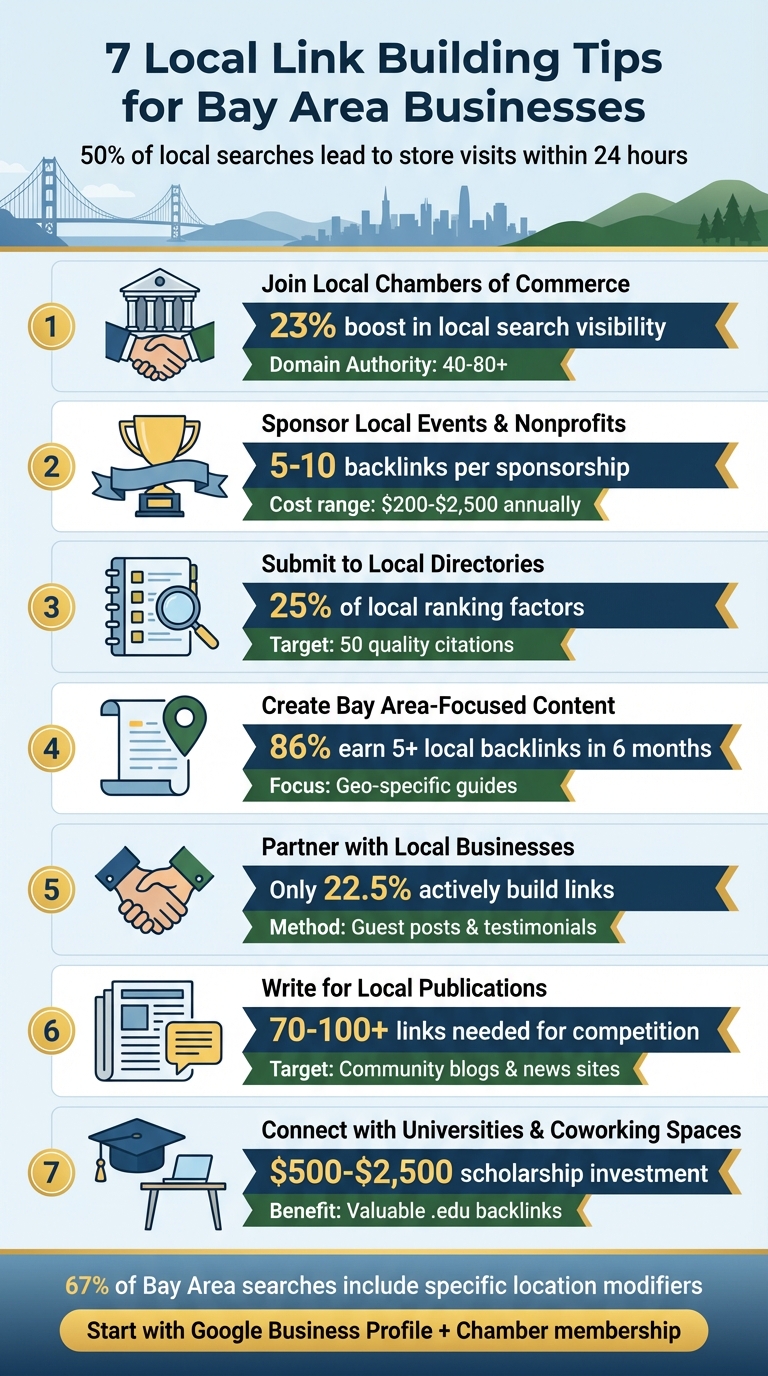
7 Local Link Building Strategies for Bay Area Businesses
Chamber of Commerce websites hold a strong reputation with search engines. Many Bay Area chambers boast Domain Authority scores between 40 and 80+, making them some of the most trusted local sources online [7]. For instance, when the San Francisco Chamber of Commerce - an institution with 175 years of history [9] - links to your business, it signals to Google that you’re an established and credible part of the community.
These links help build what Google calls an "entity relationship" within its Knowledge Graph, essentially connecting your business to a well-regarded local organization [6]. Even if these links are marked "nofollow", they still pass trust and relevance signals that can positively influence your local rankings [6]. Studies suggest that an optimized Chamber listing can boost local search visibility by an average of 23% [7].
"Think of your Chamber of Commerce link as the foundational brick in your local link-building wall. It's the first, most credible piece of evidence you can present to Google that you are a bona fide member of your business community." - Digital Kulture [6]
Joining a Chamber isn't just about a single link - it opens the door to multiple backlink opportunities. Beyond the basic member directory, you can gain links through event sponsorship pages, committee bio pages, guest blogs, and niche resource lists [6][2]. For example, the San Francisco Chamber organizes over 250 events annually [13], creating countless chances to earn valuable backlinks.
Your Chamber profile also strengthens NAP (Name, Address, Phone number) consistency, which is critical for local SEO. Even minor inconsistencies can lower local search visibility by up to 40% [7]. Use your Chamber listing as the gold standard for your business information and replicate it across all platforms.
Getting started is straightforward. Locate your local Chamber, review membership options, and complete an online application with the required dues [11]. For smaller businesses, the San Francisco Chamber offers plans tailored for solo entrepreneurs and micro-businesses with 1–3 employees [12].
Once you’re a member, focus on creating a complete and optimized profile. Businesses with fully completed profiles are 73% more likely to appear in internal Chamber searches [7], and membership can drive nearly 80% more consumer visits to member websites [11]. Include your logo, a 150–250 word description with relevant keywords, high-quality images, and a comprehensive list of services. To maximize your investment, consider joining local committees, which we’ll discuss further below.
A solid Chamber profile is just the beginning. Participating in committees like Economic Development or Young Professionals can elevate your visibility even more. These groups often provide members with dedicated bio pages that include direct links to their websites [6].
"The most successful local SEOs don't just join the Chamber; they infiltrate it. They see it not as a directory, but as a content hub and a digital PR channel for their local market." - Digital Kulture [6]
For businesses serving a larger area, multiple memberships can expand your reach. For example, the San Francisco Bay Area Hispanic Chamber of Commerce spans all nine Bay Area counties and connects with over 260 partner chambers nationwide [10]. Similarly, organizations like the Golden Gate Business Association (GGBA) focus on specific communities, offering targeted networking opportunities [13]. Each additional membership broadens your presence in local search results [6].
Getting involved with Bay Area events and nonprofits can give your business a boost in credibility and visibility. Why? Because partnerships with trusted local organizations can translate into endorsements that matter. In fact, local links ranked as the second most influential factor for local organic search results in 2023 - just behind on-page optimization [15].
"Local sponsorship link building redefines local SEO tactics. Instead of chasing random high-authority domains, you're earning links from organizations that actually matter to your target audience." – Robben Media [15]
Sponsorships don't just build authority - they can also expand your backlink portfolio in a big way. For example, sponsoring a youth sports league might land your business's link on team rosters, tournament announcements, season recaps, and sponsor pages. That’s 5–10 backlinks from a single sponsorship [15].
And if you partner with local schools for scholarships or STEM programs, you could even earn those coveted .edu backlinks. These links carry extra weight because educational domains are held to strict content standards [15][16].
Before you invest, check that the organization’s website includes a clickable link to your business. To stay within Google’s guidelines, these links should ideally use the rel="sponsored" attribute [15].
Finding sponsorship opportunities is simpler than it might seem. Start by searching terms like “San Francisco little league,” “Oakland youth soccer,” or “Berkeley school athletics booster.” Platforms like Eventbrite, Charity Navigator, and GuideStar can also help you discover local nonprofits and events [4][16].
| Sponsorship Type | Estimated Annual Cost | Benefits |
|---|---|---|
| Youth Sports Leagues | $200 - $2,000 | Multiple backlinks, logo placement, community visibility |
| Local Meetup Groups | $40 - $60/month | Website link, direct audience access |
| Downtown Associations | $500 - $2,500 | Business district visibility, event participation |
For small businesses on a tight budget, sponsoring Meetup groups can be a cost-effective option. Offer your office space for free meetings or cover snacks and drinks for $40–$60 per month, and in return, you could secure a link on their group page [17]. Including your specific Bay Area city in outreach emails can improve response rates by 20% [15][18].
"Google is totally okay with you buying a sponsorship that results in a link... find cost-effective local sponsorship opportunities." – Greg Gifford, COO of SearchLab Digital [17]
Sponsorships do more than just improve SEO - they also help you connect with your community. You might get your logo featured on event materials, receive shout-outs during gatherings, or even be included in email newsletters. In total, sponsorships can offer up to 24 unique benefits [18].
Focus on sponsorships within your immediate area to strengthen proximity signals - key for showing up in Google's "local pack" results. With over 800 million Americans performing "near me" searches each month, being visible locally is critical for drawing in nearby customers [15]. Combining links from well-known organizations with those from grassroots events like youth sports leagues or local festivals can help you build a diverse and effective backlink profile [15].
This approach not only strengthens your presence in the Bay Area but also complements other link-building strategies. For businesses looking for guidance on maximizing sponsorship opportunities, Humble Help (https://humblehelp.studio) is a local Bay Area team dedicated to helping small businesses grow their online reach.
When it comes to local link building for Bay Area businesses, accurate citations are a big deal. Think of them as proof that your business is firmly rooted in the Bay Area. By keeping your business name, address, and phone number (NAP) consistent across multiple platforms, you send a clear signal to Google that you're trustworthy. And trust matters - a lot. In fact, citations are responsible for about 25% of Google's local search ranking factors [1][2][19][20].
But not all directories are created equal. Prioritize high-authority local sites like SFGATE (Domain Authority 93) and the San Francisco Chamber of Commerce (Domain Authority 52). These carry more weight than generic national directories [21].
Citations do more than just verify your business info - they can also drive traffic. Many directories include clickable links, which not only pass link equity but also bring in referral traffic [1][24]. In competitive markets, building around 50 citations is a solid starting point. However, you should focus on securing spots on the 10–20 most important directory sites for your industry [24].
General directories like Google and Yelp are must-haves, but don't stop there. Bay Area-specific platforms are key. With 92% of consumers using online directories to find local businesses - and 88% of those reaching out within 24 hours - this effort can directly impact your bottom line [23].
Start with the basics: claim and optimize your Google Business Profile. This will act as the foundation for all other directory listings. Make sure every other submission matches the information you've verified here [19][25]. After that, focus on major platforms like Apple Maps, Facebook, Foursquare, Bing Places, Yelp, and Yellow Pages [24].
For small Bay Area businesses on a tight budget, there are free options that still pack a punch. Directories like Downtown SF (DA 34), The San Francisco Business List (DA 23), and Shop In San Francisco (DA 20) offer no-cost listings [21]. If you’re looking for even more visibility, consider paid options like SFGATE's "Best of" listings, which come with features like interactive maps and detailed descriptions aimed at Bay Area consumers [23].
| Bay Area Directory | Domain Authority | Listing Type | Estimated Cost |
|---|---|---|---|
| SFGATE | 93 | Paid | Varies (includes extra features) [21][23] |
| San Francisco Chamber of Commerce | 52 | Paid | Membership required [21] |
| Downtown SF | 34 | Free | $0 [21] |
| The San Francisco Business List | 23 | Free | $0 [21] |
| Shop In San Francisco | 20 | Free | $0 [21] |
Consistency is critical. Keep your NAP details identical across all listings to avoid penalties [19][22]. To make updates easier, maintain a master spreadsheet with your citation URLs and login credentials [25][26].
If managing citations feels overwhelming, services like Humble Help specialize in local SEO for Bay Area small businesses. They can assist with Google Business Profile optimization and directory management, taking the guesswork out of the process.
Citations aren't just about SEO - they're also a gateway to building relationships within your community. Platforms like the San Francisco Chamber of Commerce and neighborhood-specific directories can connect you with other trusted local businesses, opening doors to referrals and partnerships.
Industry-specific directories are another avenue to explore. For example, home service providers should get listed on Angi, medical practices on Healthgrades, and restaurants on platforms like TripAdvisor and Zomato [1][2].
"In a three-month period ending in 2025, Sunshine Bakery in Seattle achieved a #1 ranking for 'bakery Seattle' in the Local Pack after implementing a citation cleanup strategy. The project involved auditing all citations, claiming major listings, and submitting to food-specific directories like Zomato and Eater - resulting in a 45% increase in website visits, a 30% increase in phone orders, and a 25% boost in foot traffic." [25]
These optimized listings don’t just improve visibility - they help you engage with your local audience on a deeper level.
Publishing content tailored to the Bay Area can position your business as a trusted part of the community. Resources like "The Ultimate Guide to North Beach" or "Best Coffee Shops in San Jose" address local interests while attracting links from bloggers, community sites, and tourism pages [2][8]. Did you know that 86% of geo-specific blog posts earn at least five local backlinks within six months of being published [27]? This shows how focusing on local content can give small businesses an edge over more competitive national topics, helping them rank better for geographically-targeted keywords. Plus, this approach naturally leads to earning high-quality backlinks from authoritative sources.
Unique local data can set your content apart. For example, conducting surveys or analyzing trends like "Bay Area Housing Market Trends for 2026" creates primary sources that local media outlets are likely to cite [28][2]. You could also design interactive maps, infographics about regional history, or seasonal checklists specific to the Bay Area - these formats make your content highly shareable [29]. Even simple "Best Of" lists, such as "Top 10 Brunch Spots in Oakland," often encourage featured businesses to share and link to your content [27].
"Valuable, hyper-local content naturally attracts backlinks because it helps readers solve real problems or celebrate their community."
- Avintiv Media [8]
You don’t need a huge budget to get started. Begin by identifying topics your audience cares about. Search for "Bay Area + blogs" or check out local subreddits like r/sanfrancisco and r/oakland to uncover common questions and interests [1]. Then, create content that answers those questions better than anyone else. For example, you could feature other local businesses in "Business Spotlights", which are often highlighted on their press or "About" pages [8]. Other ideas include creating community event calendars or maintaining a directory of local workshops and festivals - this can turn your site into a go-to resource for local information [28][29].
If creating all this content feels like too much to handle, you can explore services like Humble Help, which specialize in blog and content marketing for Bay Area small businesses.
Local content does more than boost rankings - it opens doors for partnerships and community involvement. Publishing neighborhood guides or highlighting nonprofits can foster genuine connections and encourage reciprocal sharing and linking [8][29]. For instance, offering a scholarship for Bay Area students (typically $500 to $2,500) can help you secure valuable .edu backlinks from local schools and colleges [27][2]. Another option is to provide free resources, such as ebooks or localized guides, that address specific challenges in the community. These resources not only encourage organic sharing but also strengthen your reputation as a trusted local authority [28].
Teaming up with nearby businesses can expand your network and boost your credibility within the community. When a trusted local business links to your website, it’s like a public vote of confidence. This strengthens your reputation and aligns with Google’s E-E-A-T principles (Experience, Expertise, Authoritativeness, and Trustworthiness) [30][32]. For example, if a yoga studio in San Francisco links to a neighboring juice bar, it signals to Google that both businesses are active players in the local scene. These collaborations often lead to "natural local citations" - mentions of your business on a partner’s site that include a clickable link. These citations not only pass link equity but also validate your local contact details [1]. It’s a win-win for visibility and authority.
"If a business wants to be visible locally, it needs to truly be visible in the community, with the digital local community merely being an extension of the real world." - Jeff Riddall, Senior SEO Manager, Propellic [32]
Local partnerships are a goldmine for backlinks. Here are a few ways to leverage them:
These strategies not only enhance your backlink profile but also strengthen your relationships with local businesses.
Getting started is easier than it sounds. Begin with businesses you already have a relationship with - your accountant, office supply vendor, or web designer. Since there’s already trust, the conversation about collaboration will feel natural [4]. Skip the generic templates and craft a personalized message explaining how the partnership benefits both parties [30]. For instance, if you’re a dog groomer, teaming up with a local pet supply store makes perfect sense because you share the same customer base without competing.
Here’s a surprising stat: 62.7% of business owners recognize the importance of link-building, but only 22.5% actively pursue it [5]. This means many of your competitors aren’t tapping into this opportunity yet. Even one high-quality local backlink can make a noticeable difference in your organic search rankings [1].
Once you’ve built a few partnerships, you can amplify your efforts by engaging more with the community. Start by attending local meetups, connecting on social media, or participating in community events [30]. Building trust first makes collaboration easier down the line.
Some ideas for collaboration include:
"Local link building only works when the relationship behind the link is real. Before you pitch a partnership, take the time to connect." - Meagan Price, Director of Digital Marketing, Rook Digital [30]
If you’re unsure where to start or feel overwhelmed, services like Humble Help can assist small businesses in the Bay Area with building local connections and handling outreach efficiently.
Writing for blogs and publications focused on the Bay Area is a smart way to signal your local presence to search engines. It’s not just about getting noticed by Google - contributing to a San Francisco lifestyle blog or a Silicon Valley business journal also shows your community involvement. As Gombos Atila Robert, PhD, CEO of Jasmine Business Directory, puts it: "Local links often carry more weight for local search rankings than links from high-authority national sites. Why? Because Google's trying to serve the most relevant results to searchers." [14] By securing these local connections, you’re not just improving your SEO - you’re solidifying your role in the community.
Guest posts are an excellent way to earn editorial backlinks that can supercharge your local SEO efforts. Did you know that 86% of geo-specific blog posts - like "Best Coffee Shops in Oakland" - gain at least five local backlinks within their first six months? [27] To find opportunities, you can use search operators like "Bay Area write for us" or "San Francisco guest post guidelines." Focus on local news sites, community blogs, or Chamber of Commerce websites. These platforms can help you build the 70–100+ links you’ll need to stay competitive in local search rankings.
Once you see the SEO benefits, finding and securing guest post opportunities becomes a straightforward process. Tools like Ahrefs or Semrush can help you analyze where your competitors are guest posting. You might even consider partnering with other local businesses - like swapping guest posts with a complementary brand. For example, a yoga studio could write for a local wellness blog while hosting their content in return. When reaching out, keep your pitches short, personalized, and specific. Editors are more likely to respond to tailored outreach than to generic templates. Also, aim for blogs that are actively updated and show real engagement with the local community.
Guest posting doesn’t just help with SEO - it also establishes you as a trusted local resource. By contributing to local publications, you can build credibility and strengthen your ties within the Bay Area. For example, you could write about energy-saving tips for Fremont residents or share data-driven insights on industry trends relevant to San Jose. If writing full articles feels overwhelming, tools like Connectively (formerly HARO) allow you to provide short expert quotes to journalists covering Bay Area topics. This approach can quickly earn you quality mentions and backlinks while keeping your workload manageable.
The Bay Area boasts prestigious institutions like Stanford, UC Berkeley, and numerous community colleges, all with highly trusted .edu domains. Partnering with these schools can send strong geographic signals to Google, reinforcing that your business is deeply tied to the local community.
"Hyper-local backlinks are one of the fastest ways to build trust for service businesses, because they're hard to fake, usually tied to real organizations, and often come with real-world relationships." - Vaayu, RaptorKit [4]
Coworking spaces, such as WeWork or smaller hubs in San Francisco and Oakland, also act as community hubs. Links from their event calendars can significantly boost your local search rankings. The next step is to leverage these partnerships into meaningful backlinks.
One effective method is creating a local scholarship. For an annual investment of $500–$2,500, you can set up a scholarship page on your website and pitch it to financial aid offices at Bay Area universities [2][27]. While outreach to 30–50 schools is often needed, you can expect a 5–10% success rate in securing backlinks [27].
Another approach involves collaborating with student organizations that align with your niche. For instance, if your business focuses on sustainability, partnering with an environmental science club could earn links from student-run websites [33]. These strategies make it easier to build relationships while boosting your online presence.
If you have access to office space, consider offering it to local Meetup groups after hours. Greg Gifford, COO of SearchLab Digital, explains:
"If you've got some sort of a meeting room or a board room... go on meetup.com, look for local groups that have meetings on a regular basis... offer them your conference room to quickly secure a local link." [17]
No extra space? No problem. Sponsoring a local Meetup group by covering snacks and drinks - typically $40–$60 per month - can also lead to backlinks. Around 60–70% of groups with active websites are open to providing a link in return [17][27].
Take your local involvement further by hosting workshops at coworking spaces. For example, you could organize a "Legal Tips for Startups" session in San Jose or a "DIY Marketing" class in Oakland. These events not only strengthen community ties but also earn you spots on event calendars, which are valuable for local SEO [27].
Additionally, property managers or home service providers can reach out to university housing offices to be included in off-campus resource guides. Just make sure the organization’s "Sponsors" page includes clickable links rather than non-interactive text mentions in PDFs [4][27]. These efforts not only enhance your backlink profile but also solidify your role as an active, trusted member of the local community.
Local links in the Bay Area do more than just improve search rankings - they help foster deeper connections within the community. The seven strategies we’ve discussed offer a practical path to earning backlinks from local chambers of commerce, publications, universities, and community organizations.
The impact of these efforts is clear. Consider this: 67% of local searches in the Bay Area include specific location modifiers beyond just "San Francisco" [34]. Plus, nearly 50% of searches with local intent lead to a physical store visit within 24 hours [3]. For businesses targeting high-income demographics and searchers using precise location terms, this represents a major opportunity [3][34]. However, while 62.7% of business owners recognize the importance of link building, only 22.5% actively implement a strategy [5].
Getting started is straightforward. Start by claiming your Google Business Profile, join your local chamber of commerce (membership typically costs $300–$400 per year), list your business in essential directories, and consider sponsoring a youth sports team for $200–$500 per season [4]. When working with local organizations, remember that in-person outreach tends to be far more effective than cold emails [1].
Local links send strong signals of relevance to search engines and AI tools, aligning perfectly with the high expectations of Bay Area consumers [1][34]. As Russ Shumaker from Hearst Bay Area aptly states:
"Google Maps is the new storefront" [3].
For tailored advice, reach out to Humble Help (https://humblehelp.studio), a team focused on practical growth strategies for service-based small businesses in the Bay Area.
To measure success, use Google Business Profile metrics like direction requests and phone calls over the next 4–6 months. The connections you create today - whether it’s with a nonprofit, a local blogger, or a coworking space - can lead to ongoing referral traffic, new revenue streams, and long-term visibility. These efforts will not only strengthen your online presence but also cement your role in the Bay Area community, building on the strategies we’ve outlined here.
There’s no magic number of local backlinks you need to compete in the Bay Area. But earning high-quality backlinks from local sources - like community organizations, local news outlets, and business associations - plays a key role in boosting your local SEO and increasing your online presence.
Nofollow and sponsored links might not directly boost your rankings, but they can still play a role in supporting your local SEO efforts. How? By helping to build your site's relevance and trust within your community. For example, links from credible local sources - like partnerships or business directories - can enhance your visibility and establish a stronger local presence. Even without passing ranking signals, these connections can make a difference.
The fastest and most budget-friendly way to earn local backlinks is by getting involved with your community. You can start by supporting local events, whether through sponsorships or partnerships. Another smart move is collaborating with nearby businesses - think co-hosted promotions or joint campaigns. Finally, don’t overlook listing your business in local directories. These simple steps not only boost your backlinks but also improve your local presence without breaking the bank.
Discover strategies to elevate your business.