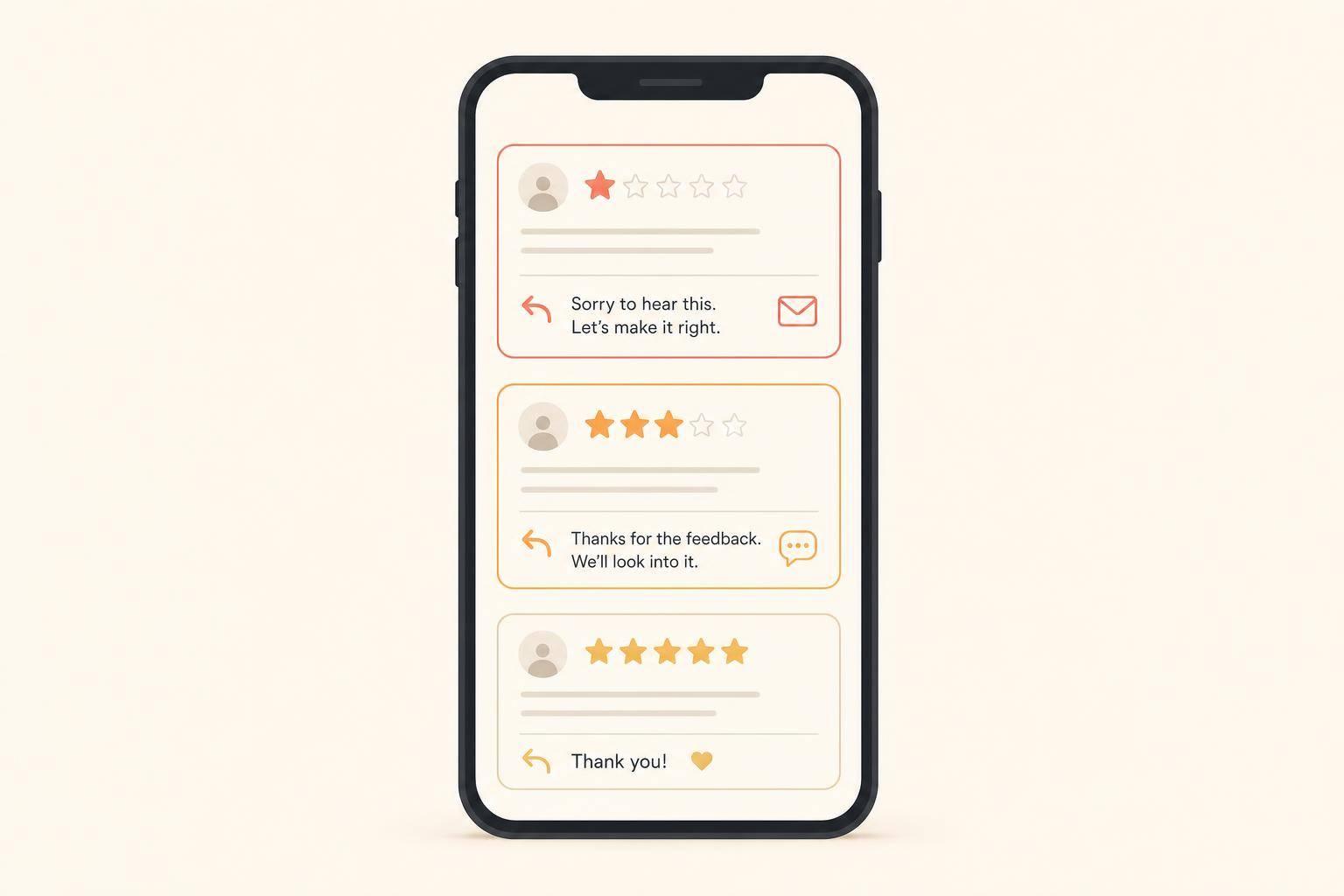
Yes, one 1-star review can drop your Google rating fast - and getting back usually takes 8 to 20 new 5-star reviews. If I have a small review count, the hit is worse, but the fix is simple math: respond fast, ask every customer for reviews, and keep requests steady.
Here’s the short answer:
A bad review feels personal. But in most cases, it’s a numbers problem, not a mystery. If I know my current rating, total reviews, target score, and monthly review pace, I can make a rough recovery timeline and start fixing the damage today.
When a business has only a small batch of reviews, one low score can change the whole first impression people see on Google. And that shift happens fast.
Google uses a simple average: total stars divided by total reviews [1]. So when you have only 10 or 20 reviews, one 1-star rating can drag your average down in a hurry.
Here’s what that looks like:
That’s the gut punch. With a small review count, each new rating carries more weight. One bad review doesn’t just sit there. It changes the number people notice first.
Once you see how much the average fell, getting back up turns into a math problem.
The rating drop is only part of the issue. The bigger problem is what happens next.
A single 1-star review can reduce calls by 22%, and 94% of consumers say a negative review has convinced them to avoid a business entirely [5]. On top of that, dropping below 4.7 stars can lead to a 13% decrease in conversion rates, while falling below 4.0 stars can cut click-through rates by as much as 70% [11].
That’s not just a number on a screen. It shapes whether people tap, call, or move on to the next option in Maps or Search.
So the next step is pretty clear: how many new positive reviews do you need to lift the average back up?
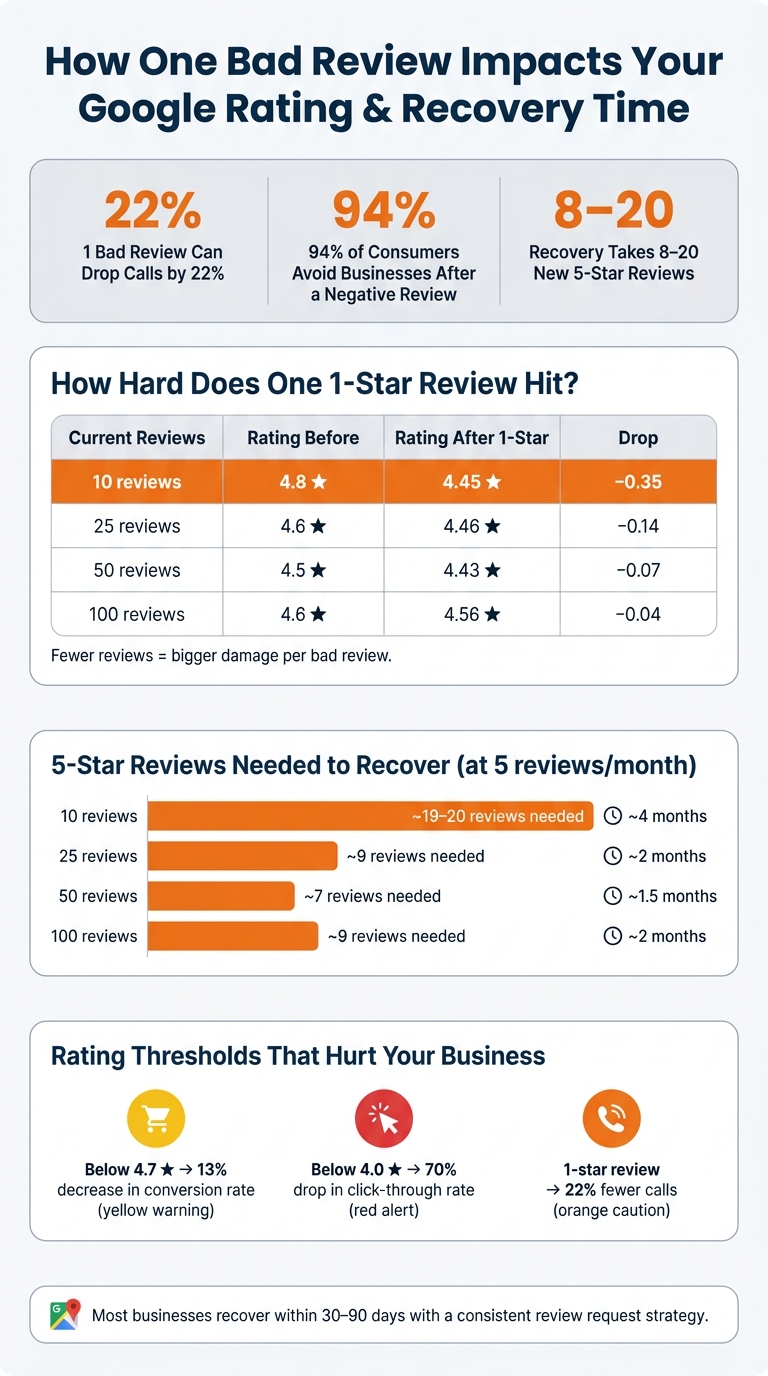
How One Bad Review Impacts Your Google Rating & Recovery Time
Recovery time comes down to four numbers: your current rating, total reviews, target rating, and how many new reviews you get each month.
Start by multiplying your average rating by your total reviews. That gives you your total stars. Then use this formula:
Reviews needed = Current Reviews × (Target Rating − Current Rating) ÷ (5 − Target Rating) [3]
Google shows ratings to one decimal place, so in most cases, you only need to get past the next visible decimal.
From there, you can figure out how many new reviews you’ll need in a normal business setting.
If one bad review dragged your average down, the examples below show how many 5-star reviews it can take to get back up. These examples assume a steady pace of about 5 new reviews per month.
| Current Reviews | Rating Before | Rating After 1-Star | Target Rating | 5-Star Reviews Needed | Est. Timeline |
|---|---|---|---|---|---|
| 10 | 4.8 | 4.45 | 4.8 | ~19–20 | ~4 months [1] |
| 25 | 4.6 | 4.46 | 4.6 | ~9 | ~2 months [1] |
| 50 | 4.5 | 4.43 | 4.5 | 7 | ~1.5 months [8] |
| 100 | 4.6 | 4.56 | 4.6 | 9 | ~2 months [1] |
Here’s the big takeaway: when you have fewer reviews, each new one hits harder. The flip side is that you can also recover faster with a focused push. If you’re under 25 reviews, one 1-star review can knock your average down by 0.3 to 0.5 stars almost at once [7][2]. Once you’re at 500+ reviews, that same review may barely change the number people see [1][2].
Once you know the review count, divide it by your monthly pace to estimate recovery time.
If you only get 2 or 3 reviews a month on your own, and you need 9 new 5-star reviews, you’re likely looking at about 3 to 4 months [8]. Most businesses start seeing movement within 30 to 90 days when they collect reviews on a steady basis [4]. Slow months can stretch that out.
That gives you the rough timeline. The next step is what you do right after the bad review hits, because that can help move things along.
Act in the first 24 to 48 hours. That early response shapes how future customers read the review. Move fast, and new reviews can start pulling your rating back up sooner.
Reply within 24 hours. That kind of speed can win back about a third of the trust lost with future customers [5]. Before you write anything, check your CRM, invoices, or call logs so you know what happened.
Keep the reply short - usually 2–5 sentences is enough. Acknowledge the issue, don’t argue in public, and move the conversation offline with a phone number or email. The goal isn’t to win the comment section. It’s to show other people that you take problems seriously and handle them calmly.
If you’re in healthcare or financial services, be extra careful. Don’t confirm in a public reply that the reviewer is a patient or client. Stay general and move the discussion offline right away.
Flagging a review can feel good in the moment. Most of the time, it doesn’t lead anywhere. Fewer than 5% of flagged reviews are removed by Google’s moderation team [11].
Flag reviews only when there’s a clear policy issue, such as:
Most bad reviews won’t come down. If you can’t find any record of the reviewer being a customer, say you can’t find a matching visit under that name and ask them to contact you with more details so you can look into it. If the review stays up, don’t get stuck there. Shift to the fastest legal way to rebuild review volume.
The fastest policy-safe path is simple: ask every customer in a steady, consistent way. Don’t just ask the happy ones. Showing review requests only to happy customers breaks Google’s policies and can get your profile suspended [17][6].
The same rule applies to incentives. Don’t offer discounts, gifts, or cash for positive reviews. That violates Google policy and can also trigger FTC enforcement [12][14].
Timing matters. Send the request 1–2 hours after the job, visit, or appointment is done. SMS works especially well, with roughly a 98% open rate versus about 20% for email [15]. If your CRM or booking system supports it, automate the request so it goes out every time without fail.
For in-person businesses, tap-to-review signs or cards can cut friction and make it easier for people to leave feedback in the moment [4][17]. Keep the flow steady. Big bursts of requests can trip spam filters [11][16].
After the immediate response, turn this into a repeatable review system.
After your first reply, stop treating this like a one-review crisis. Build a system that increases review volume, so the next bad review has less impact. That shifts recovery from a single-review problem to a volume problem.
Run this every week.
Monitor your Google Business Profile weekly. Turn on email alerts so you know about new reviews as soon as they come in. Respond fast and stay consistent with every review, whether it's positive or negative [8]. Request reviews through one steady process with every customer [8]. Improve by treating negative reviews as feedback you can use [10].
When the same complaint shows up twice, it's not random anymore. It's a pattern. That gives you something concrete to fix, which ties review recovery to day-to-day operations instead of guesswork.
One bad review is often just noise. A pattern is a problem.
Look at your lowest-rated reviews from the last 30 to 90 days. If several customers point to the same issue - long wait times, one staff member, billing mistakes - that's not bad luck. That's a repeat issue inside the business.
| Signal | One-Off Incident | Systemic Problem |
|---|---|---|
| Review pattern | Single complaint; no similar mentions recently | Recurring themes in lowest-rated reviews over 30 to 90 days |
| Internal context | Tied to a specific event, such as staff illness or a one-time disruption | No specific event; issue repeats across shifts or days |
| Recommended response | Apologize, explain the one-time issue briefly, and offer to make it right | Acknowledge the pattern, state the specific change made to fix it, and invite the customer back to see the improvement |
A one-off needs a calm, direct reply. A repeat issue needs an operational fix. And your public response should say what changed.
It typically takes 8 to 20 new five-star reviews to offset the rating damage from one 1-star review [9][1]. Aim for 4.5 to 4.7, not 5.0. Ask every time, respond to every review, and fix the issues that keep showing up in feedback.
Yes. One bad review can affect your Google ranking, mostly in an indirect way.
Here’s the simple version: if your average rating drops, fewer people may click on your listing. And when clicks go down, your visibility in local search can slip too.
How much that one review matters comes down to your total review count.
Think of it like a GPA. One low grade hits a small sample much harder than it hits a long record of strong scores.
Yes - ask every customer for a review if you want to build a steady, honest reputation. The key is simple: don’t filter or gate who gets asked.
The best compliant approach is to send review requests for all completed transactions. The only exception is customers with active disputes or unresolved complaints. That keeps your review profile honest and helps you build enough review volume to bounce back from negative ratings.
Aim for a rating you can keep up with as more reviews come in - usually the high 4s, not a perfect 5.0. For most small businesses, the sweet spot is around 4.3 to 4.6.
If you're sitting in the low 3s, getting into the low-to-mid 4s can already make a big difference in trust. Going after 5.0 usually doesn't make sense once you have even one rating below 5.
Discover strategies to elevate your business.