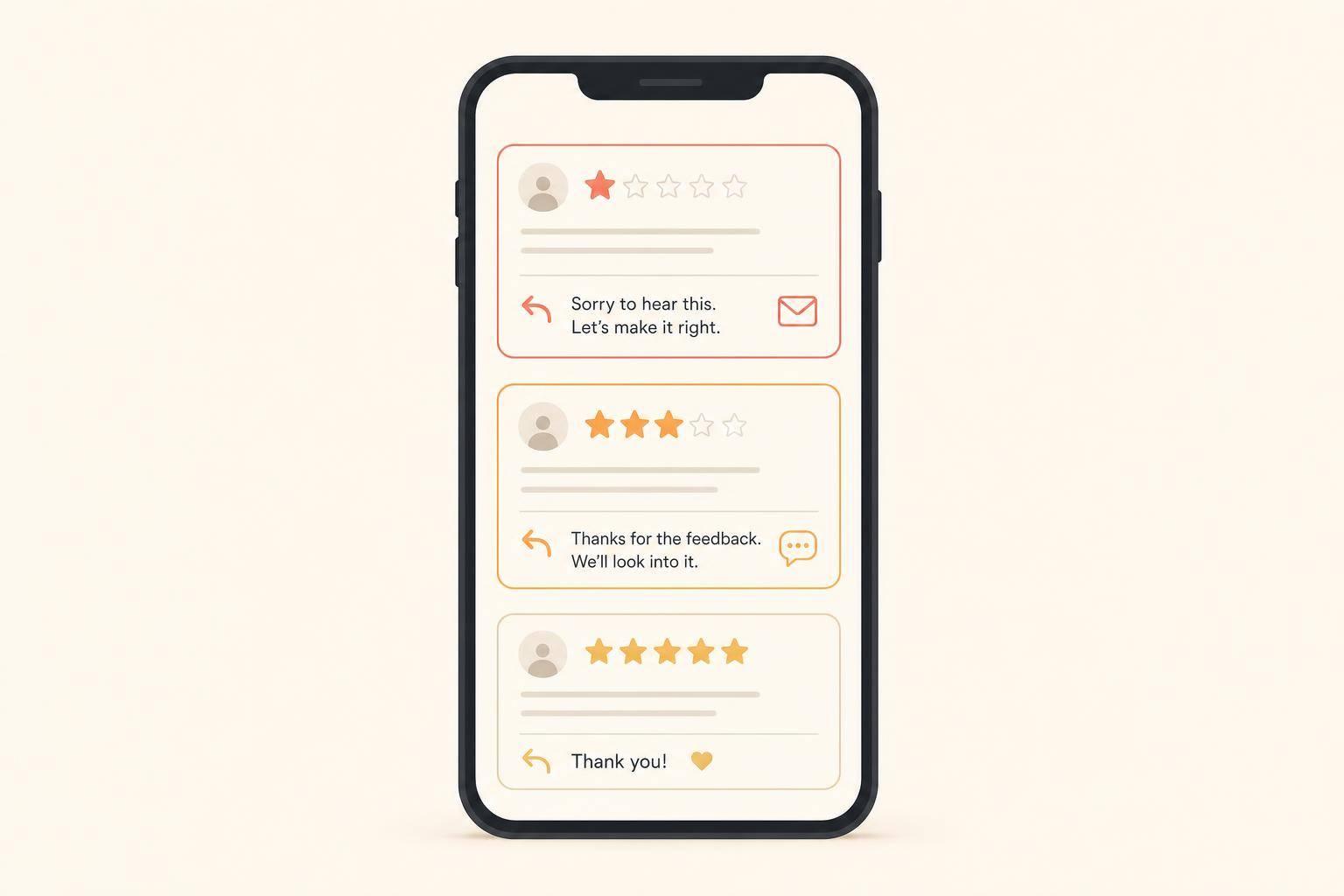
Yes - if you can, reply to every review. If time is tight, I’d handle 1-star to 3-star reviews first, then reply to positive reviews in batches. That approach helps you look present, not like you only show up when something goes wrong.
Here’s the short version:
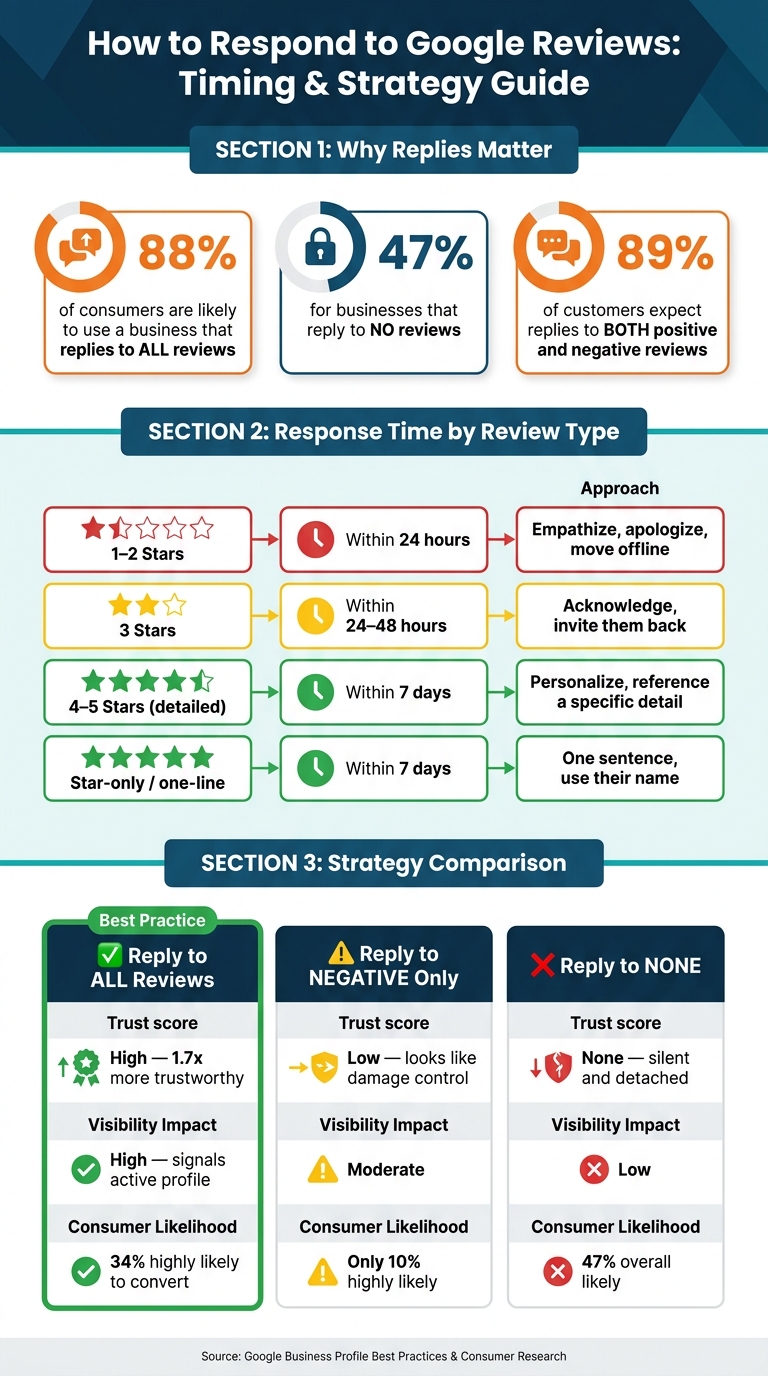
The reason is simple: your replies are public on Google Search and Maps. People read them before they call, visit, or buy. And the numbers are hard to ignore: 88% of consumers are likely to use a business that replies to all reviews, versus 47% for businesses that do not reply at all. Also, 89% expect replies to both positive and negative reviews.
A bad pattern is replying only to complaints. It can make your business look like it reacts only under pressure. A better pattern is steady, visible replies across the board.
If I had to boil the whole article down to one rule, it would be this: reply fast to unhappy customers, but don’t ignore the happy ones.
How to Respond to Google Reviews: Timing & Strategy Guide
| Approach | How it looks to customers | What to do |
|---|---|---|
| Reply to all reviews | More active, more caring, more consistent | Best option |
| Reply only to bad reviews | Reactive and uneven | Use only as a short-term fallback |
| Reply to none | Silent and detached | Worst option |
That’s the whole playbook in one view: be consistent, be brief, and start with the reviews that can hurt you most.
When a business only replies to complaints, the profile feels reactive instead of customer-first. To anyone scrolling through reviews, it sends a pretty plain message: "we only respond when we have to."
That kind of selective replying can make people feel brushed off. And that matters, because 89% of customers expect businesses to reply to both positive and negative reviews [2][8]. It also throws away a simple chance to strengthen loyalty. People who took time to leave praise notice when no one acknowledges it. So do potential customers reading those reviews later.
There’s another piece here too: consistent replies show Google that the profile is active.
The difference between these two approaches is easy to spot once you line them up:
| Strategy | Impact on Trust | Impact on Visibility | Owner Workload |
|---|---|---|---|
| Consistent (All Reviews) | High: 1.7x more trustworthy; signals total accountability [1] | High: Signals an active profile to Google [4][6] | ~30 mins/month for 15 reviews [2] |
| Negative-Only (Damage Control) | Low: Looks like damage control; ignores loyal advocates | Moderate: Misses engagement signals from positive reviews | Low |
The trust gap gets even sharper in the numbers. Only 10% of consumers are highly likely to use a business that replies only to negative reviews. That jumps to 34% for businesses that reply to both positive and negative reviews [4].
Once you see how much replies shape trust, the next step is figuring out which reviews need the fastest response.
Start with the unhappy reviews. If someone leaves a negative or mixed review, speed matters most.
A solid target is within 24 hours for 1- and 2-star reviews and within 24 to 48 hours for 3-star reviews [6][10][11].
Three-star reviews often get brushed aside, and that’s a mistake. These people are on the fence. A careful reply that acknowledges what they said and invites them back can nudge them toward coming in again [2][6].
For negative or mixed reviews, keep your public reply short and steady. Acknowledge the issue, apologize, and move the conversation offline by sharing a direct phone number or email [6][10]. Don’t argue in public. And don’t post private details like prices, addresses, or order information [4][5].
Positive reviews need a different kind of reply.
Positive reviews still merit a response. You just don’t need as much text.
If a reviewer mentions a staff member or calls out a specific service, write a personal reply that refers to that detail. That shows you read the review and helps build more loyalty with the customer who took the time to write it [6][10][11].
Short reviews like "Great service!" or a 5-star rating with no text are a different case. A one-line reply such as "Thanks for the rating!" is enough [2][8][10][11]. Just don’t paste the same reply under every 5-star review. People can spot that a mile away.
| Review Type | Response Time | Approach |
|---|---|---|
| 1–2 Stars | Within 24 hours | Empathize, apologize for the experience, move the issue offline |
| 3 Stars | Within 24–48 hours | Acknowledge feedback, invite them back |
| 4–5 Stars (detailed) | Within 7 days | Personalize, reference a specific detail |
| Star-only or one-line | Within 7 days | One sentence, use their name |
Platform rules also affect what you can say and how people will see it.
Google Business Profile requires verification before you can reply to reviews [8][10]. Your reply shows up publicly on Google Search and Maps, so it’s not just for the reviewer. Future customers will read it too [10].
If a review looks fake or abusive, don’t accuse the reviewer in public. Use Google’s "Flag as inappropriate" tool in your GBP dashboard to report it [10][2][3]. While you wait for Google’s decision, you can still post a short factual reply - something like "We cannot match this to a visit in our records, but we would like to help" - so future readers don’t see an unanswered warning sign.
Once you know the timing and the rules, the next move is to use a simple reply framework.
Not every review should get the same kind of reply. If you're going to respond at scale, the structure needs to match the situation.
| Review Type | Core Steps | Tone | Ideal Length | When to Move Offline |
|---|---|---|---|---|
| Positive | Thank by name, mention one specific detail, invite back | Warm and appreciative | 1–2 sentences | Never |
| Neutral (3-Star) | Thank for honest feedback, acknowledge the specific concern, invite them back to make it right | Professional and attentive | 2–3 sentences | Only if the issue needs private follow-up |
| Negative | Acknowledge the experience, apologize for the frustration, offer direct contact | Calm and accountable | 2–4 sentences | Always |
| Star-only | Thank for the rating | Brief and polite | 1 sentence | Never |
Across all four, one rule stays the same: use the reviewer's name and don't recycle the same opener or sign-off. That matters more than it may seem. Generic replies turn off 50% of consumers, who see them as a sign of poor customer care [2].
The goal is simple: keep replies short, specific, and steady. These examples give you a starting point.
Plumber - positive review:
"Thanks Maria! Glad we could replace your water heater the same day. We'll let the technician know you appreciated the quick service!" [10]
Restaurant - neutral review:
"Hi Alex, thanks for the feedback. We're sorry the dessert missed the mark and appreciate you flagging it. We've shared this with the team." [2]
Local retailer - mixed feedback on wait times:
"Appreciate the kind words, Jake! Glad you liked the selection. We hear you on the weekend wait times and are adding an extra staff member on Saturdays to speed things up." [2]
Law or accounting office - negative review (privacy-safe):
"We appreciate this feedback. Our firm is committed to high-quality service for every client. Please contact us directly at [phone] so we can discuss your concerns further." [7]
If you work in a regulated field, keep public replies broad and take the details offline. That's the safer move for privacy.
A decent template can still go sideways if the reply sounds stiff, salesy, or combative. In some cases, a bad reply does more damage than saying nothing at all. Here are the six mistakes to watch for:
With a few rules and a few go-to templates, the next step is setting up a simple workflow.
Once you have a few reply templates, the last piece is a simple workflow that helps you respond on time. You do NOT need to watch reviews all day. A basic system is usually enough for a small business to keep up without constant interruptions.
Pick one person to handle review replies, turn on Google Business Profile notifications so new reviews reach them right away [12], and set aside one or two short sessions each week to respond [5][9][1]. Start with the newest reviews, because those are the first ones customers are likely to see [5][2]. Then handle negative reviews before recent positive ones [2]. If a review is critical, draft the reply and wait 30 minutes before posting so the tone stays calm and measured [5][8].
For multi-location teams, one clear approval rule can save a lot of back-and-forth. Managers can reply to positive reviews, while anything below 3 stars should go to the owner or a senior manager before it goes live [12]. Sign each reply with a real first name and title, such as "Sarah, Owner", so people can see there is a person behind the message [5][12]. You can also use AI draft tools or saved templates to speed things up, then tailor each reply so it still feels personal [1][8][7].
That gives you a process that is fast, personal, and easy to keep up with.
Use a simple weekly workflow, answer negative reviews fast, and give positive reviews a short personal reply. When you respond on a steady basis, people notice. And with a simple system in place, that kind of consistency is much easier for busy owners to keep going.
If time is tight, don’t go silent. Set aside one block each day or week to handle reviews in batches instead of replying the moment each one comes in.
Put your attention on negative reviews and detailed complaints first. For positive reviews, short and sincere templates usually do the job. If you need to move faster, use AI-powered tools to draft replies, and try to answer negative feedback within 24 to 48 hours.
Yes. Older reviews still show up for potential customers, and replying to them shows that you pay attention to your business profile.
If you’ve got a backlog, start with the newest reviews first, especially low-star or negative ones. For older positive reviews, a short thank-you works fine. A late reply is still better than no reply.
If a review looks fake, don't accuse the person of lying. That almost always makes the situation worse.
Instead, post a short, neutral reply. Say you couldn't find a matching visit, and invite them to contact you directly in case there was a mix-up.
Then report the review in your Google Business Profile and pick the closest violation category. Google may take weeks to remove it, so in the meantime, keep your attention on getting legitimate reviews from real customers.
Discover strategies to elevate your business.