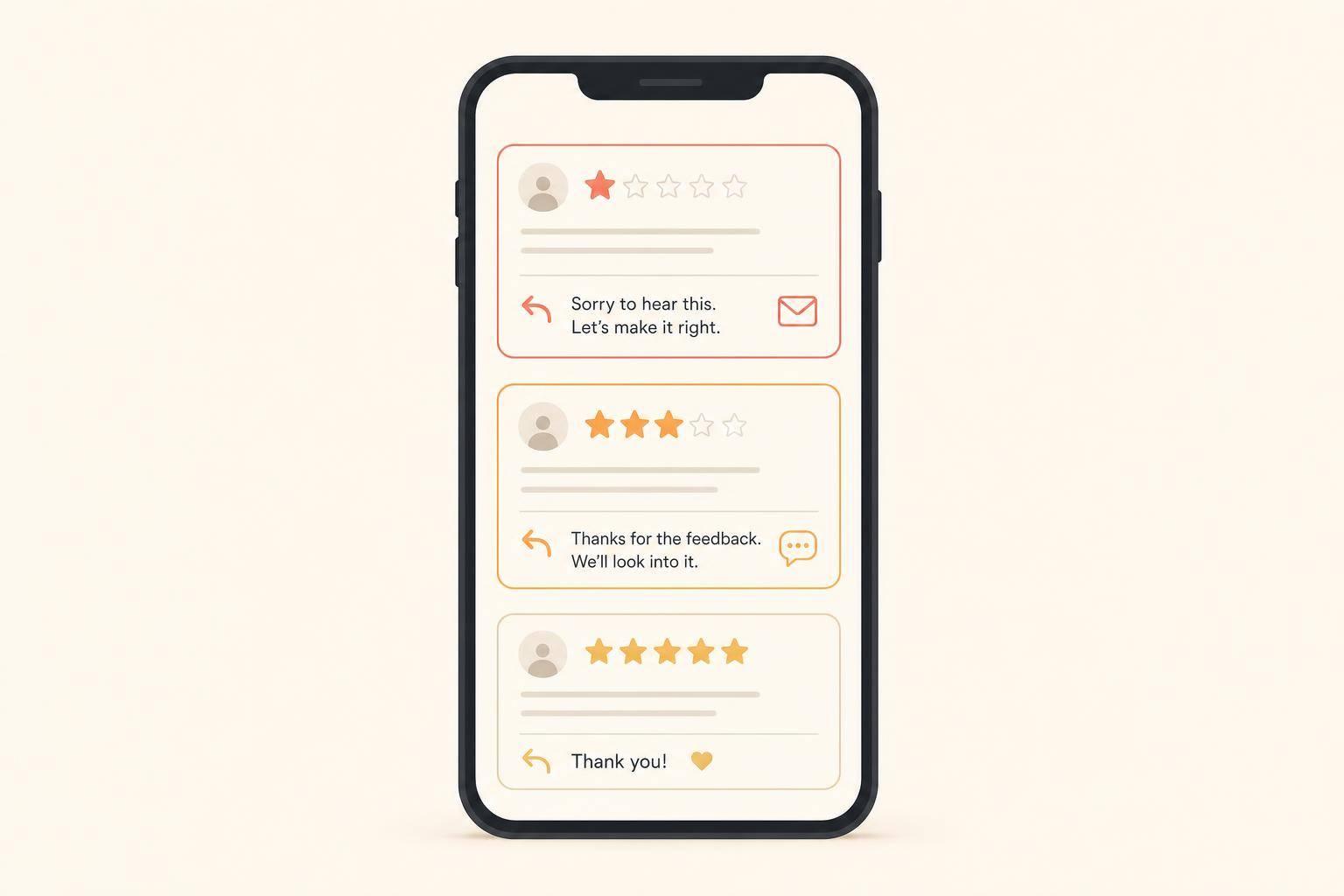
96% of US consumers read reviews before choosing a local business. But here’s the catch: they’re not just reading - they’re watching how businesses respond. Ignoring reviews? That’s like walking away from a customer mid-conversation.
Why does this matter?
Responding to reviews isn’t just polite - it’s an opportunity to build trust, improve visibility, and retain customers. Whether it’s a glowing review or a tough critique, every response makes a difference. This guide explains how to respond effectively, manage feedback efficiently, and turn reviews into lasting customer relationships.

Review Response Statistics: Impact on Local Business Trust and Customer Retention
Not all reviews tell the same story. Some are emotional outbursts, others are glowing endorsements, and many fall somewhere in between. The trick to writing effective responses is understanding what the reviewer is really saying and tailoring your reply to match.
Start by picking up on specific details in the review. For instance, if someone mentions "cold food", it might signal a broader issue with equipment or staffing, not just dissatisfaction with their meal. If they highlight a staff member or mention a particular dish, you’ve got a chance to personalize your response and show you’re paying attention. Timing also matters - if a review mentions a delay during peak hours, it provides useful context for your reply.
It can help to think of reviewers in categories. There’s the evangelist who raves about your business, the undecided customer with mixed feedback, and the legitimate complainant who had a bad experience. Each type requires a different approach: acknowledge and thank evangelists, reassure the undecided, and show complainants you’re taking action to address their concerns.
By decoding these cues, you can craft responses that feel thoughtful, timely, and purposeful.
Did you know 60% of reviewers expect a response within two days [1]? Waiting too long can give the impression that you’re not paying attention, so aim to reply within 24–48 hours.
Personalization is everything. A generic “Thank you for your feedback” just won’t cut it. Instead, reference specific details from the review to make your reply feel genuine. A personalized response not only strengthens loyalty but can also spark meaningful conversations.
"Owner responses represent one of the greatest assets your local business has for becoming an active contributor to your online reputation, rather than a powerless bystander."
– Miriam Ellis, Local SEO Subject Matter Expert, Moz [1]
Match the tone of the review. If someone leaves an enthusiastic comment, keep your reply casual and upbeat. For more formal reviews, stick to a professional tone. And don’t forget to sign off with a name - whether it’s the owner or a manager - so the response feels personal and human.
When it comes to negative reviews, consider moving the conversation offline. Sharing a direct phone number or email address, along with a specific contact person, allows you to resolve the issue privately while still showing accountability in your public reply.
| Review Type | Primary Goal of Response | Key Elements to Include |
|---|---|---|
| Positive (4-5 Stars) | Build loyalty & SEO | Gratitude, personal details, invitation to reconnect |
| Neutral (3 Stars) | Spark improvement | Thanks, reinforce positives, apologize, ask for details |
| Negative (1-2 Stars) | Damage control & retention | Calm tone, sincere apology, solution, offline follow-up |
| Fake/Spam | Protect reputation | Flag for removal; reply only if needed to clarify |
Having a clear internal process for responding to reviews ensures consistency and saves time.
If you’re a solo business owner, set aside 15 minutes each week to tackle reviews. For larger teams, create guidelines around who’s responsible for responding, the tone to use, and how quickly replies should go out.
Sensitive reviews, like those involving claims of illegal activity, require extra care. Document the issue and seek legal advice before responding. For fake or spam reviews, flag them for removal and only respond publicly if necessary to clarify inaccuracies.
One last tip: avoid using AI-generated responses. Over 60% of consumers prefer knowing there’s a real person behind the reply [3].
Need help managing this process? Services like Humble Help offer tools and guidance to make handling reviews and growing your online presence much easier.
When responding to positive reviews, aim for a thoughtful and personalized approach. A simple three-part framework works well: thank the customer by name, acknowledge something specific they mentioned, and suggest a clear next step. This format shows genuine appreciation and opens the door for future interaction.
Start by addressing the reviewer by name, then highlight a unique detail they shared - like a specific dish they loved, a staff member they praised, or a service they enjoyed. This demonstrates that you’ve genuinely read and valued their feedback. Wrap up your response by encouraging them to take a next step, such as trying a new menu item, attending an upcoming event, or joining your loyalty program.
"Learning to see local business reviews as the beginning of a conversation which an individual customer is trying to start with your brand is a good way to ensure that patrons you've already earned aren't feeling ignored."
– Miriam Ellis, Founder, Miriam Ellis Consulting [3]
If the customer mentioned a particular staff member or specific experience, include that in your reply. This adds a personal touch and reinforces a sense of connection. The key is to make every response feel heartfelt and authentic. By doing so, you not only express gratitude but also create opportunities for deeper engagement.
After crafting a personalized response, take it a step further by encouraging customers to stay engaged. Once you’ve thanked them, use your reply to invite future interaction. For example, you could offer a discount, mention an upcoming event, or suggest they follow your social media channels. This turns a simple review into a chance to build a lasting relationship.
You can also cross-promote related services. If someone praises a specific product or service, suggest a complementary option they might enjoy next time. Keeping the conversation alive ensures customers feel valued beyond their initial visit. Research shows that customers are 33% more likely to upgrade their review if a business responds with a personalized message within 24 hours [7], and businesses that respond consistently see 12% more reviews than those that don’t [8].
To maintain these connections, a Customer Relationship Management (CRM) system can be a game-changer. With a CRM, you can organize customer feedback, track interactions, and manage follow-ups with ease. Tools like Humble Help's free Business CRM let you centralize customer data and streamline communication.
Modern CRMs can integrate with your POS system to automate review requests and rewards. They also compile reviews from platforms like Google, Yelp, and Facebook into one dashboard, ensuring no feedback goes unnoticed. By identifying frequent reviewers, you can tailor future interactions, turning one-time responses into ongoing conversations. This approach helps transform positive reviews into lasting customer loyalty.
Negative reviews aren't personal attacks - they're opportunities in disguise. When a customer takes the time to detail what went wrong, they're handing you a guide to improve. While 94% of consumers are less likely to engage with a business after seeing negative feedback [9], it's worth noting that shoppers are 52% more likely to trust a business with some negative reviews compared to one with a spotless record [9]. A mix of feedback makes your business seem genuine rather than suspiciously perfect.
Pay attention to recurring themes in your negative reviews. For instance, if several customers mention slow service in the same month, it's likely a staffing issue that needs addressing. Or, if multiple reviews point out a product defect, that’s crucial information for your production or supplier teams. Here's an encouraging fact: 95% of dissatisfied customers will return if their concerns are resolved quickly [9]. Every negative review is a chance to turn things around and strengthen your business.
"Negative reviews are gold for internal improvement. Track patterns. Feed relevant feedback to your product, logistics, or support teams." – REVIEWS.io [9]
With this perspective in mind, here’s a structured approach to responding to negative reviews effectively.
Before you respond, take 15–30 minutes to cool off [9]. Reacting immediately, especially when emotions are high, can often make things worse. Use this time to gather facts, review records, and consult your team if needed. Then, follow this proven response strategy: thank the reviewer for their feedback, sincerely apologize for their frustration, address the specific issue, propose a practical solution, and provide a way to continue the conversation privately.
Take inspiration from the Stamford Plaza in Brisbane, which received a critical review from a loyal guest about an anniversary stay. The management responded by addressing the guest by name, thanking them personally, and outlining specific steps they were taking to fix the service issues mentioned [9]. This thoughtful approach reassured both the reviewer and potential customers reading the exchange.
Make sure your response feels personal. Reference the specific details mentioned in the review instead of relying on generic templates. Always include a direct contact method - like a phone number or email address - so the issue can be resolved privately. Moving the discussion offline not only prevents public escalation but also shows you're serious about making things right. Once the matter is resolved, it’s okay to politely ask if the customer would consider updating their review to reflect the resolution [9][10].
Finally, once you've offered a solution publicly, know when to wrap things up to maintain professionalism.
Not all reviews require a response. If a review contains illegal allegations against your business, avoid responding publicly. Instead, document the review and consult legal counsel [1]. For spam, fake reviews from competitors, or large-scale "review bombing", use the platform's reporting tools rather than engaging in a public dispute [1][11].
"Should any review allege illegal practices on the part of the business, don't respond. Instead, you may need to document what is happening and seek legal advice." – Miriam Ellis, Local SEO Subject Matter Expert, Moz [1]
Once you've apologized, offered a solution, and provided a way to contact you offline, your role in the conversation is complete. Continuing to engage beyond this point often escalates the situation and can make your business appear defensive. Businesses that respond to reviews are perceived as 1.7X more trustworthy [2], but endless back-and-forth exchanges can erode that trust. If a reviewer refuses to continue the discussion privately after you’ve made a professional offer, it’s best to stop responding. Your thoughtful and solution-focused reply will stand out to future customers reading the thread, reinforcing your commitment to quality service.
Customers leave reviews across various platforms, depending on how they discovered your business. For instance, a Google Business Profile captures those searching for local services, Yelp attracts diners and service seekers, and Facebook connects with your social media audience. Each platform serves a distinct purpose, making manual tracking a hassle. To streamline this, start by auditing your online presence. List key platforms where reviews appear and rate their accuracy on a scale of 1–5. This will help you identify gaps and ensure your profiles are up-to-date and reliable [13]. This audit lays the foundation for building a structured response strategy.
For small teams, having clear roles and realistic timelines is essential to stay on top of reviews efficiently. If you're receiving just a couple of reviews weekly, set aside 15 minutes each week to respond in batches [1]. For higher volumes, establish a daily routine and prioritize reviews based on urgency:
To make this process smoother, create internal guidelines with response templates for common scenarios. For example, have a pre-written thank-you for glowing reviews or an apology template for negative feedback [15]. Templates save time but shouldn’t replace personalization - add specific details from the review to show customers you’ve genuinely paid attention [14]. With clear workflows and personalized responses, you’ll ensure consistency and efficiency in managing reviews.
Once your workflows are running, tracking key metrics will help you refine your approach. Focus on the following:
These metrics will reveal how effective your system is and highlight any bottlenecks. Tools like Humble Help's free Analytics Dashboard (https://humblehelp.studio) are a great resource for small businesses, offering insights into traffic, visibility, and performance - all in one place. Additionally, keep an eye on recurring customer feedback. For instance, if reviews frequently mention issues like "slow service" or "cold food", it may signal a deeper problem that needs addressing [4][5]. Monitoring these patterns not only helps improve operations but also strengthens customer relationships. With 88% of consumers saying they’re more likely to choose a business that responds to all reviews [12], your efforts in managing feedback can directly influence your ability to attract new customers.
Review responses are a vital element of customer service. Treating every review as the beginning of a conversation - not just a static rating - sends a clear message to potential customers about how you’ll treat them. As Moz aptly states:
"Owner responses represent one of the greatest assets your local business has for becoming an active contributor to your online reputation, rather than a powerless bystander" [1].
The statistics back this up in a big way: 82% of consumers are more likely to choose a business when they see the owner actively responding to reviews [3]. On top of that, 97% of people who read reviews also check out the business's responses [2][16], and customers spend 50% more with businesses that take the time to engage [2]. These numbers clearly show how much this practice can influence your bottom line.
Consistency is key, no matter the type of review. Whether it’s a glowing five-star review or a tough one-star complaint, how you respond reflects your business’s values to everyone watching. Consider this: 73% of unhappy customers are willing to give you a second chance if your response addresses their concerns [3][6], and 54% of them may even revise their negative review into a more positive one [3][6].
Even dedicating just 15 minutes twice a week to this effort can make a big difference. Establish simple workflows, create clear response guidelines for your team, and monitor your response rate and timing. The goal isn’t to be perfect - it’s to show up consistently and genuinely for the people who took the time to share their experiences.
Reviews are happening whether you engage or not. Make sure you’re part of the conversation by responding thoughtfully to every single one.
To make your review responses feel more genuine and personal, always start by addressing the reviewer by name and referencing specific details from their feedback. For instance, mention the product, service, or experience they highlighted. This demonstrates that you’ve truly read their review and value their input. Adjust your tone to match theirs - keep it warm and cheerful for positive reviews, and empathetic yet professional for negative ones.
Adding a personal touch can make a big difference. Consider signing off with your name (e.g., “ - Sarah, Owner”) or including a profile photo to make your response feel more human. While templates can be a time-saver, don’t rely on them entirely - customize each reply by using the reviewer’s name and addressing their specific experience. These small adjustments can turn a simple acknowledgment into a meaningful exchange.
For those who need a little extra help managing and personalizing responses, Humble Help offers tools and optional support to assist small businesses in creating thoughtful and engaging customer interactions.
When dealing with a negative review, it’s essential to take a moment to breathe and avoid jumping into an emotional response. Start by carefully reading the customer’s comments and any related details to fully understand their concerns. This will help you craft a thoughtful and accurate reply.
Make sure to respond publicly and professionally within 24 hours. Begin by thanking the reviewer for their feedback - this shows you value their input. Acknowledge the issue they’ve raised, offer a genuine apology, and express empathy for their experience. Then, guide the conversation offline by providing your contact information, like a phone number or email, so you can address their concerns directly and privately.
After resolving the issue, consider circling back to the public review with a brief update. This demonstrates that you’ve taken action and care about making things right. Use the feedback as a learning opportunity to identify trends and improve your services, turning a challenging situation into a chance to grow.
Responding to every review - whether it’s glowing, neutral, or critical - sends a clear message: you care about your customers and their experiences. Research shows that over 90% of consumers pay attention to how businesses respond to reviews, and nearly 60% are more inclined to choose a business that actively addresses feedback. Taking the time to reply not only builds trust but also shows accountability and a commitment to delivering great service.
But there’s more to it than just relationship-building. Responding to reviews is also a smart and budget-friendly way to market your business. Replies are highly visible on platforms like Google and Yelp, giving you free exposure while highlighting your dedication to customer satisfaction. Addressing negative reviews quickly can even help retain customers - a much cheaper option than trying to win over new ones. For local businesses, tools like Humble Help make it easier to craft thoughtful, professional responses that enhance your reputation and encourage growth.
Discover strategies to elevate your business.