Small Bay Area restaurants can use budget-friendly video ads to stand out in a competitive market. Video content drives higher engagement, with platforms like Instagram Reels and TikTok delivering strong results for local businesses. Here’s a quick breakdown of seven effective video ideas to boost visibility and sales without overspending:
Start with simple tools like your smartphone, free editing apps, and natural light. Post consistently on platforms like Instagram, TikTok, and Google Business Profile to engage local audiences. Even a small budget can deliver measurable results for your restaurant.
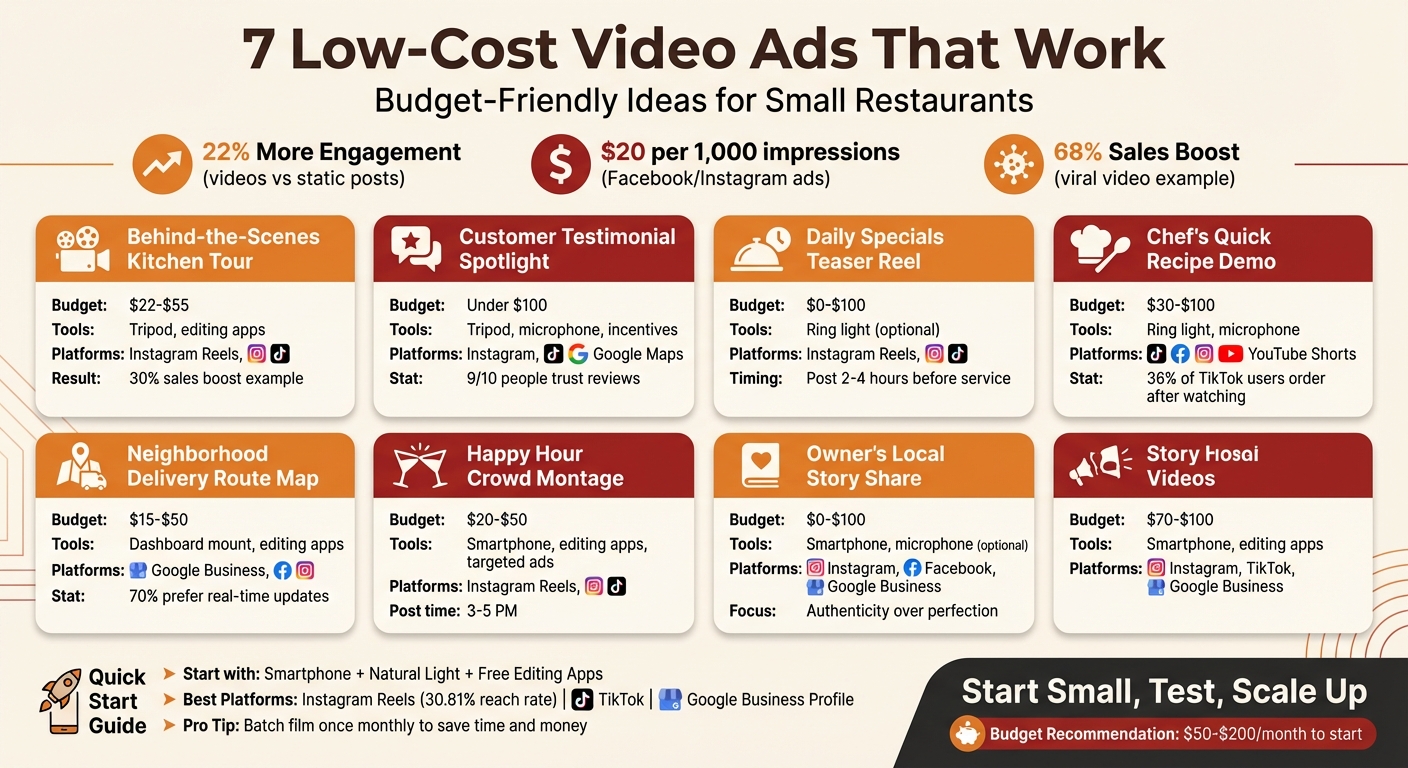
7 Low-Cost Video Ad Ideas for Small Restaurants with Budgets and Platforms
A behind-the-scenes kitchen tour video can highlight the care and craftsmanship that go into every dish. Take inspiration from Salim Nasser, the 24-year-old co-owner of Abu Salim Middle Eastern Grill in San Francisco. In September 2021, he started sharing TikTok videos of "hummus spins" and close-up food prep. Despite some initial doubts from his partner, these clips - featuring freshly blended hummus topped with paprika and olive oil - boosted overall sales by 30% and tripled sales of the highlighted menu items [2].
Creating your own video doesn’t require fancy equipment - just your smartphone. Shoot vertically (9:16 aspect ratio) to fit platforms like Instagram Reels and TikTok, and keep the video short, ideally 60–90 seconds [7]. Natural light is your best friend, so film near a window and use a $5 white cardboard to soften shadows. For steady shots, invest in a smartphone tripod, which costs between $20–$50 [7]. These simple tools can help you capture the story behind your dish.
"Seeing and hearing the food being cooked and plated has a much more stimulating effect than a still photo."
- Ben Hon, Food Photographer and Content Creator [7]
Focus on one dish for your video. Start by showing fresh ingredients from a Bay Area farmer’s market, then move through the process - washing, chopping, sizzling, and plating. Include close-ups of textures and sounds like sizzling oil or the rhythmic chop of a knife [11, 14]. To ensure clear audio, silence loud appliances like AC units and vents, and speak close to the microphone to minimize echo [7].
Once you’ve shot your footage, polish it for maximum impact. Instagram Reels, for example, have an average reach rate of 30.81%, which is double that of other formats, and they generate 22% more engagement than standard posts [11, 12]. Share your video on Instagram Reels, TikTok, and YouTube Shorts to reach a larger audience. Use free editing apps like CapCut or Filmora to add captions (a must for viewers watching without sound), music, and on-screen text [8]. Want to expand your reach further? Tag local Bay Area influencers like Tim Cheung, Paul Arihara, or Preeti Gill [2]. And the best part? The cost for this entire setup - cardboard, tripod, and editing software - totals just $22–$55.
Customer testimonials are one of the most convincing ways to build trust. Studies show that 9 out of 10 people trust customer reviews more than a business's own claims [11]. On top of that, 77% of people who watch a brand testimonial video feel motivated to make a purchase [11]. The good news? You can easily create these testimonials using just your smartphone.
Take the example of a local restaurant that, in May 2025, teamed up with Vidlo to roll out a video testimonial campaign. They placed QR codes on their tables, offering diners 20% off their next order in exchange for a quick video review. The result? Dozens of genuine, engaging videos flooded platforms like TikTok and Instagram, leading to a 42% increase in sales [12].
"A raw, real conversation on a smartphone is more believable and more effective than a scripted, polished performance." - Top Rated Local [13]
Setting up your testimonial shoot doesn’t require fancy equipment or a big budget. Here’s a simple guide:
To encourage participation, offer a small reward, such as a free dessert, signature drink, or a 20% discount (costing $5–$15 per testimonial). Once you’ve collected the videos, share them on Instagram Reels, TikTok, and even your Google Maps profile. Use location-specific hashtags like #SFBites or #OaklandEats to attract diners in your area.
Even with a limited budget - under $100 for a tripod, microphone, and incentives - this strategy builds trust and drives engagement. It’s a low-cost way to connect with your community and boost visibility while creating content that resonates with potential customers.
A daily specials teaser reel is a quick and effective way to turn casual scrollers into paying customers. The idea is simple: create a 7–15 second vertical video showcasing your special dish, post it a few hours before service, and watch the orders roll in. Salim Nasser, co-owner of Abu Salim Middle Eastern Grill in San Francisco, saw impressive results with this strategy. In late 2021, he started sharing close-up videos of fresh hummus and loaded shawarma on TikTok. The outcome? A 30% overall sales boost whenever a video went live, with sales for featured items tripling [2]. This approach proves that mouthwatering visuals can drive real results.
To make your teaser reel stand out, focus on capturing enticing details. Highlight "appetite triggers" like steam rising from a dish, cheese stretching, a drizzle of sauce, or the sizzle of food hitting a hot pan [14]. Be'Anka Ashaolu, co-founder of Nirvana Soul in San Jose, sums it up perfectly:
"I have to check in with our baristas before I post any of our drinks, because whatever I post is typically the thing that we sell out that day"
[2]. For the best lighting, film near a window during the day or use a $30 ring light for evening shots [14].
Timing is key. Post your reel 2–4 hours before lunch or dinner service - around 10:30 AM for lunch or 4:30 PM for dinner - to catch people while they’re deciding where to eat [14]. Add text overlays like "Today Only" or "Until 7 PM" to create a sense of urgency [14]. Don’t forget to use hyper-local hashtags like #SFeeats, #OaklandFoodie, or #MissionDistrict, and tag your exact location to appear in Instagram's "Near You" algorithm [14][15].
Here’s why it works: Instagram Reels generate 22% more engagement than regular posts, with an average reach rate of 30.81%, compared to just 13.14% for static images [14][15]. You don’t need fancy equipment - just your smartphone. Include a clear call to action, such as "Link in bio to order" or "Show this Reel for 10% off" to track conversions [14]. The total cost? Less than $100 if you invest in a ring light - or nothing at all if you stick to daylight filming.
A chef's recipe demo can turn your culinary skills into a powerful marketing tool - and you can do it with just your smartphone for under $100. Keep your video short and snappy, ideally between 15 to 60 seconds, to perform well on platforms like TikTok and Instagram Reels. Why? Videos under a minute have a 62% completion rate[1]. Quick tutorials not only entertain but also educate, making them a hit - how-to content is the most popular category on YouTube[6]. Abbey Hudetz, Founder & Creative Director of Oyster Creative, highlights the importance of content like this:
"Creating high-quality content, not necessarily high production value, that educates your target audience and answers their questions is key for your digital strategy." [6]
Focus on showcasing signature dishes or high-margin menu items to make the biggest impact. Use a top-down or 45° angle for filming, and prep most ingredients in advance. Save the most visually striking moments, like drizzling sauce or plating, for the camera[9]. To ensure great quality, record in 4K using your phone’s native camera app and take advantage of natural daylight. If you're shooting indoors at night, a budget-friendly ring light (about $30) can work wonders, and activating your phone's grid will help you frame the shot perfectly[16].
The first three seconds of your video are critical - this is your chance to grab attention. Start with a visually stunning moment, like a dramatic cooking action or a perfectly plated dish. Add on-screen text that includes key ingredients and steps for viewers who might be watching without sound. And don’t forget a clear call-to-action, such as “Order this tonight in the Mission District” or “Check the link in bio for reservations”[5].
Once your video is ready, share it across multiple platforms. TikTok and Instagram Reels are a must - 36% of TikTok users have ordered from a restaurant after watching a video[17], and Instagram Reels get 22% more engagement than regular posts[8]. Don’t stop there - upload your demos to YouTube Shorts for better long-term visibility and add them to your Google Business Profile to appear in local "near me" searches in areas like San Francisco, Oakland, and San Jose[5]. Use hyper-local hashtags and mention neighborhood names to connect with Bay Area food lovers.
You can launch this strategy with just your phone and natural light, or spend a little - under $100 - for extras like a ring light or external microphone. For efficiency, batch your filming once a month to keep your content pipeline full without breaking the bank[16].
A delivery route map video can showcase your delivery coverage and speed, helping potential customers visualize the process. Seeing the journey builds confidence, especially for first-time customers[18]. In the Bay Area, where neighborhoods are distinct and traffic can be unpredictable, showing exactly where you deliver - whether it’s the Mission, Hayes Valley, or the Financial District - creates trust with locals who want to know if your service covers their area.
Keep it simple: film a time-lapse from your delivery driver’s perspective. Highlight well-known landmarks along the route to make it relatable. For example, show the Transamerica Pyramid or Dolores Park if they’re part of your delivery area. Keep the video short - under 30 seconds - and shoot vertically so it’s perfect for Instagram Reels or TikTok. All you need is your phone and a $15 suction cup dashboard mount. Add text overlays to highlight delivery zones and estimated times, such as "15-minute delivery to SOMA" or "Now serving the Marina District." This resonates with customers, especially since 70% of people prefer businesses offering real-time delivery updates[20]. One great example: in August 2025, a café in the Mission District saw a 45% boost in weekend foot traffic after using Facebook Location Awareness ads with "Get Directions" CTAs, generating 120 new leads in just one month[4].
Once your video is ready, focus on local distribution. Start by uploading it to your Google Business Profile - this increases visibility in local "near me" searches. Then, share it on Facebook and Instagram, using radius targeting for a 1-2 mile range around your restaurant. This strategy can reach between 10,000 and 50,000 potential customers per campaign[4]. Use hashtags like #MissionDistrict or #SFHills to connect with your community, and mention landmarks in your captions to make it relatable. Schedule ads during peak meal times - lunch (11:00 AM - 1:00 PM) and dinner (5:00 PM - 8:00 PM) - when people are deciding what to order[4].
The best part? You can keep costs low. A dashboard mount costs around $15, and you can spend $5-$50 on Facebook ads to boost your reach within your delivery zone[4]. Use free apps to add subtitles and finish with a clear call-to-action like "Order now - we deliver in 20 minutes!"
Highlight your restaurant as the after-work destination with a vibrant happy hour video. Showcasing a packed bar, lively groups, and bartenders mixing drinks creates social proof, drawing in customers. This approach works because 39% of people attend happy hour to catch up with friends[22].
Film during your busiest happy hour moments. A time-lapse or quick 30-second montage can capture the energy: the bar filling up, bartenders shaking cocktails, and friends clinking glasses. Use your phone’s grid for steady shots and stick to natural or warm bar lighting - skip the flash for a more inviting vibe. For example, Nossa Caipirinha Bar in Los Angeles had a staff member film one video weekly between December 2023 and June 2024, spending just 6–9 hours per month. When one of their reels went viral, they saw a 30% jump in average weekly covers[16]. It’s proof that consistent, dynamic visuals can drive real results.
Timing matters. Post your happy hour videos between 3:00 PM and 5:00 PM, when people are wrapping up their workday. Platforms like Instagram Reels and TikTok are ideal - 91% of Instagram users watch videos weekly, and TikTok's local-focused algorithm can amplify your reach[21]. To connect with your community, use hashtags like #SFfoodie or #BayAreaEats and overlay text such as "Happy Hour 4–6 PM Daily" or "Half-price margaritas in the Mission." This ensures viewers catch the details even if they’re watching without sound[21].
Editing is simple with free apps like Flixier. Add music, captions, and even spend $20–$50 on targeted ads to boost visibility within a 1–2 mile radius of your restaurant. Include a call-to-action like "Tag a friend who owes you a drink" to encourage engagement and keep the buzz going[23].
After showcasing your kitchen and sharing glowing customer testimonials, your personal story is another fantastic way to connect with your audience. It’s what sets your restaurant apart from big chains and other competitors in the Bay Area. A short, heartfelt video about why you started your restaurant, your family recipes, or how you source ingredients from local farms can create a genuine emotional bond that encourages loyalty.
You don’t need a professional setup - just grab your smartphone and keep it natural. Film yourself in your restaurant, unscripted. Talk about what inspired you to open in your neighborhood, walk viewers through preparing a signature dish, or share your culinary philosophy as you move through your dining space. Keep it under 60 seconds to hold attention and focus on keeping it real. For instance, a family-owned taqueria in the Mission District recorded a 45-second clip of the owner talking about her grandmother’s mole recipe while preparing it in the kitchen. That simple, authentic video racked up over 15,000 views on Instagram Reels and brought in 23 new customers who mentioned seeing it - all within one week.
"Authenticity is what resonates. People want to know the real story behind their meal, not a polished commercial."
Share your video on Instagram Reels, Facebook, and your Google Business Profile. Instagram and Facebook are particularly effective for Bay Area businesses since they’re where local families and homeowners spend much of their time online[24]. Posting on your Google Business Profile ensures your video shows up when people search for nearby restaurants[25]. Use local keywords in your captions, like "family-owned in Berkeley" or "Oakland neighborhood favorite", and include a clear call-to-action such as "Visit us this weekend" or "Order online today." For a small investment - under $100 - you can get an external microphone to improve audio quality, which is crucial for keeping viewers engaged[10].
Continuing to share your story builds trust and brings people through your doors, just like it has for other beloved Bay Area spots. Up next, learn how to compare costs and pick the best platforms for maximum results.
Here’s a breakdown of estimated costs and platform suggestions for different types of videos. These recommendations align with the video concepts to help you pair the right content with the most effective and budget-friendly platforms.
Production costs vary depending on whether you go DIY or hire professionals. For instance, creating a behind-the-scenes kitchen tour or a teaser for daily specials can cost as little as $40 to $500 if you’re using basic smartphone equipment. However, hiring a Bay Area agency for the same project could cost anywhere from $800 to $2,500[26]. For mid-range projects like customer testimonials or owner story videos, expect to spend $500 to $2,000 with a freelancer or $1,500 to $5,000 with a professional studio[26][27].
Batching content is a smart way to save money. Dedicate one morning a month to filming multiple videos - perhaps a few chef demonstrations, daily specials teasers, and a happy hour montage[28]. This method saves time and keeps costs manageable. In fact, nearly half of companies spent under $5,000 on total video production in 2024. Many small restaurants are also leveraging AI tools to slash production costs by up to 80%[28]. This efficient strategy allows you to allocate more funds to ad promotion.
When it comes to promotion, video ads are surprisingly affordable. Facebook and Instagram ads average about $0.07 per view, while YouTube pre-roll ads typically cost between $0.10 and $0.30 per view[1]. If you’re interested in streaming TV ads to target local audiences, platforms like Adwave let you launch campaigns starting at just $50 per month[3][28]. For example, a farm-to-table restaurant in Charlotte used Adwave in October 2025 to run streaming TV ads aimed at local food enthusiasts within a 10-mile radius. With a $300 monthly budget, the campaign reached over 50,000 households, driving more walk-in customers who mentioned seeing the restaurant "on TV"[3].
Choosing the right platform is just as important as managing costs. Instagram and TikTok are ideal for high-engagement content like behind-the-scenes tours, chef demos, and happy hour clips. For longer videos, such as detailed demos or owner stories, YouTube and Google Business Profile are better fits[1][5][19]. Keep your Google Business Profile updated with daily specials and virtual tours - it acts as a 24/7 digital storefront for potential customers searching "restaurants near me"[30][5]. Facebook is great for sharing delivery route maps or owner stories, as its community-focused groups build lasting local connections[29][1]. Don’t forget Yelp for customer testimonials, as 92% of diners check reviews before deciding where to eat[3].
"Low-cost video that fails to engage may waste your investment." - TechBoogie Media [26]
Start small with DIY videos on Instagram and your Google Business Profile, then reinvest earnings into freelancers or targeted ads. A Chicago-based pizza restaurant demonstrated this strategy in 2025, spending $400 per month on Google Ads targeting "deep dish pizza delivery" within a 5-mile radius. With an average cost of $2.05 per click, they generated over 180 direct calls and online orders[3]. This step-by-step approach mirrors the success stories shared above.
This guide has explored how low-cost, genuine video ads can boost foot traffic and online orders for your restaurant. These seven ideas are both easy on the budget and highly effective. Start with the ones that align best with your restaurant’s vibe. If you’re comfortable in front of the camera, consider sharing the owner’s story or filming a quick chef demo. If your customers are already fans, grab your smartphone and record their testimonials - it’s quick, simple, and can be shared within hours.
Experiment with platforms to find the best fit for your Bay Area audience. For instance, a behind-the-scenes kitchen tour might shine on Instagram Reels, while customer testimonials could bring in more reservations through your Google Business Profile. As Abbey Hudetz from Oyster Creative points out:
"The number one category on YouTube? How-to videos. I tell our clients to start with sharing tips, tricks, and even behind-the-scenes of their operation on video."
Testing different approaches will help you refine your content strategy.
Keep in mind, authenticity beats perfection. Real, unscripted moments resonate far more than polished productions. As Samantha Russell from Twenty Over Ten explains:
"Even if you're recording videos with your smartphone, starting somewhere is better than not being visible at all."
Once you find a winning formula, track your results. Use tools like customer feedback and promo codes to measure impact [3]. If a teaser for daily specials drives more lunch orders than a happy hour montage, focus on what works. Start small with a $50–$200 monthly budget on one platform, monitor the results, and scale up from there [3].
Don’t wait - film and post your first video before the weekend rush. Engage your Bay Area audience now. In such a competitive dining scene, showing up consistently matters far more than aiming for perfection.
Kick things off with a behind-the-scenes video that captures your restaurant’s daily preparations. Whether it’s your chefs skillfully crafting dishes, fresh ingredients being prepped, or your team working together, this kind of content does more than just entertain - it builds trust. It gives viewers a glimpse of your dedication and passion for quality, creating a connection that feels genuine.
Local audiences especially love seeing the real effort that goes into their meals. It’s a simple yet powerful way to highlight the care and authenticity that define your business. Plus, it’s the kind of content that encourages engagement and keeps people coming back for more.
To find out if your video is boosting sales, use tools that provide measurable insights like tracking links, conversion tracking, or analytics platforms. Add unique URLs or promo codes directly to your video or its call-to-action buttons. Then, track their performance using website analytics or advertising platforms. You can also compare sales figures from before and after the campaign to identify any revenue shifts. Tools like Google Analytics are particularly helpful for monitoring engagement, click-through rates, and conversions linked to your video ads.
Consistency is the secret sauce when it comes to posting. While there’s no hard-and-fast rule about how often you should post, sticking to a schedule - whether it’s weekly or bi-weekly - makes a big difference. Mix things up with different types of videos, such as behind-the-scenes glimpses, menu spotlights, or customer testimonials. Regular posts not only keep your restaurant on people’s radar but also help you connect with your local audience. Over time, this steady rhythm builds momentum and encourages your followers to keep coming back for more.
Discover strategies to elevate your business.