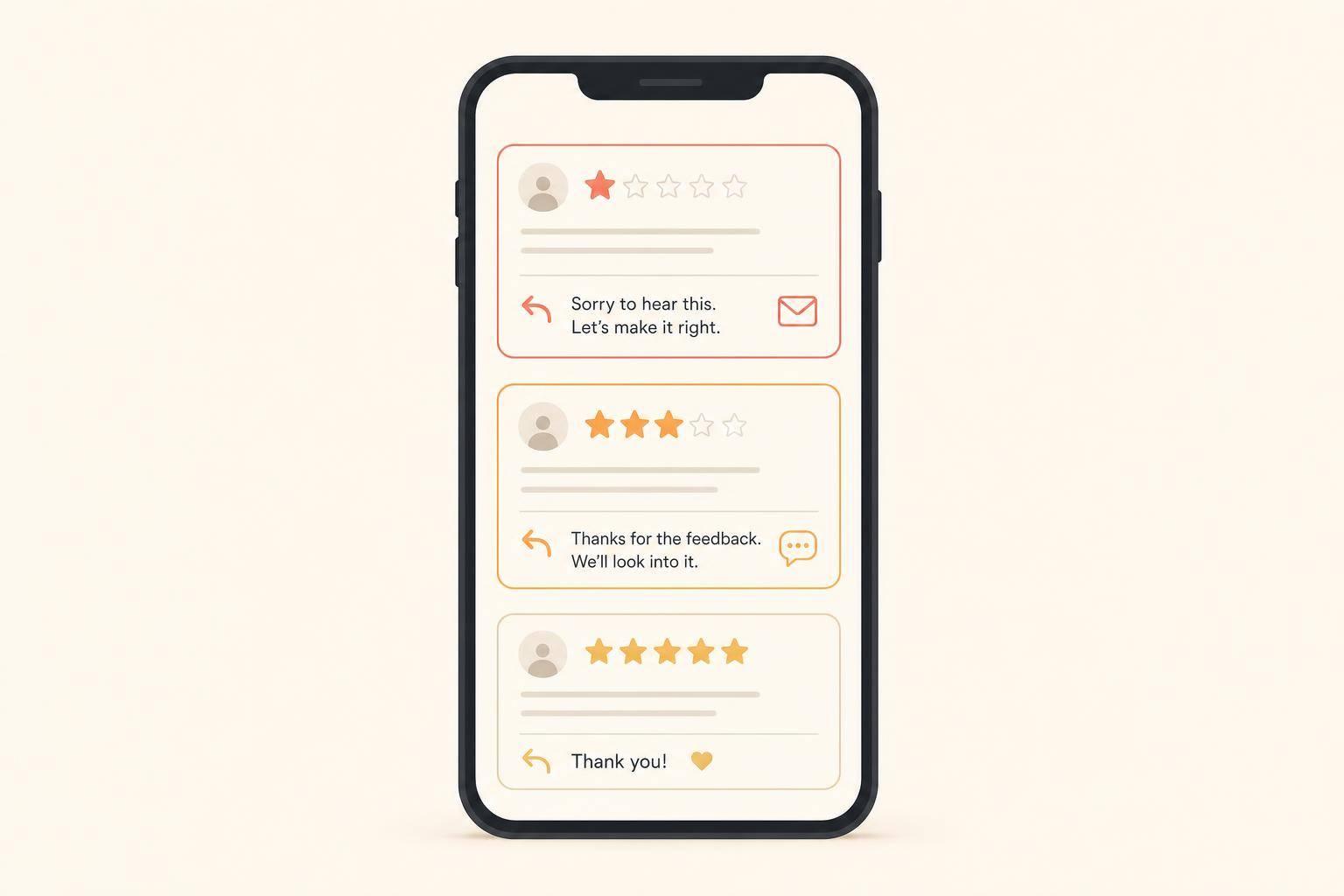
When a customer threatens a bad review, I don’t argue, panic, or offer money on the spot. I acknowledge the frustration, move the conversation to a private channel, ask one clear question, and give one next step.
That matters because reviews shape buying decisions. The article points out that a rating under 3 stars can hurt trust fast, and that 54% of unhappy customers may change a bad review after a better second experience. It also notes that 73% will give a business another shot if the issue is handled well.
If I need a simple playbook, this is it:
A few lines do most of the work. I can say: “I hear your frustration. I want to fix this directly - can we talk now?” Or: “Walk me through what happened from the start and what outcome you want.” Those lines lower the temperature without giving up control.
What I avoid matters too. I don’t say “You misunderstood,” “Nobody else complained,” or “You should have read the policy.” And I never connect a refund, discount, or free service to whether someone posts, edits, or removes a review.
The core idea is simple: solve the issue without rewarding the threat. That protects my reputation, my margins, and my team at the same time.
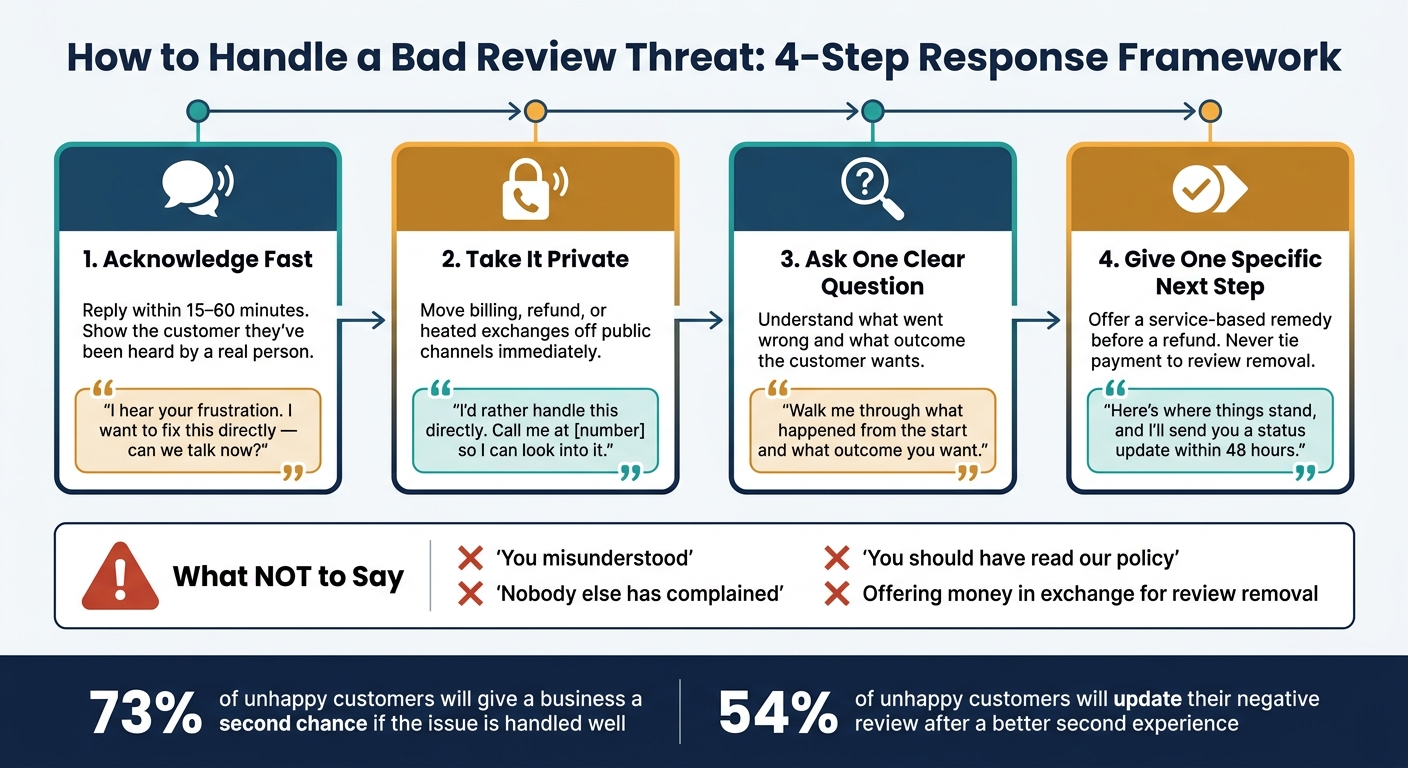
How to Handle a Bad Review Threat: 4-Step Response Framework
Your first job is to slow things down, not jump into defense mode. A simple four-part flow works well here: acknowledge what’s happening, take charge of the next move, clarify the issue, then offer one clear next step.
The first line does a lot of heavy lifting. You want the customer to feel heard by a real person, not brushed off with a canned reply. These lines work on the phone, in person, by text, or over email:
After that opener, ask one clarifying question and stop talking: "Walk me through what happened from the start and what outcome you want." [1] Then let the customer speak without interruption until you understand both parts of the problem: what went wrong and how they feel about it.
If the threat comes in writing, reply within 15–60 minutes so the customer knows you saw it. If the review is already live, give it at least an hour before posting a public reply. [1] [6]
A few phrases may feel natural in the moment, but they tend to pour gas on the fire. Skip anything that sounds like you’re correcting the customer, brushing off their experience, or protecting yourself instead of fixing the issue.
Don’t use blame-shifting lines like "You misunderstood," "Nobody else has complained," and "You should have read our policy." [5] Those lines turn the exchange into a fight and make escalation more likely.
Also, never connect money, discounts, or refunds to whether someone posts, edits, or removes a review. That teaches the customer that the threat gets results. [6] [5]
One other mistake is signing off as "The Management" or "The Team." That sounds faceless and corporate. Use a real first name and title, not "The Management" or "The Team", to show personal accountability. [6]
| Response Behavior | Short Description | Likely Impact on Review Outcome |
|---|---|---|
| Acknowledge & Move Offline | Immediate response inviting a private call to resolve the root cause. | High - review often updated or never posted. |
| Non-Monetary Remedy | Expedited service or a prioritized fix instead of a refund. | High - fixes the relationship without rewarding the threat. |
| Public Argument | Correcting the customer's facts point-by-point in a public forum. | Very low - usually entrenches anger. |
| Immediate Refund Offer | Offering money the moment a review is threatened. | Mixed - may stop the post short-term, encourages repeat behavior. |
| Defensive Denial | Telling the customer they're overreacting or that nobody else complains. | Near zero - almost guarantees a 1-star post. |
The pattern that lowers review risk is pretty simple: respond fast, move the conversation to a private channel, and lead with one specific next step instead of a refund. When a problem gets handled well, 73% of unhappy customers will give a business a second chance, and 54% will update their negative rating and review to reflect a better second experience. [2]
Once the tone is right, you can adjust the wording to fit the type of dispute in front of you.
Use the same calm framework, but adjust the wording to fit the issue in front of you.
When money is the flashpoint, separate the complaint from the demand for payment, free work, or a refund. A simple line works well here: "I see the discrepancy you're mentioning. I want to review the original estimate against the final invoice personally. Can we talk at 2:15 p.m.?"
If someone asks for free work or a refund in exchange for staying quiet, treat that as review extortion. Save the exact wording, then report it through the review platform and the FTC at ReportFraud.ftc.gov.
If a partial adjustment makes sense, present it as a goodwill gesture while also stating your policy at the same time. Keep those two points together. What you should not do is tie any payment to review removal. Don't trade money for review silence. It can invite the same threat again.
Sometimes the money issue isn't the main issue at all. It may just be frustration about delays or service. In that case, use a different script.
When someone waited too long or a project missed its deadline, they often feel brushed aside. That feeling matters. Use direct language like "I dropped the ball" or "I'll personally handle this." Skip lines like "We're short-staffed", "We got slammed," and "We'll look into it." Those phrases tend to sound like distance, not ownership.
Try this instead: "We're sorry your appointment started late and that our communication made the situation more frustrating. Please contact me at [phone] so we can review what happened."
Then give one clear next step. For example: "Here's where the project stands right now, and I'll send you a status note within 48 hours."
If a fix makes sense, start with service-based remedies before offering a discount. In many cases, expedited service or a prioritized fix does more than money ever could.
If the problem is less about timing and more about how something was said or understood, shift to the language below.
Even when the facts are in dispute, the person's reaction is still real. Start by owning the communication miss: "You're right - we should have explained [X] before we finished. I'd like to go through those details with you now."
Then confirm the gap in plain terms: "You expected [X], but got [Y]. Did I miss anything?" That one line can lower the temperature fast because it shows you're trying to understand, not argue.
If the complaint is about staff tone, say: "I'm sorry you felt dismissed, rushed, or talked down to. That isn't the experience we want to provide, and I'd like to hear more so I can address it with my staff personally."
After you've acknowledged the issue, document what was said and move the discussion offline.
After you acknowledge the complaint, take the rest of the exchange offline. The rule is simple: do it as soon as the issue touches billing, private details, refunds, approvals, or a heated back-and-forth. A private conversation takes away the audience and helps cool things down.
Keep the invitation clear and accountable: "I'd rather handle this directly. Call me at [direct number] so I can look into it."
| Situation | Why Move Offline |
|---|---|
| Billing or refund dispute | Protects financial privacy and stops a public negotiation over rates |
| Repeated back-and-forth | Removes the audience and lowers the emotional temperature |
| Large-ticket job | Gives you time to review the details in private |
| Needs approval | Stops front-line staff from making promises they can't keep |
| Legal, safety, or identity concerns | Avoids public statements that could be used in a liability claim |
If the threat includes payment demands, document it and report it right away.
As soon as the conversation moves private, save the record. Screenshot every threat right away and log the date, time, platform, and exact wording. If the threat happens by phone or in person, write a short note as soon as the conversation ends.
At the same time, gather your internal records:
If a staff member was involved, get their account while the details are still fresh. That record helps protect your side of the story and supports a platform report. Among businesses that reported review extortion with documented communication evidence, 67% had the fraudulent review removed within 30 days across Google and Yelp combined. [4]
If a customer demands money or free services to avoid a bad review, treat it as extortion. Report it through Google Business Profile using the most specific violation category available, and file with ReportFraud.ftc.gov. If a dollar amount was demanded, also file with ic3.gov. [4] [7]
Once you've handled the first conversation, the next step is simple: fix the process that caused the problem.
If the same issue keeps setting people off, the problem usually isn't the response. It's the system behind it.
Use written scopes, reminders, and change alerts so expectations stay clear from the start. Send delay updates before the customer has to chase you down. Make refund and cancellation policies easy to find. A post-service check-in also helps because it gives people a private place to speak up before they post in public.
It also helps to train staff on one steady script for upset customers. That way, people don't wing it in tense moments. Pair that with a simple escalation rule so the right person steps in right away when a complaint needs more attention.
Once the process is in place, use simple monitoring tools to catch problems early.
Fast responses can stop a small issue from turning into a public mess. Turn on Google Business Profile email notifications so new reviews land in your inbox within the hour. [6]
For repeat issues, a CRM can help you log escalated interactions, tag closed issues, and follow up for 90 days to spot patterns. [1][6] That gives you a clearer view of what keeps going wrong instead of treating each complaint like a one-off.
A weekly review meeting can also help. It gives your team a set time to flag repeat complaints and update your SOPs before the same problems show up again. [6][3]
Clear systems reduce complaints, speed up recovery, and keep problems off Google.
If they do, respond in a calm, professional way to protect your reputation. Acknowledge their frustration, avoid arguing, don’t share internal details, and invite them to contact you in private so you can sort it out.
If you can’t match them to a visit, say that plainly and welcome direct contact. If the review breaks Google’s policies, report it. After you resolve the issue, you can politely ask whether they’d be open to updating the review - but never offer compensation.
Usually, yes.
Start with a calm, professional public reply. That shows you’re paying attention and ready to help. Keep it short, acknowledge the complaint, and invite the customer to continue the conversation by email or phone.
There are two exceptions:
A bad review threat turns into extortion when someone asks for money, free products, or services in return for posting, removing, or changing a negative review. That’s very different from a frustrated customer sharing honest feedback.
If this happens, do not negotiate or pay. Save the threat, report it through your Google Business Profile and the FTC, and contact law enforcement if it looks criminal.
Discover strategies to elevate your business.