There is no fixed Google review number that puts you at the top. What matters most is how your profile compares with the businesses already ranking in your city and category.
If I had to boil the whole article down, it would be this:
Here’s the short answer: I don’t need “the most” reviews. I need enough reviews to match or beat the local leaders, plus a steady flow of new ones. In many cases, the first 20–50 reviews do the most work, and after that, review age and activity can matter more.
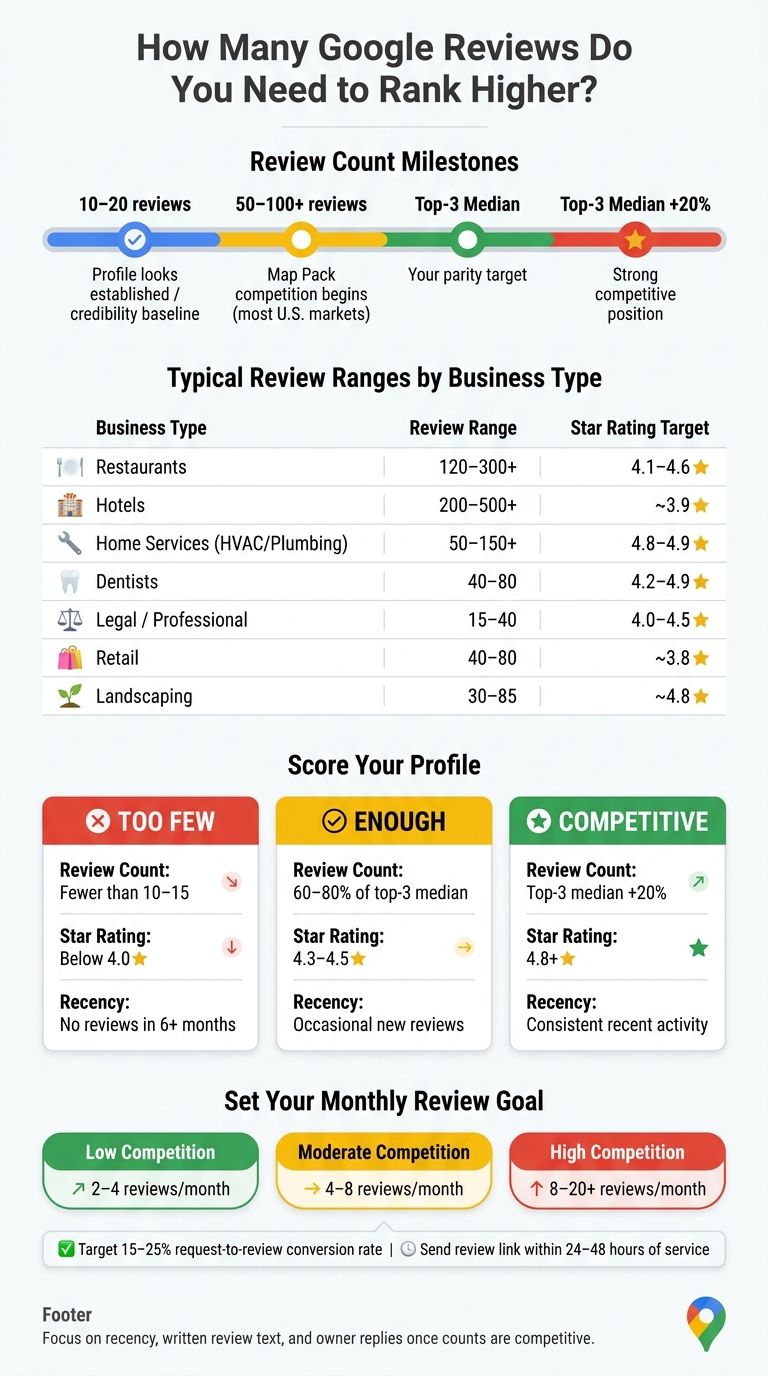
| Benchmark | What it means |
|---|---|
| 10–20 reviews | My profile stops looking thin |
| 50–100+ reviews | Common starting point for Map Pack competition |
| Top-3 median | My parity target |
| Top-3 median + 20% | A strong goal if I want to move ahead |
| Last 90 days | The review window I should watch closely |
| 15%–25% | A solid request-to-review conversion range |
So if I want a simple plan, I’d do this: check the top 3 map results, compare review count, star rating, and newest review date, set a monthly goal from the gap, and ask every happy customer within 24–48 hours.
That’s the whole playbook in plain English.
How Many Google Reviews Do You Need to Rank? Benchmarks by Business Type & Market
Review count doesn't work like a cheat code. There isn't one perfect number that flips your profile from invisible to dominant.
Still, there are clear checkpoints.
Your first 10–20 reviews help establish credibility [3][6][7]. That’s the point where people stop seeing a bare profile and start seeing a business that looks active and trusted. But being credible and being competitive are two different things.
The next step is Map Pack visibility. In most small-to-mid-sized U.S. markets, you generally need 50–100+ reviews to have a realistic shot at competing for a place in the Google Map Pack [3][6][7]. That’s the starting line, not a promise of rankings. In major metros, the bar is usually higher, with businesses often needing 1.5x to 2x more reviews than those in rural areas [8].
A smarter benchmark is simple: look at the review count of the #10-ranked business in your city [1]. If your profile sits below that number, you're probably still on the outside looking in.
Not every business needs the same number of reviews. A restaurant might see dozens of customers a day, while a lawyer or dentist has far fewer chances to ask for feedback. That changes the target.
| Category | Common Review Range | Rating Expectation |
|---|---|---|
| Restaurants | 120–300+ | 4.1–4.6★ |
| Hotels | 200–500+ | ~3.9★ |
| Home Services (HVAC/Plumbing) | 50–150+ | 4.8–4.9★ |
| Dentists | 40–80 | 4.2–4.9★ |
| Legal / Professional Services | 15–40 | 4.0–4.5★ |
| Retail | 40–80 | ~3.8★ |
| Landscaping | 30–85 | ~4.8★ |
If your review count falls short of these ranges, the job is pretty straightforward: close the gap with a steady flow of new reviews.
The first 20–50 reviews usually drive the biggest ranking gains [2]. After that, the effect starts to level off. In plain English, going from 5 reviews to 35 can change a lot. Going from 135 to 165 often won't.
Once your profile is in line with the top three competitors, piling on more reviews tends to matter less than recency and response activity [2][6][7].
When businesses are close on review count, the small things start to decide who stands out: newer reviews, better detail in those reviews, and thoughtful owner responses.
Use the top three Map Pack results in your city as the benchmark. The gap between your profile and those three tells you if you're behind, roughly even, or out front.
Open an incognito tab, search for your main service plus your city, and note each competitor's:
Then calculate the median review count across those three listings. That median is your parity target. If you want to move past the pack, aim for 20% above that number.
Start with review count. If counts are close, use rating and recency as the tiebreakers. This table gives you a fast read on where your profile stands:
| Status | Review Count | Star Rating | Recency |
|---|---|---|---|
| Too Few | Fewer than 10–15 reviews [6] | Below 4.0 stars [10] | No reviews in 6+ months [2] |
| Enough | 60–80% of top-3 median [2] | 4.3–4.5 stars [9] | Occasional new reviews [5] |
| Competitive | Top-3 median + 20% [2][6] | 4.8+ stars [1] | Consistent recent activity [10] |
When counts are close, recency often decides the outcome. You might have more reviews overall, but if the newest one is months old, the issue isn't volume. It's freshness.
"A business with 50 reviews, all received within the last 6 months, often outranks a business with 200 reviews where the most recent was 14 months ago." - Kevin Reed, Author, Flento [2]
If your rating is below 4.3, fix service issues and your response process for negative reviews before pushing for more volume [1][5].
And if your review count is close to the leaders but you still lag behind, the next things to check are review quality, recency, and how often you respond.
If your review count is close to your competitors, these signals often decide who shows up higher.
Newer reviews tell Google your business is still active. Reviews from the last 90 days tend to carry more weight, while older ones fade over time [5][2]. That’s why a steady stream usually works better than a big spike once or twice a year.
A consistent pace also looks more natural and can help you avoid review filtering [3][10][6]. For many low-competition service businesses, 2–5 reviews per month is a solid rhythm. In tougher city markets, 8–20+ per month can make more sense [2].
"A contractor with 30 reviews and 10 of them in the last 90 days will frequently outrank a competitor with 150 reviews and none in the past 18 months." - RepuClinic [5]
A star-only review doesn’t give Google much to work with. But when a customer says something like "they fixed my furnace fast and the technician explained everything", Google gets useful context. That can help connect your profile to searches like "furnace repair" or "HVAC service" in your area [2][6][10].
That’s where relevance comes in. A written review can support it in a way a plain star rating can’t.
There’s also the trust factor. Ratings in the 4.2–4.9 range often look more believable than a perfect 5.0 [10][4]. So if your rating is already in good shape, it often makes more sense to focus on written reviews and a steady review pace than to chase a tiny bump in your average.
Written detail helps relevance. Responses show trust and activity.
Replying to reviews shows that your business is active, and that can support prominence [5]. It can also help turn more profile views into leads. Businesses that respond to every review can see conversions lift by 16.4% [4].
The good news? You don’t need long, stiff replies. Short and specific is better. For example, "Thanks, Maria - glad the water heater install went smoothly. Appreciate you taking the time." feels human and useful. A plain "Thank you for your feedback!" doesn’t say much.
Quantity gets you close. Recency, detail, and responses help keep you there.
That makes the next step simple: turn those signals into a steady review process.
Once you know your local benchmark, turn that number into a review process you can repeat month after month.
Keep it simple. Ask every eligible customer using the same optional request. Then send the review link by text within 24–48 hours of the job.
That timing matters. Wait too long, and the job is no longer top of mind. Send it while the experience is still fresh, and you're far more likely to get a response.
The aim here isn't a big spike of reviews all at once. It's a steady flow of new reviews over time.
Once your request process is set, turn your review gap into a monthly goal.
Take your current review count and compare it to the top-3 median in your market. Subtract your count from that number, then divide the gap by your target time frame to set your monthly pace [2].
Here’s the rough range:
This gives you a goal that fits your market instead of a random number pulled out of thin air.
If you don't track requests, follow-up tends to slip.
Use a spreadsheet or a simple CRM to log:
A 15%–25% request-to-review rate is a good mark [4]. If you're below that range, your process likely needs a tweak. Maybe the timing is off. Maybe the message is too vague. Maybe customers aren't getting the link at the right moment.
Track requests every week and adjust if your response rate falls below 15%–25%.
Yes. You can rank with fewer reviews than competitors because Google looks at a mix of signals, not just the total number of reviews.
In many cases, rating, review recency, and a steady flow of new reviews matter more than raw volume. A business with strong ratings and fresh activity can outrank one with more reviews but a lower rating or a stale profile.
Ask for reviews on a steady schedule. Don’t do it in random bursts. Make it part of your day-to-day process.
The best time to ask is right at the point of service or within 24 to 48 hours after the job is done. That’s usually when the experience is still fresh and the customer is most likely to respond.
For most local businesses, a good target is 8 to 15 new reviews per month. If you run a higher-volume business, you may need 20 to 40. The key is to keep requests consistent, because sharp jumps in review activity can trigger Google’s spam filters.
If your star rating is below 4.3, ranking gets tougher and conversions often slip. The first move isn't getting more reviews. It's fixing the service problems that caused the bad feedback in the first place.
Once service quality is better, you can estimate how many 5-star reviews you need with this formula:
current review count × (target rating − current rating) ÷ (5 − target rating)
Then ask for feedback on a steady basis. Just don't use review gating or other illegal tactics.
Discover strategies to elevate your business.