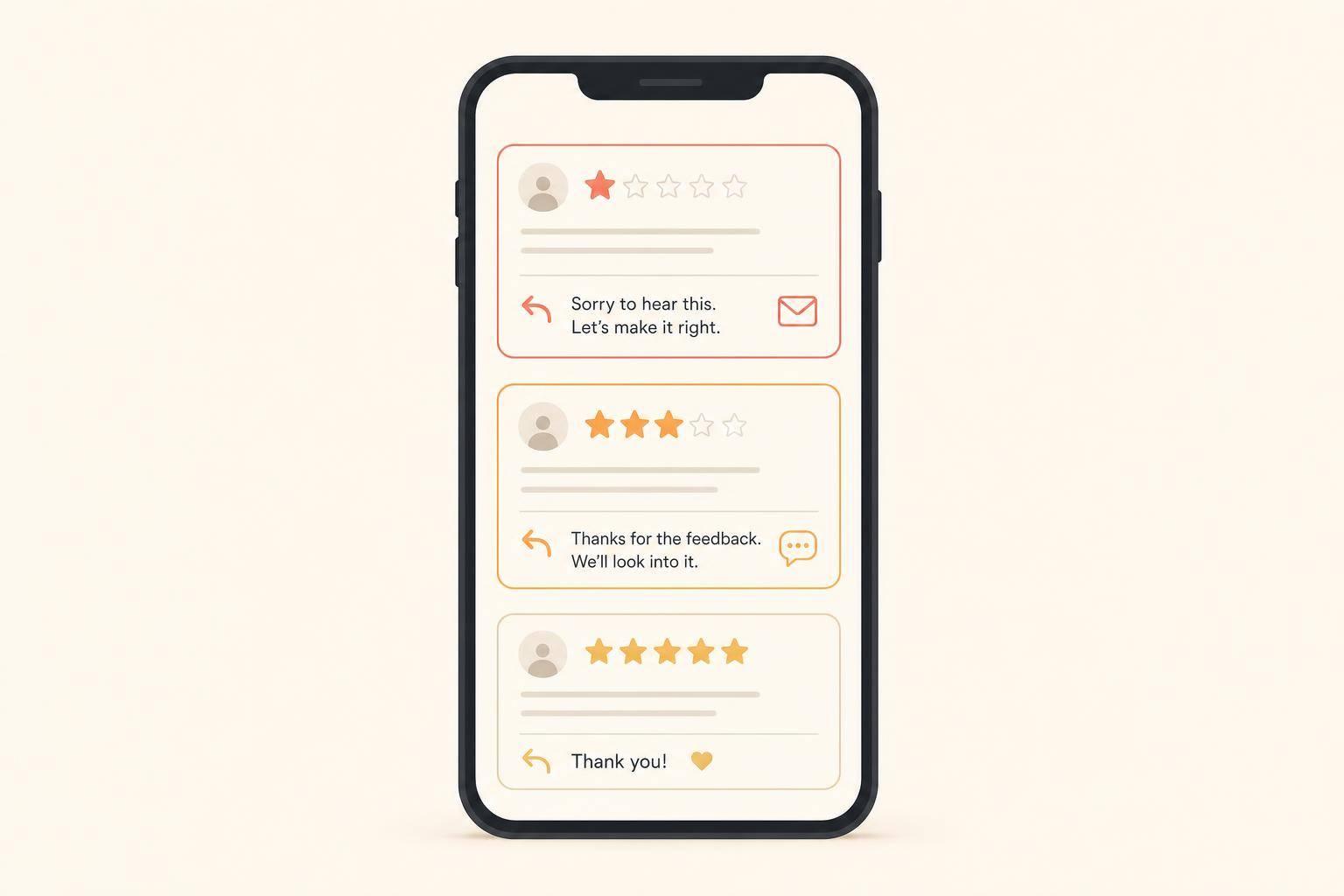
Yes - replying to reviews can bring in more customers, mostly by improving trust and driving more calls, clicks, bookings, and direction requests. It usually does not lead to big ranking gains. But it can change what people do when they land on your Google Business Profile.
Here’s the short version:
If I had to boil the article down to one simple takeaway, it would be this: replying to reviews is worth the time when it helps more people contact you. For most local businesses, that means focusing on Google reviews first, answering 1-star and 2-star reviews fast, and tracking results for 8–12 weeks.
What this article covers:
In other words: this isn’t about replying just to “look active.” It’s about whether those replies lead to more customer action.
How Review Responses Impact Local Business Revenue & Customer Behavior
The numbers here are hard to brush off.
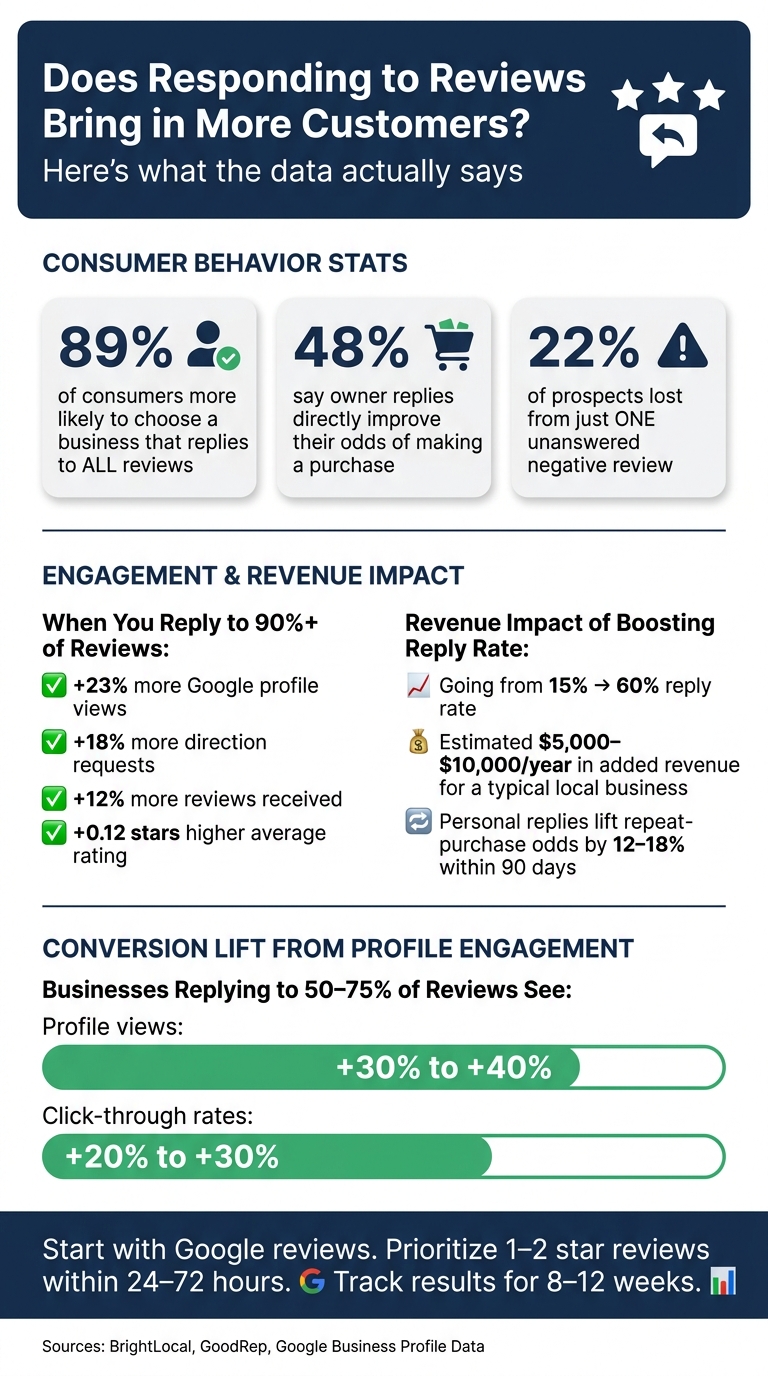
89% of consumers are more likely to choose a business that responds to all of its reviews [7]. On top of that, 48% say that seeing owner replies directly improves their odds of making a purchase [7]. That goes past a simple preference. It's a buying signal.
There's money tied to this too. Moving a response rate from 15% to 60% is linked to an estimated $5,000 to $10,000 in annual revenue lift for a typical local business [5]. Businesses that reply to 90% or more of their reviews also get 23% more Google profile views and 18% more direction requests than businesses replying to fewer than half [7]. More profile views and direction requests usually mean one thing: stronger intent.
Replying on a steady basis is also linked to 12% more reviews and a 0.12-star higher average rating [7]. Those may look like small jumps at first glance. But when a customer is choosing between two businesses with similar ratings, even a slight edge can tip the decision.
That same pattern shows up inside Google Business Profile.
When people compare two businesses with about the same star rating, the one with recent, specific replies often feels safer to pick. That's even more true when negative reviews are in the mix.
30% to 45% of customers who read a critical review say they're more likely to use the business if the owner responded with care [5]. A calm, direct reply doesn't make the bad review disappear. What it does is show people how the business deals with problems when things go sideways.
"The response isn't just defending the rating. It's converting the negative review into a trust signal." - GoodRep Team [5]
There's also a retention angle. Personal replies lift repeat-purchase odds by 12% to 18% within 90 days [3]. So review responses don't just shape what new prospects think. They can also pull past customers back in.
The next question is where that influence shows up in Search and Maps.
When someone searches for your business by name or spots you in the local pack on Google Maps, your reviews and owner replies show right on the profile. So replies become part of your first impression before a shopper calls, asks for directions, or books.
Google says responding to reviews shows customers that you value their feedback. [2] And a specific reply can remind people what your business actually does when they're weighing a few options side by side. In that moment, visibility matters. It can shape whether someone clicks, calls, or books.
This matters because Google Business Profile is often the last stop before a customer makes a move. At that point, even a little hesitation can cost you. Replies help smooth that out right when the person is ready to act.
Businesses that increase reply rates to 50% to 75% see profile views go up 30% to 40% and click-through rates climb 20% to 30%. [2] Those aren't direct ranking gains. They're engagement gains from a profile that looks active and trustworthy next to competing listings, and each one can push a prospect closer to a call, booking, or direction request.
That's why steady replies can be such a simple way to stand out with a local SEO strategy. The next question is whether the payoff is worth the time.
Start with Google reviews. They're the reviews people see in Search and Maps before they call, visit, or book.
Negative reviews should be first in line. One unanswered negative review on the first page of your profile can turn away about 22% of prospects.[6] Four or more negative reviews can drive away up to 70% of prospects.[6] Even so, only 9.8% of 1-star reviews ever get a public reply, compared with 29.3% of 5-star reviews.[4]
For most small businesses, this order makes sense:
| Priority | Review Type | Target Response Time |
|---|---|---|
| Critical | New 1–2 star reviews | Within 24–72 hours |
| High | Recent 3-star reviews with questions | Within 72 hours |
| Medium | Recent 4–5 star reviews | Weekly |
| Low | Reviews older than 6 months | Monthly or optional |
Once you've handled the highest-risk reviews, the next job is simple: write replies that help build trust.
Good replies sound human. Use the customer's own wording when it fits, mention the service or product they brought up, and skip clunky keyword stuffing. Nobody wants to read a reply that sounds like it was written for a machine.
Here’s how that can look in two common cases:
Home services (plumbing):
Weak: "Thanks for the kind words!" Strong: "Really glad we could help with your water heater installation. We know how disruptive that kind of issue can be. If anything comes up, don't hesitate to call us directly."
Restaurant:
Weak: "We appreciate your feedback." Strong: "Thanks for mentioning the vegetarian thali - that dish is one of our chef's favorites to prepare. Sorry the wait time was longer than expected on Saturday. We're working on staffing during peak hours and hope to see you again soon."
A good target is 40–120 words. Too short can feel cold. Too long can sound like you're arguing your case.[2][8]
For negative reviews, keep it simple. Acknowledge the issue, say what you're doing about it, and invite the person to continue by phone or email. Don't get pulled into a public back-and-forth. And if the review looks fake or breaks Google's policies, flag it for removal instead of replying to it.[1]
If replies still aren't helping leads, the issue usually isn't the wording by itself. It's often the number of reviews you have, or the mix of good and bad ones.
Replying to reviews is worth it when it changes what customers do next. It helps you manage the reviews you already have. It does not generate new ones.
This work tends to matter most on Google. It matters less on platforms that don't lead to calls or bookings in your industry.[1]
Spam reviews and duplicate reviews you've already reported usually aren't worth your time. Replying to a fake review can put a spotlight on it. Report it, then move on to reviews from actual customers.
If calls, clicks, and bookings don't change after 8–12 weeks, replies probably aren't the bottleneck. At that point, spend less time on responses and more time getting new reviews.
Once replying starts to look worth doing, the next move is simple: make it a habit. Set aside 15 to 30 minutes once a week to respond to reviews. Open your Google Business Profile, then handle the highest-risk reviews first.
To keep things easy, use a short document with a few reply patterns:
Then tailor each response so it sounds personal. That part should take about 90 seconds per reply.[5]
After the routine is set, check whether it changes the actions you care about. Track the customer actions review replies are meant to influence: calls, clicks, directions, and bookings.
Start by writing down a baseline for monthly calls, website clicks, and direction requests. Then watch those same numbers each week in GBP Insights. Pay close attention to Discovery Searches - people who find your business by category instead of by name - along with Profile Actions like calls, clicks, and directions, plus your response rate.[2]
Businesses that respond to 90% or more of their reviews get 23% more Google profile views and 18% more direction requests than businesses that respond to under 50%.[7] That’s a gap worth watching.
Give the process 8 to 12 weeks before you judge the result. During that time, avoid changing other parts of your profile. If you tweak too many things at once, it gets hard to tell whether review replies caused the lift.[1][2]
Replies can keep shaping profile behavior after they go live, so the effect may build over time.
If the numbers go up, keep going. If they don’t, change the process or stop.
Replying to reviews can build trust and increase lead actions over time, even if rankings don’t jump. In most cases, the clearest gains show up in profile engagement - calls, clicks, and direction requests - not dramatic ranking changes. Set a response target that fits your schedule, track your GBP metrics each week, and give it 8 to 12 weeks before you decide whether the work is paying off.[1][2]
Yes. Replies still matter when you only have a handful of reviews, but they don’t take the place of getting more reviews.
If your review profile is thin, your main job is to get more recent, honest feedback. That said, replying to the reviews you already have can still help. It can build trust, improve click-through rates, and show potential customers that your business is active, professional, and accountable.
Reply to every review, not just the unhappy ones. Start with negative and three-star reviews first. That helps you handle risk and protect your reputation. But don’t ignore positive reviews. Those replies build trust and show both customers and Google that your business is active and paying attention.
A simple workflow usually works best:
This approach keeps things moving without turning review management into a daily time sink.
Most business owners start to see measurable gains in local visibility, profile engagement, and leads within 60 to 90 days when they keep their response rate high on a steady basis.
Some signals, like click-through rates and trust, can improve sooner. But it’s smarter to judge results over an 8- to 12-week window, since week-to-week performance can swing based on review volume and competitor activity.
Discover strategies to elevate your business.