Here’s the short answer: when I asked ChatGPT for the best plumber in a city, it usually picked companies that were easier to verify across the web, not just the ones with the most Google reviews.
I found the same pattern again and again. The plumbers that showed up most often had plain-text license numbers, matching business info across sites, reviews on more than one platform, and mentions on third-party lists like Expertise.com. In one cited report, 45% of U.S. consumers used AI to find a local business recommendation in 2026, up from 6% the year before. That means these AI answers can affect who gets the call first.
If you want the main takeaways fast, here they are:
A few examples stood out. Nick’s Plumbing in Houston appeared often because its site showed a license number in plain text and it had third-party mentions. Austin Emergency Plumbers showed up in many emergency searches. Meanwhile, some plumbers with solid customer feedback were left out because their web footprint was thin or split across different business names.
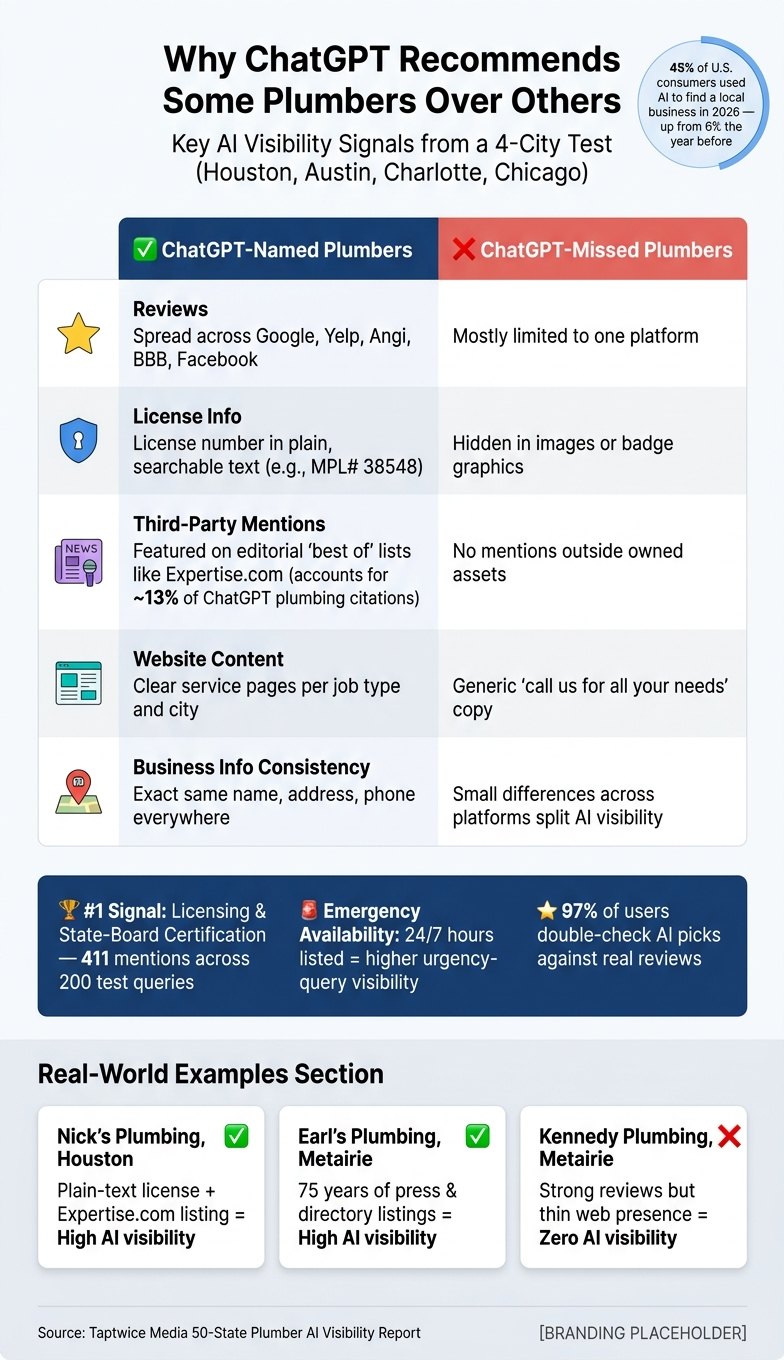
Why ChatGPT Recommends Some Plumbers Over Others: Key Visibility Signals
| Signal | Plumbers ChatGPT Named More Often | Plumbers ChatGPT Missed More Often |
|---|---|---|
| Reviews | Spread across Google, Yelp, Angi, BBB, Facebook | Mostly limited to one site |
| License info | Written in plain text | Hidden in images or not easy to find |
| Citations | Listed on directories and “best of” pages | Few outside mentions |
| Website pages | Clear pages for each service and city | Generic service copy |
| Business info | Same name, address, and phone everywhere | Small differences across platforms |
Bottom line: if AI can’t confirm the same business details in several places, it is less likely to mention that company. That was the main result of my test, and it points to a simple fix list for local plumbing companies.
I used the same plumber prompt several times across different cities, then checked which businesses showed up and what seemed to be driving those picks.
Each prompt was run at least three times because ChatGPT can return different businesses from one run to the next. I tested headline, urgency, hyper-local, trust, and specialty prompts in Houston, Austin, Charlotte, and Chicago.
| Prompt Type | Example Used | What It Tests |
|---|---|---|
| Headline | "Best plumber in Charlotte" | Broad market authority |
| Urgency | "Emergency plumber open now in Charlotte" | GBP hours and 24/7 attributes |
| Hyper-local | "Plumber near me in South End Charlotte" | Neighborhood-level signals and proximity |
| Specialty | "Plumber for tankless water heater install in Charlotte" | Service-specific content depth |
| Trust | "Who is the most trusted plumber in Charlotte?" | Review sentiment and third-party mentions |
For each response, I tracked three things:
Researchers also logged any source URLs the AI cited. After that, I matched those business names against the local signals that usually shape visibility.
Once the responses were recorded, I compared each business against its Google profile, reviews, website, and citations. Then I checked each answer against the signals Google and AI models tend to trust.
That included Google Business Profile completeness, reviews, hours, and emergency attributes across Google, Yelp, and Angi. I also looked at whether the business website had clear city or service-area pages and whether license numbers were listed on the site.
Source consistency mattered too. Businesses were also checked against best-of lists, trade directories like the PHCC contractor directory, and local citations to see if ChatGPT kept leaning on the same sources. A 50-state research report by Taptwice Media found that Expertise.com accounts for roughly 13% of ChatGPT's plumbing citations. [7]
ChatGPT leaned toward plumbers with proof across the web, not simply the ones with the biggest pile of Google reviews. A few signals showed up again and again.
In Houston, Nick's Plumbing appeared more than once - not because it had the most reviews, but because it was listed on Expertise.com's "Best Plumbers" page and showed its Master Plumber license number, MPL# 38548, in plain text on its site. Santhoff Plumbing also came up often, helped by its veteran-owned positioning and strong ratings across Google, Facebook, and Angi. [1]
In Austin, Austin Emergency Plumbers showed up in 75% of emergency-query responses, and Reliant Plumbing appeared in about 50%. The same kind of pattern showed up in the other test cities too.
What does that tell us? ChatGPT tends to trust a business more when it can verify the same story in more than one place. That usually means:
That last point matters more than many businesses think. An editorial "best of" list can carry more weight than a company's own sales copy. You can see that in the comparison below.
The businesses ChatGPT named shared a tight group of visible trust signals. The table below shows how they differed from similar local plumbers that didn't get mentioned.
| Visibility Factor | ChatGPT-Named Plumbers | Plumbers ChatGPT Skipped |
|---|---|---|
| Review Footprint | Spread across Angi, Yelp, BBB, and Facebook | Concentrated almost entirely on Google Reviews |
| License Display | License number in plain text | "Licensed & Insured" badge or license buried in a logo |
| Third-Party Mentions | Featured on editorial "best of" lists like Expertise.com | No mentions outside of owned assets |
| Website Content | Clear service pages and service details | Generic "call us for all your needs" copy |
| Structured Data | Current schema markup | No structured data or outdated schema |
The takeaway is pretty simple: ChatGPT favors businesses that are easy to verify across several sources. In Taptwice Media's 50-state report, licensing and state-board certification ranked as the top visibility signal, with 411 mentions across 200 test queries. Review volume came next, followed by 24/7 emergency availability. [7]
The businesses ChatGPT picked matter. But the ones it missed tell you just as much.
ChatGPT doesn't read Google Maps live. Instead, it builds answers from third-party listings, editorial roundups, and directories.[1][5]
That creates a clear pattern: plumbers with strong ratings but a weak web trail often get left out. In a March 2026 audit of Metairie, Louisiana, Kennedy Plumbing didn't appear in ChatGPT results even though it had strong customer reviews for same-day service. Earl's Plumbing, which was established in 1949, kept showing up because 75 years of press mentions and directory listings gave AI models a much deeper source trail to pull from.[4]
Urgent searches can add another problem. A prompt about immediate help may bring up old phone numbers or outdated hours from unclaimed profiles, which means a business can get recommended based on stale details instead of current ones.[3]
Business name changes can also muddy the waters. If a company appears as "Abacus Plumbing" on Google but "Abacus Plumbing, Air Conditioning & Electrical" on Angi, ChatGPT may read those as two separate businesses. When that happens, the authority tied to one company gets split across both names instead of building in one place.[2]
Google Maps tended to reward proximity and a complete GBP. ChatGPT leaned more on corroboration across separate sources.[1][6]
| Company | Google Maps Presence | ChatGPT Visibility | Key Reason for the Gap |
|---|---|---|---|
| Roto-Rooter (Austin) | Strong (National) | Not surfaced | Massive entity graph and national brand mentions [2][4] |
| Nick's Plumbing (Houston) | Strong (Houston) | High | Expertise.com listing plus plain-text license (MPL# 38548) gave AI clear verification signals [1] |
| Kennedy Plumbing (Metairie) | Moderate (Metairie) | None | Thin web presence beyond review platforms [4] |
| Earl's Plumbing (Metairie) | Strong (Metairie) | High | 75 years of press and directory listings created a deep, trustworthy source trail [4] |
| Abacus Plumbing (Austin) | Strong | Fragmented | Name variations across platforms split AI visibility into weaker, separate entities [2] |
Those gaps point straight at the visibility fixes local businesses need next.
These gaps point to a short list of problems you can fix. And those fixes often decide which plumbers ChatGPT mentions and which ones it ignores.
Put your state license number in plain text on your GBP and About page.
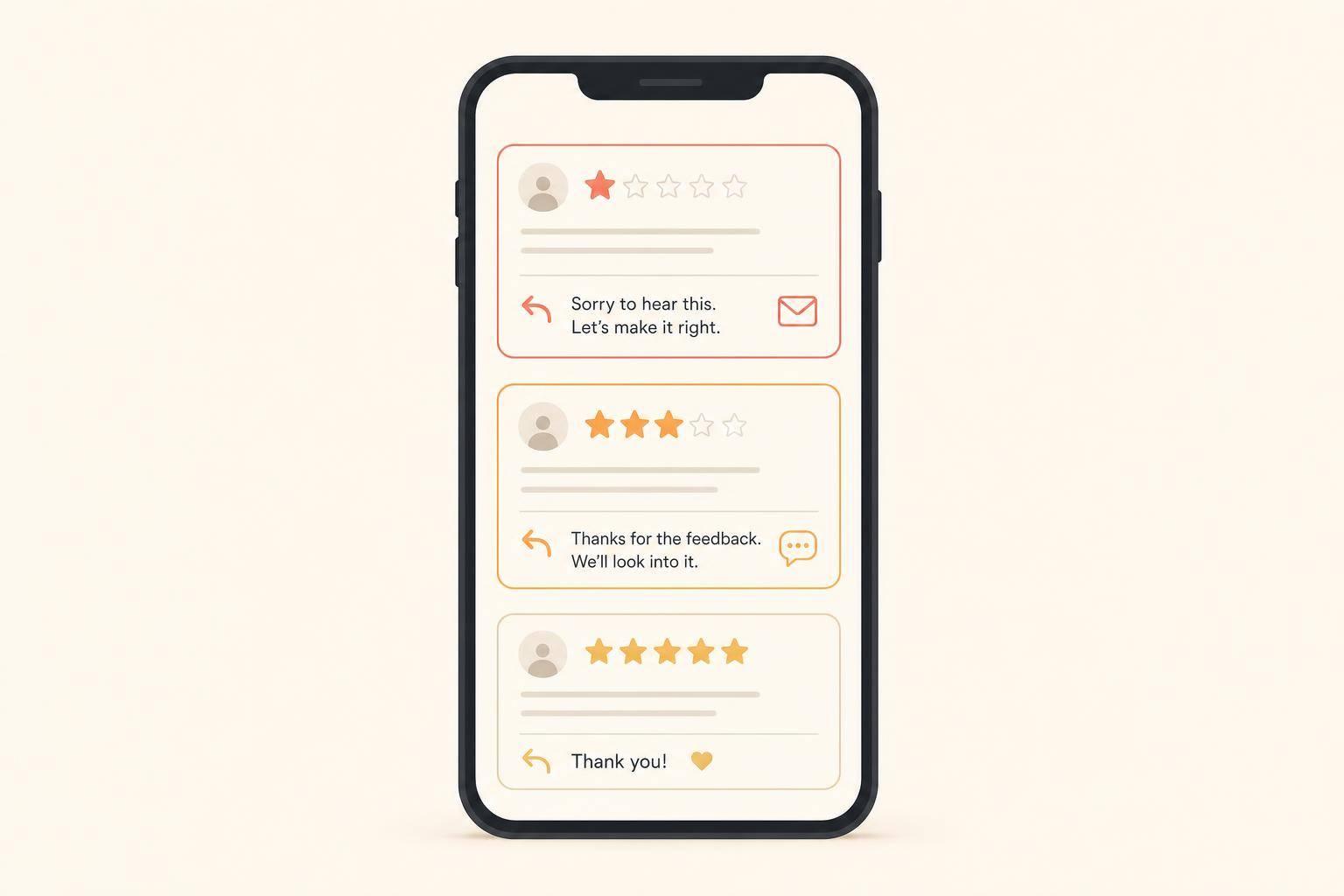
Ask for reviews that mention the exact job. Then reply to every review.
Keep your business name, address, and phone number exactly the same across your GBP, website, Angi, Yelp, and the BBB. Even small differences can split visibility.
Publish pages that answer direct questions, like "Water Heater Replacement Cost in [Your City]".
| Visibility Factor | Why It Matters | Action Steps | In-House? | Tools / Support |
|---|---|---|---|---|
| GBP Completeness | Feeds Google's AI results; hours, photos, services, and service-area data [5] | Verify every field; set the primary category to Plumber; add every specific service; keep hours and emergency attributes current; upload recent job photos | Yes | CRM |
| Reviews & Owner Responses | 97% of users double-check AI picks against real reviews [9]; review text drives AI matching | Ask customers to name the specific job; respond to every review | Yes | Review management tool |
| Website Authority & Schema | Structured data helps AI read your credentials, services, and location as facts [8] | Add LocalBusiness and Plumber JSON-LD schema, including availableService and hasCredential; publish job-specific pages with direct answers near the top |
SEO Specialist | Analytics dashboard |
| Local Citations | Seven of the top twelve AI citation sources are directories like Angi, Yelp, and Expertise.com [7] | Claim and fully complete profiles on Angi, Yelp, BBB, and Expertise.com; keep NAP identical across all profiles | Specialist | SEO support |
| Service and Cost Pages | Specific job and cost pages give AI a direct answer it can use to match user queries [1] | Create pages for common jobs with real price ranges and city or neighborhood references | Yes / Specialist | SEO support |
These fixes matter for a simple reason: AI can only recommend what it can verify.
Businesses like Nick's Plumbing and Earl's Plumbing showed up because they were easier for AI to read and confirm. Their licensing data was consistent. Their reviews used job-specific language. Their directory profiles were complete. And their websites had pages tied to actual services people search for.
That gives AI more signals to work with and more reason to name them. In plain English, GBP completeness, reviews, citations, and service pages now shape whether a plumber appears in AI recommendations.
ChatGPT may skip highly rated plumbers because it doesn't look at Google reviews or star ratings alone. It checks for matching signals across sites like Yelp, Angi, HomeAdvisor, BBB, and local listicles.
That means a business can have strong Google ratings and still get passed over if the rest of its web presence looks thin, messy, or out of date.
It may also skip businesses with:
Make your business easy to verify across public sources. Keep your business name, address, phone number, and service area the same on your website, Google Business Profile, and major directories. Those profiles should be complete, up to date, and easy to check at a glance.
On your website, use clear plain text for your services, pricing or cost ranges, and license number. Add LocalBusiness and FAQ schema too. And keep earning recent reviews across platforms.
No. ChatGPT does not use Google Maps rankings to choose plumbers.
Instead, it uses a separate data pipeline and looks for businesses that show up consistently across sources like Yelp, Angi, Foursquare, directory lists, and community threads.
That creates a gap a lot of people miss: a plumber can rank #1 on Google Maps and still not appear in ChatGPT if its off-site presence is weak or inconsistent.
Discover strategies to elevate your business.