More reviews do not mean higher Google Maps rankings. If a competitor ranks above you with fewer reviews, Google usually sees them as a better match for the search, closer to the searcher, or stronger across profile and website signals.
Here’s the short answer:
What I’d check first:
A common pattern is simple: one business has more reviews overall, while the other has a better category match, newer reviews, and cleaner business data. In that case, the second business often wins.
| Factor | Why it can beat review count |
|---|---|
| Primary category | Tells Google what the business does |
| Distance | Helps decide local results fast |
| Recent reviews | Show current activity |
| Profile completeness | Gives Google more detail to rank |
| NAP consistency | Reduces data conflicts across the web |
| Website support | Confirms services, city, and business details |
Bottom line: if you want to close the gap, fix category fit first, then review recency, then website and citation issues. That is often where rankings move.
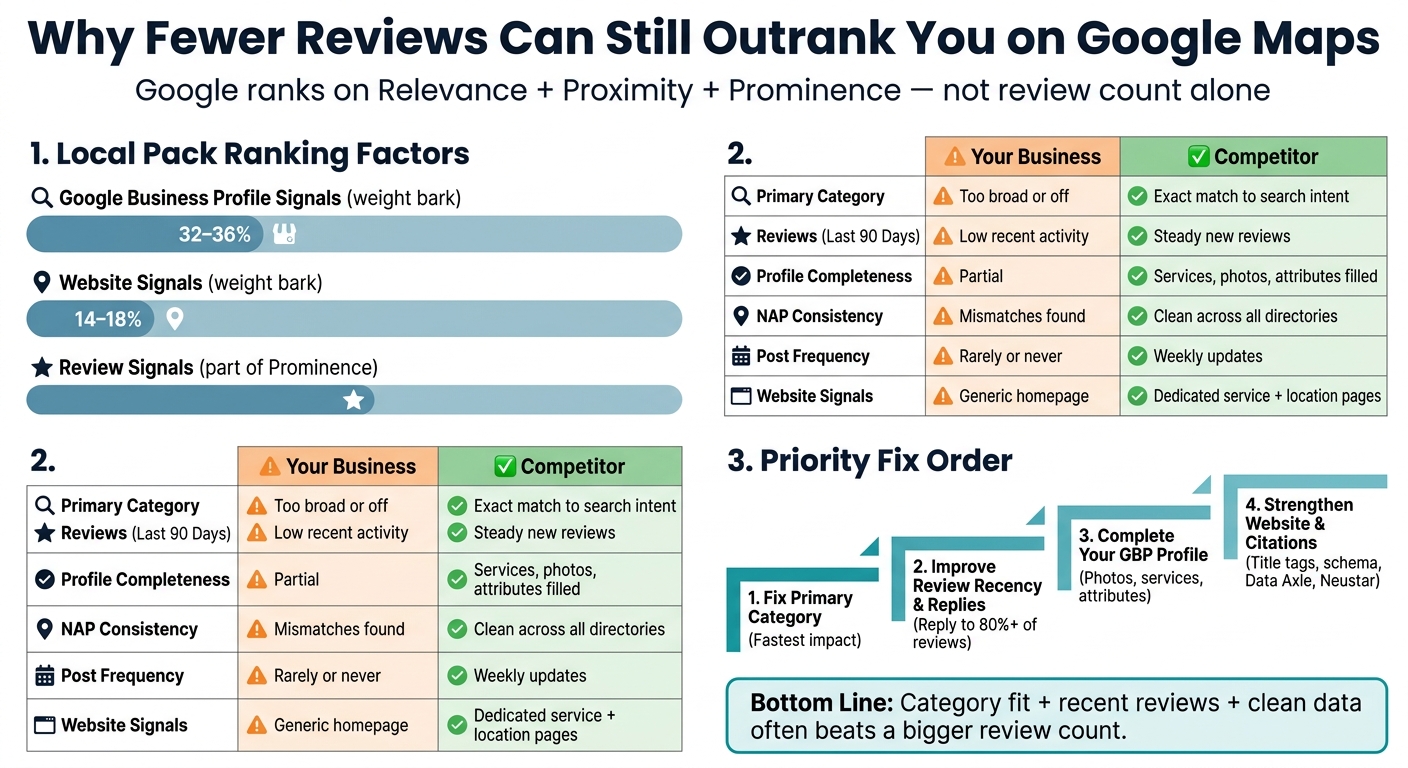
Why Fewer Reviews Can Still Outrank You on Google Maps
If a competitor ranks above you even though they have fewer reviews, start with the most basic check: does Google think they’re a better fit for the search?
Your Google Business Profile primary category is one of Google’s strongest relevance signals. It tells Google what your business does. If that category is too broad or slightly off, it can hold your rankings back without making any noise.
A Scottsdale dental practice moved from position 6 to position 2 in 18 days after changing its primary category to a better match for search intent. [1]
This plays out in all kinds of local markets. An HVAC company using "HVAC Contractor" can lose to a competitor using "Air Conditioning Repair Service" during summer searches. A roofing company tagged as "General Contractor" can lose to one listed as "Roofing Contractor." Small category differences can lead to a big ranking gap.
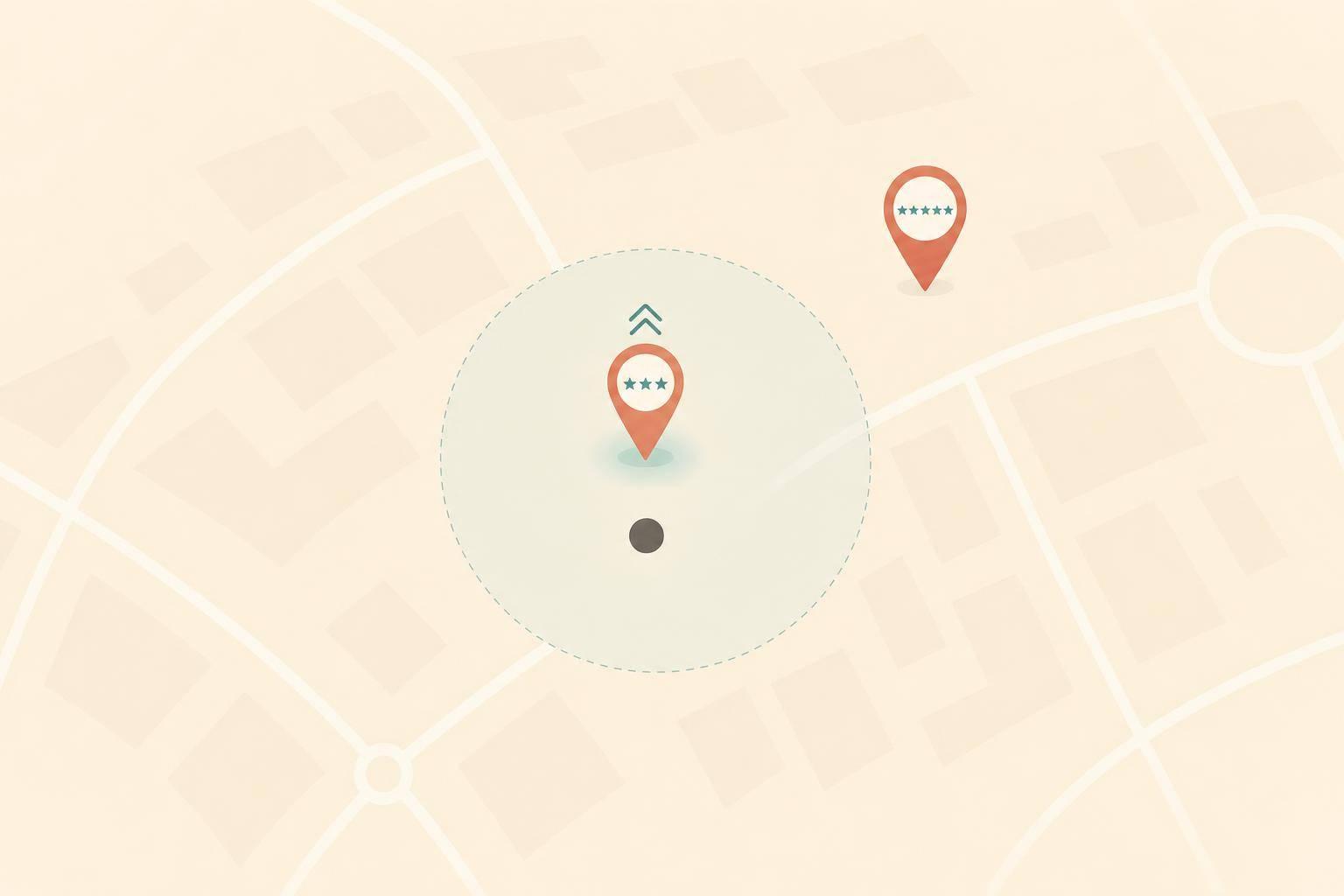
If both businesses are close on category fit, distance often decides the winner. In many cases, proximity beats review count, especially for "near me" searches.
Review count matters, but review freshness often matters more. A business with fewer recent reviews can look stronger than one sitting on a big but old review profile.
Prominence signals matter too. Clean NAP data, citations, and backlinks help build trust. If a competitor has fewer reviews but cleaner and more consistent business info across the web, Google may see them as the safer pick over a business with more reviews and messy listings.
Your website and Google Business Profile need to match. If your phone number, services, or location details don’t line up, rankings can slip.
A strong local website backs up your GBP in two main ways:
Website signals account for roughly 14% to 18% of Local Pack ranking weight [3] - not the biggest piece, but enough to matter when everything else is close.
These are often the hidden reasons a competitor pulls ahead before review count even comes into play.
A manual audit can show the biggest gaps fast. Search your main keyword in an incognito window, note the top 3 Local Pack results, and compare each competitor's primary and secondary categories to yours by opening the listing details. This gives you a clean way to spot which ranking pillar is lagging: relevance, distance, or prominence. The fastest move is simple: put the two listings side by side and compare them.
Use this checklist to compare signals, not just review count. Go through these six areas for both your listing and the competitor's:
| Factor | What to look at |
|---|---|
| Primary category | Does theirs match search intent more closely? |
| Review velocity | Reviews received in the last 90 days |
| Profile completeness | Services, attributes, photos, hours |
| NAP consistency | Name, address, and phone across Yelp, Bing, Apple Maps |
| Post frequency | Weekly vs. monthly vs. none |
| Website signals | Dedicated service or location pages |
Most businesses that get outranked run into one of three issues: a weaker category match, weaker recent engagement, or a proximity disadvantage.
The most common thing an audit turns up is an incorrect or overly broad primary category. That can create a major relevance gap. [1]
Recent activity matters too. A business with a steady flow of new reviews can look stronger than one with a bigger review total that has gone quiet.
And in dense local markets, proximity can beat stronger review counts. [4]
Once you spot the gap, the order of fixes matters. A lot of businesses go straight to asking for more reviews. That feels like the obvious move, but it often isn't the one that gives you the biggest lift. Start with the signal that most clearly separates you from the competitor: category fit, then review freshness, then website trust.
Fix your primary category first. Most ranking gaps start with a weak category match, and GBP signals account for 32–36% of Maps pack ranking determination [3].
After that, tighten up the rest of the profile. Write clear service descriptions for each service and add a large photo set that shows the business as it is. Then point your GBP website link to a specific service page or location page, not your homepage. That sends a much clearer signal.
If your category is already right, move to review recency and profile completeness.
A competitor with fewer reviews can still rank above you if their recent review activity and engagement are better. That's why review count alone doesn't tell the whole story.
Work review requests into your normal post-job routine. Ask customers to mention the service they received and where they got it done. When you reply, naturally work in the service and city name [2]. Responding to 80% or more of your reviews is tied to measurable ranking gains [5], and it also shows Google that the business is active.
If the profile looks strong but the gap is still there, turn to the website and citation signals behind it.
Optimize each page's title tag with this format: Primary Service + City + Business Name [3]. Add LocalBusiness schema and check it with Google's Rich Results Test to make sure it matches your GBP data exactly.
For local links and citations, fix the source first. A Chamber of Commerce membership can give you a strong local backlink [3]. And fix core citations at the source, especially Data Axle and Neustar/Localeze, because errors there can spread into other directories [3].
Once you work through the checklist, the pattern usually starts to show. A competitor with fewer reviews can still rank above you because Google looks at relevance, proximity, and prominence - not review count by itself. Reviews still matter, but category fit and location can beat them.
The next move is pretty simple: find the weakest signal and fix that first. That could be your category, reviews, website, or NAP consistency. The order of priority stays the same: category fit first, then review freshness, then website and citation trust.
Some fixes move faster than others. Category and website updates can have an effect sooner. Reviews and links usually take more time, but they help build strength that lasts.
Top Maps spots usually go to businesses with the best overall mix of signals: a strong profile fit, website support, and a steady flow of recent reviews.
There’s no fixed timeline. It depends on the changes you make and how competitive your local market is.
Google Business Profile updates, like category or service changes, may lead to measurable ranking shifts in 2 to 6 weeks. Review and citation improvements often take 6 to 12 weeks. Broader authority and content gains can take 6 to 12 months.
Yes. Changing your primary category can hurt rankings for a bit, especially if you do it too often. Google needs time to reassess how your business fits that category, and that can lead to a short-term dip.
That said, if your current category is too broad, moving to the most specific and accurate option can help your rankings. In most cases, changes take 2 to 4 weeks to settle, and a better category match often makes up for that temporary drop.
If your reviews already look strong, the gap is often relevance or citation consistency.
Start with your Google Business Profile. Check your category setup and make sure the primary category is the most specific, accurate match for what you do.
Next, line up your website title tags and page content with your service-plus-city keywords. Think along the lines of the exact terms people in your area would search for.
The upside? These are changes you can control directly, and they often start to show results in two to four weeks.
Discover strategies to elevate your business.