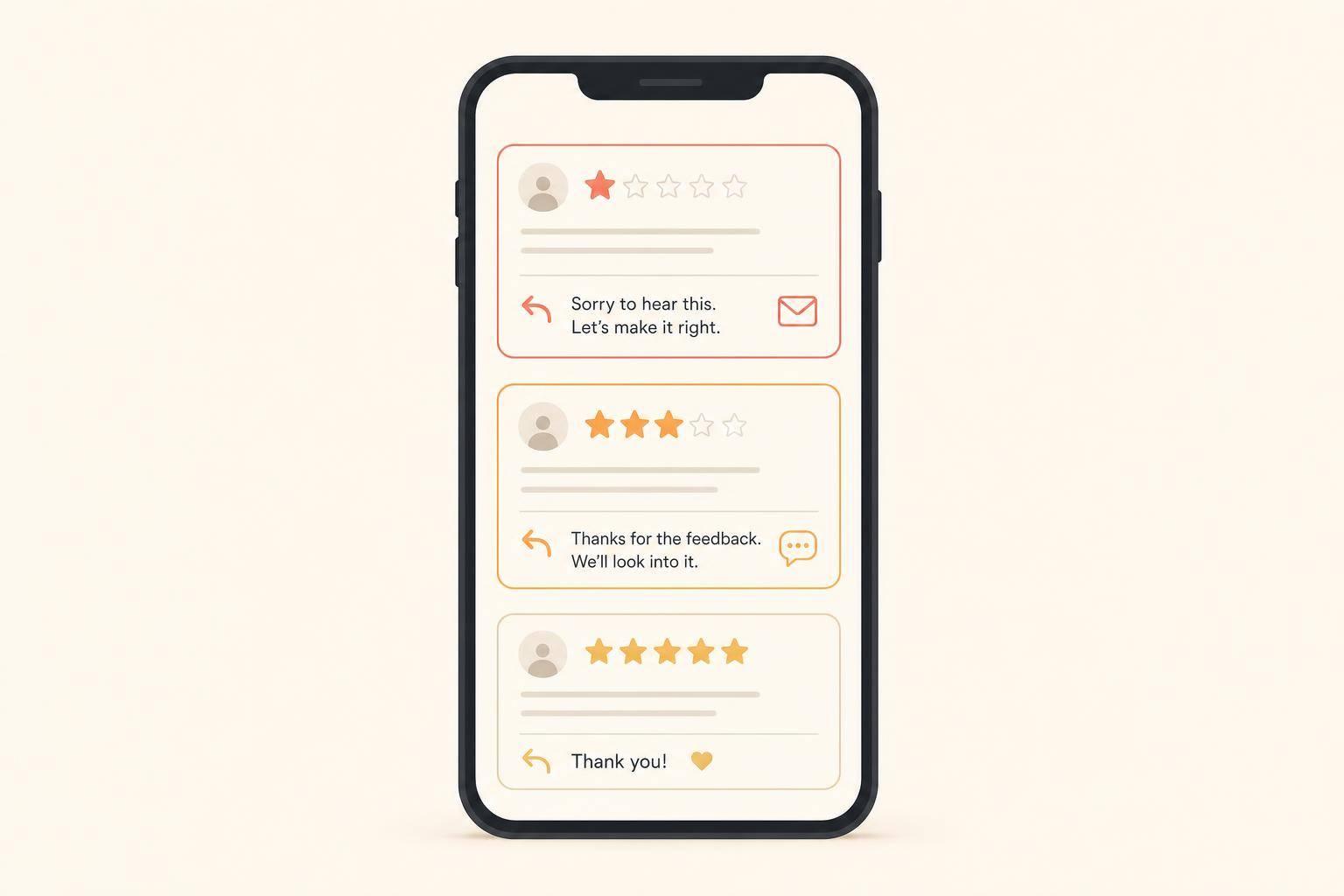
If review management is eating your week, the fix is simple: stop treating every alert like it needs an instant reply. I cut daily rank checks, daily posting, low-value directory checks, and nonstop profile edits. Then I moved review replies into set weekly blocks, checked core metrics once a month, and automated review requests after each sale or job.
Here’s the short version:
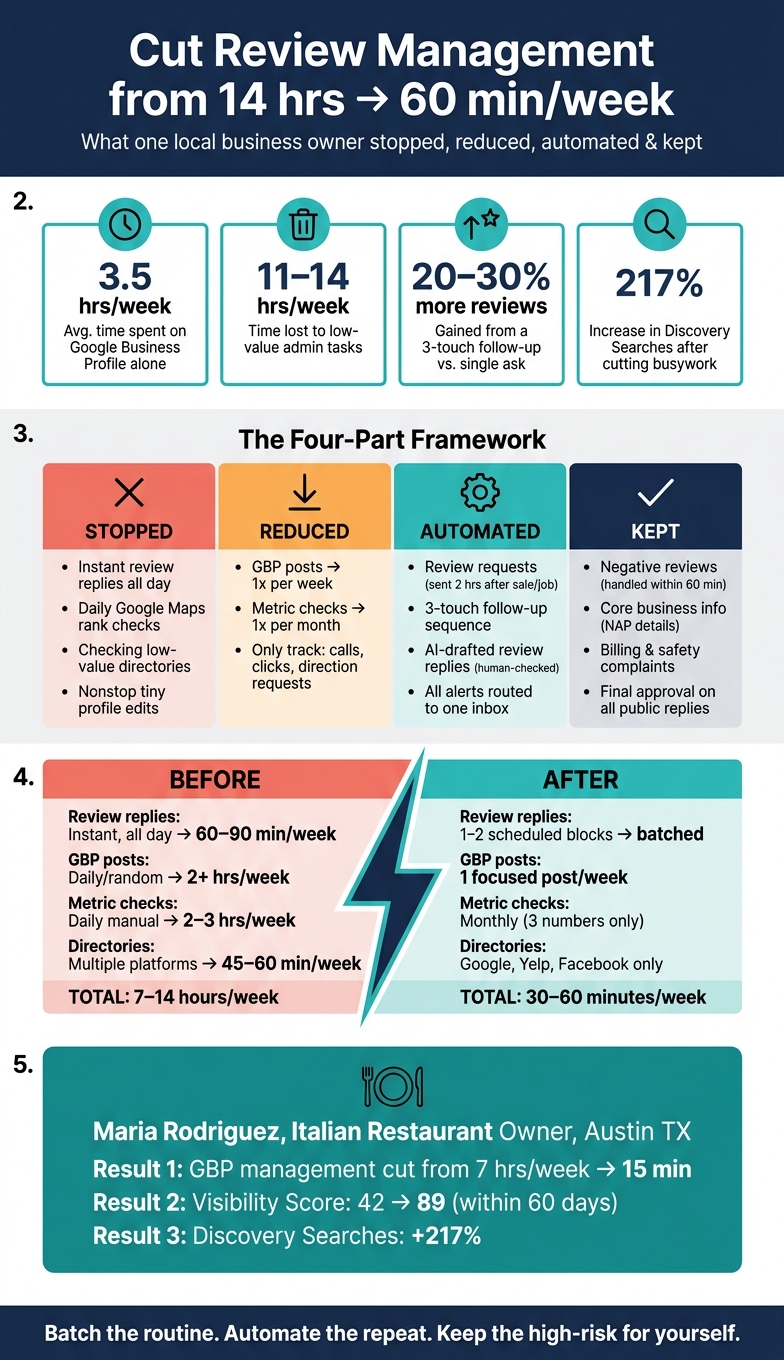
That shift cut review and profile work from 7–14 hours per week to about 30–60 minutes, while still protecting calls, local visibility, and customer trust. In short: batch the routine work, automate the repeat work, and keep the high-risk work for yourself.
A few numbers stand out:
How One Business Owner Cut Review Management from 14 Hours to 60 Minutes Per Week
| What I changed | Old way | New way | What happened |
|---|---|---|---|
| Review replies | Instant replies all day | 1–2 scheduled blocks per week; bad reviews within 24 hours | Fewer interruptions |
| GBP posts | Daily or random posting | 1 post per week | Less time spent |
| Metrics | Daily checking and map searches | Monthly check of calls, clicks, and direction requests | Less noise |
| Review requests | Sent by hand | Automated text/email sequence | More reviews |
| Risky issues | Mixed in with routine tasks | Owner handles negative reviews and complaints | Better control |
If you run a local business, this comes down to one question: what needs your judgment, and what is just habit?
Every ping used to yank me out of whatever I was doing.
I stopped replying to reviews the second they came in and switched to a 24-to-48-hour response window instead. That was still enough to keep trust in place and support local visibility.
Replying within minutes didn't help rankings. It just wrecked my focus. Once I put review replies on a schedule, a lot of the other busywork started to fall away.
I used the same thinking for profile upkeep: fewer checks, fewer tweaks.
At one point, I was logging into five or six platforms just to see whether anything had changed. I scaled that back and put my attention on Google Business Profile, Yelp, and Facebook [4].
Manual Google Maps rank checks were another habit that felt useful but wasn't. Searching for my own business on Google Maps gave me uneven, one-off data [1]. It ate time and didn't give me anything I could act on. I also stopped making nonstop tiny profile edits, because too many changes can trigger profile flags or verification problems [5].
These were the biggest things I cut, along with what changed after I stopped doing them.
| Task Stopped | Estimated Time Cost | What it really changed |
|---|---|---|
| Instant review replies | 60–90 min/week | Very little; a 24- to 48-hour window keeps the same trust and local visibility [4][2] |
| Daily posting | 2+ hours/week | Low impact; weekly posts usually do more [5] |
| Manual Google Maps position checks | 30 min/day | None; it creates anecdotal data, not visibility metrics you can use [1] |
| Checking low-value directories | 45–60 min/week | Low impact; most local discovery comes from Google, Yelp, and Facebook [4] |
In early 2026, Maria Rodriguez, who owns an Italian restaurant in Austin, Texas, cut her Google Business Profile management from 7 hours per week to 15 minutes by dropping daily rank checks and immediate review responses. Her Visibility Score went from 42 to 89 within 60 days, and Discovery Searches increased by 217% [1].
"The question is never 'how do I do more marketing?' It's 'which part of this actually needs me - and which part am I just doing out of habit?'" - Rulrr Content Team [7]
The first thing I cut was the urge to reply the second a review came in. After that, I put reply time on the calendar instead of treating it like an always-open task.
Now there’s one hard rule: negative reviews get handled within 24 hours. Positive reviews can wait. I batch those into one or two 15-minute blocks each week, keep the replies short and personal, and then I’m done.
Posts still matter, but once a week is plenty. Most GBP posts expire after seven days, so a weekly schedule is enough to keep the profile active [9]. I cut back to one focused post per week and stopped stressing about posting every day.
I also moved metric checks to once a month. I only look at three numbers: calls, website clicks, and direction requests. If one drops hard, I dig into it. If not, I leave it alone. A monthly check of calls, clicks, and direction requests gives me numbers I can actually use [1].
The weekly time drop was big, but the work that still matters stayed in place.
| Task | Old Routine | New Routine | Time Saved |
|---|---|---|---|
| Review replies | Immediate response to every alert; daily monitoring | One or two set blocks per week; negatives first | 2–3 hours/week [9] |
| GBP posts | Daily or sporadic, high-effort content | One focused post per week | ~1.5 hours/week [9] |
| Metric checks | Daily manual rank tracking | Monthly review of calls, clicks, direction requests | ~2–3 hours/week [1][3] |
| All alerts | Checking multiple inboxes throughout the day | All alerts routed to one inbox | Fewer interruptions |
"A consistent rhythm of weekly Google Business Profile posts does more for visibility than any single one-time optimization pass." - Max Jennings, Spilt Media [9]
That shift cut the total time from 7–14 hours a week to just 30–60 minutes [1][3]. The key pieces stayed the same: the ones that affect trust and visibility.
Once I stopped checking everything every day, I shifted the repeat work to automations and staff.
Now, an SMS or email with a direct Google review link is sent 2 hours after payment or job completion [2]. That one change took a repetitive task off my plate right away.
I also put a 3-touch follow-up sequence in place: an initial ask, one reminder, and a final nudge. That setup brings in 20% to 30% more reviews than sending just one request [2]. And once a customer leaves a review, the follow-up stops automatically.
For review responses, AI now drafts the first reply based on the reviewer's name and comments. I still give it a quick pass, usually spending 30 to 60 seconds checking the tone and adding one specific detail before I post it [2][10].
That means I’m not starting from scratch every time, but I’m also not handing over the final word on public replies.
The setup was simple: automate the routine work, hand off the tasks that need a person but not my time, and keep the judgment-heavy stuff for myself.
| Task | Owner handles it | Automated | Delegated |
|---|---|---|---|
| Review requests | No | Yes | No |
| Draft replies | No | Yes | Staff/VA |
| Negative reviews | Yes | No | No |
| GBP photo updates | No | No | Staff |
| Complaint handling | Yes | No | No |
Negative reviews and real complaints still stay with me. Routine work doesn’t.
So what’s left on my side? The calls where tone, context, and judgment matter most.
Even after handing off work and using automation, I still keep a few jobs on my plate. These are the ones where one bad edit can hurt trust or local visibility.
I don't hand off business hours, phone number, or service categories. When a business lets its Name, Address, and Phone (NAP) details drift across directories, local search rankings can drop by 40% [5]. So once a week, I spend about five minutes in the GBP "Pending changes" tab to catch anything Google may have updated on its own [5][8].
Negative reviews also stay with me. If it's 3 stars or below, I look at it within 60 minutes [6]. And if the review mentions a billing error, a safety complaint, or anything that could spill into an offline issue, I don't post a public reply first. I call.
I keep a few clear guardrails for staff and outside help. That way, routine work moves fast without letting risky stuff slip through.
The work I kept for myself is a pretty small set, but it matters most: core business info, serious complaints, and the weekly check to make sure nothing quietly broke.
You don’t need to answer reviews the second they come in. Fast replies often add more work, and they don’t do much for search rankings.
A better target is simple:
That’s usually enough to show people you’re paying attention without turning review management into a fire drill. Consistency matters more than speed.
Automate the low-risk stuff first:
Keep negative or complex complaints, verification disputes, and other sensitive cases manual. That part needs human judgment. A tense review can turn into a public mess fast if the reply sounds canned or misses the point.
Never hand off or fully automate work that calls for your judgment, your identity, or your brand voice.
You should stay in control of final response personalization, escalation decisions for sensitive negative reviews, and strategy or process changes based on review trends. Automation can help draft replies, track patterns, and flag issues. But the final call should still come from you.
Discover strategies to elevate your business.