
Fake or unfair Google reviews can harm your Bay Area small business by lowering search rankings, reducing customer inquiries, and cutting revenue. Here’s how to handle them:
For most small businesses, hiring a specialist with performance-based pricing is the quickest and most reliable option. Don’t wait - negative reviews can cost thousands in lost revenue each year.
Google only removes reviews that break its specific content policies - not ones that are harsh, unfair, or that you simply disagree with [3].
"Google doesn't get involved in conflict between businesses and customers. Negative reviews can highlight areas for improvement and aren't always a sign of poor service." - Google Business Profile Help [3]
Here’s what qualifies for removal: fake or spam reviews (not tied to an actual experience), conflict of interest posts from competitors or former employees, harassment targeting your team, off-topic complaints unrelated to your business, and content containing hate speech, impersonation, or personal information like home addresses [5]. If you flag a review, make sure it clearly violates these policies. Vague suspicions won’t cut it.
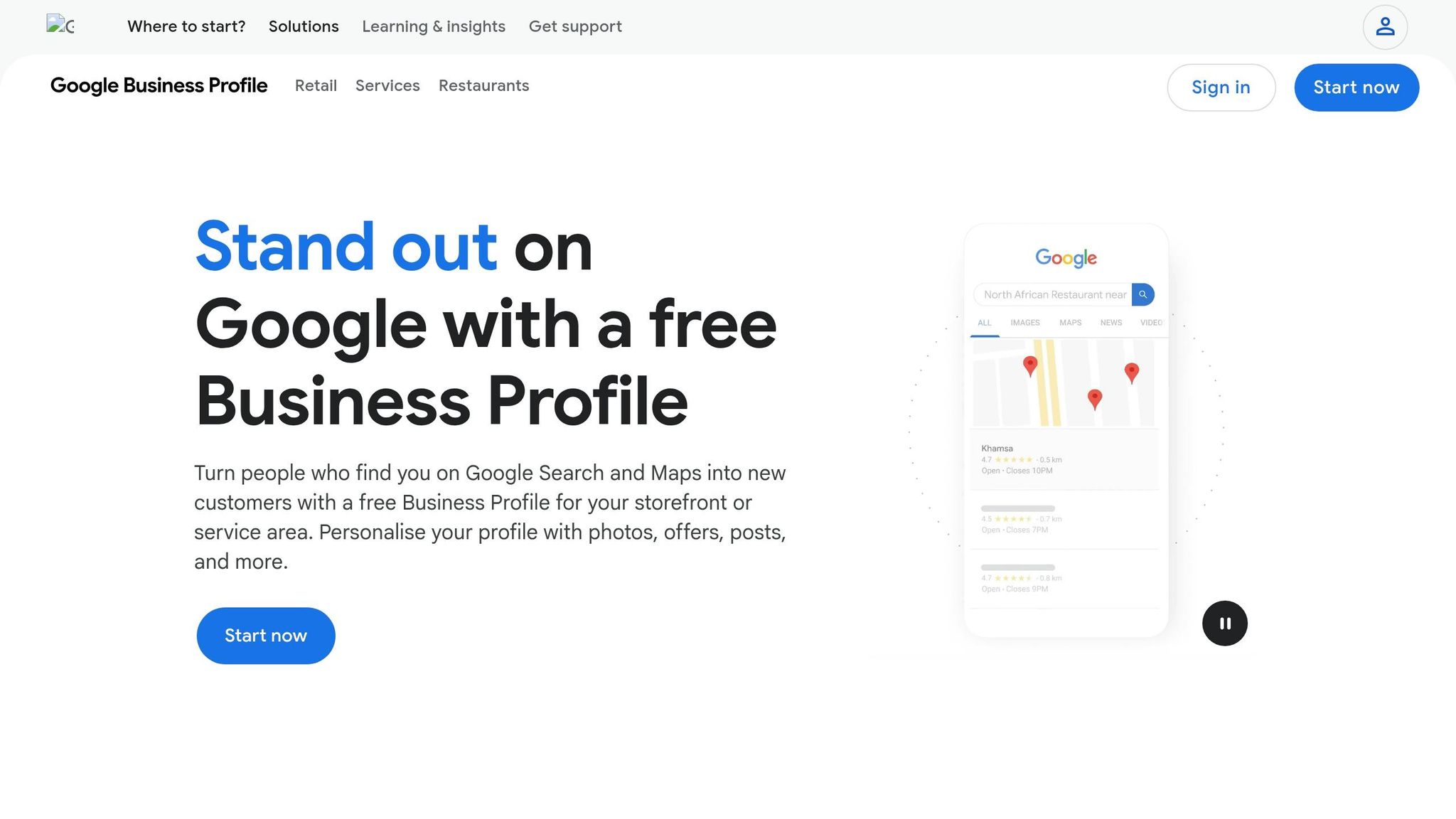
To flag a review, log into your Google Business Profile, navigate to "Read reviews", click the three-dot menu next to the review, select "Report review", choose the correct violation category, and hit "Send report" [3][8]. Alternatively, the Reviews Management Tool lets you track the status of your report and submit an appeal if needed. Review statuses can appear as one of four options: Decision pending, Report reviewed - no policy violation, Escalated - check your email, or Content removed [3]. If a review is marked as "no policy violation", you can still file a one-time appeal.
If your report is denied, you can appeal through the Reviews Management Tool by selecting "Appeal eligible reviews." Be prepared before starting the evidence form - you’ll have only 60 minutes to upload supporting documents like a business license, utility bill, or tax certificate [4]. If you miss this window, your evidence won’t be attached to the case. Appeals are typically resolved within five business days [4].
For reviews involving defamation, privacy violations, or copyright issues, submit a Legal Removal Request using Google’s legal troubleshooter [6]. If standard reports and appeals don’t work, contact Google Business Profile support directly. Go to the "Support" section in your GBP menu, select "Contact Us", and choose "Customer Reviews and Photos" to request a callback or chat [7]. If all else fails, you might consider consulting local marketing agencies or reputation management experts for additional help.
When Google's own dispute process doesn’t deliver the results you need, turning to local marketing specialists can provide a more focused and effective solution.
Specialists bring a structured, policy-driven approach to disputes. Instead of simply clicking the "Report review" button, they compile detailed dispute files, complete with policy references and supporting evidence, to boost the chances of success.
But they don’t stop there. These experts also keep an eye on reviews across platforms like Google, Yelp, and Facebook, craft professional responses, and manage campaigns to generate positive feedback. Their efforts often lead to noticeable changes within weeks, with broader improvements visible in a few months [1].
For their services, specialists typically charge in two ways: a pay-after-results model (around $550 per removed review) or monthly management fees ranging from $499 to $999. These packages often include ongoing review monitoring and local SEO strategies [2][10].
The Bay Area is a fiercely competitive market for local search, making it essential to work with agencies that understand the nuances of ranking in this region. From optimizing multi-location listings to competing with well-funded rivals, local expertise can make all the difference.
Take Review Dispute Pro, for example. This agency specializes in industries like healthcare, legal, and home services across California. In one case, they helped a dental practice in a competitive area remove 7 out of 8 fake competitor reviews within just 14 days. The result? A 40% surge in new patient inquiries [1]. Similarly, Webo Creators has achieved impressive results in Google Business Profile optimization. One client in San Francisco reported a 60% boost in local visibility and store visits after their profile received a thorough overhaul [10].
These agencies don’t just handle technical tasks - they also provide tailored reputation management strategies to help businesses thrive.
Humble Help, a Bay Area agency, focuses on supporting small and local businesses. They go beyond basic marketing to provide hands-on guidance for optimizing Google Business Profiles. Their services include category audits, fixing NAP (Name, Address, Phone) inconsistencies, and crafting local search strategies designed for competitive markets.
"A great website won't guarantee Map Pack placement - optimize your Google Business Profile, fix NAP inconsistencies, and earn more reviews." - Humble Help [9]
What makes Humble Help especially appealing to small business owners is their free set of tools. The Milo AI Marketing Coach offers step-by-step advice on what to improve, while their free Analytics Dashboard helps you track which efforts are driving calls and direction requests. For businesses not ready to commit to a full-service agency, these tools provide a way to identify and address gaps independently - without spending a dime.
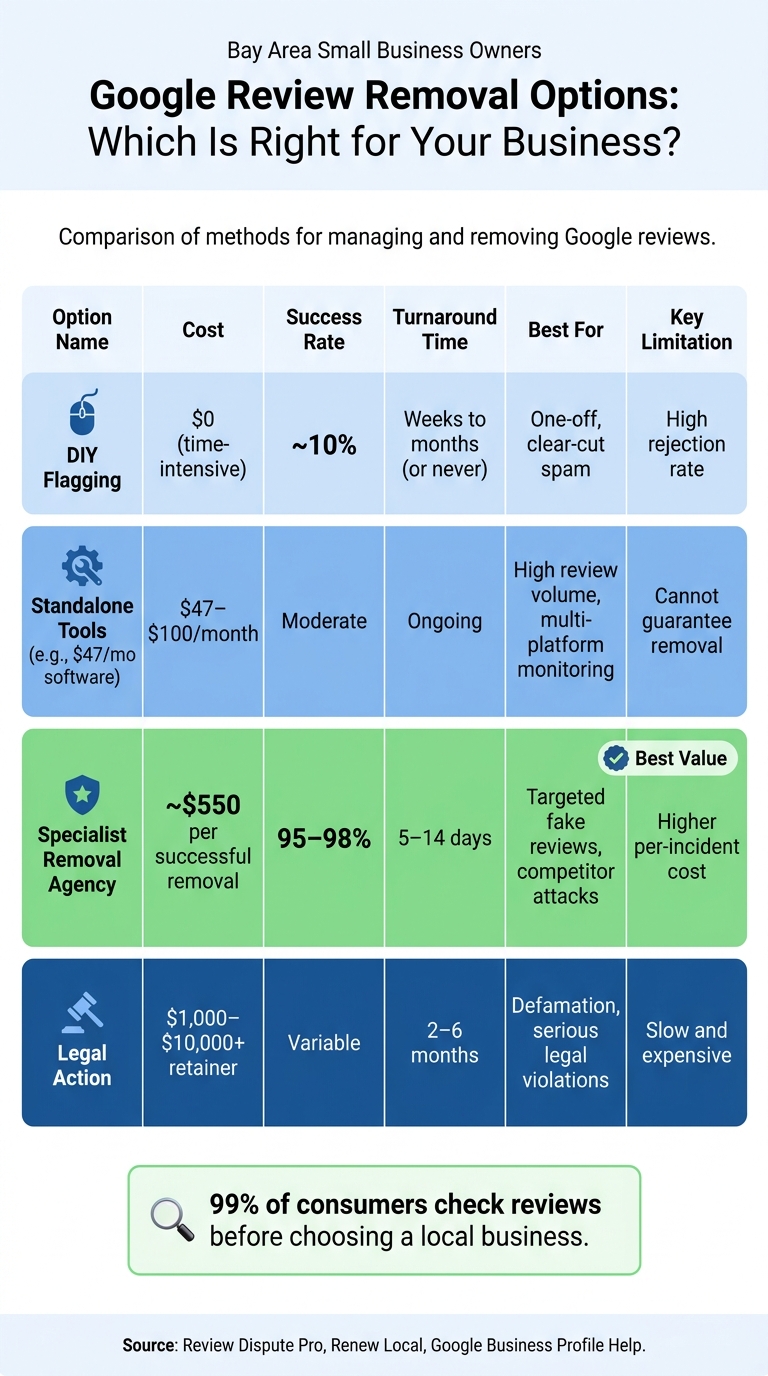
Google Review Removal Options for Bay Area Small Businesses: Cost, Speed & Success Rate
Reputation management services follow a structured process to handle review disputes. They evaluate each review against Google's 12 content policy categories, which include issues like spam, conflicts of interest, off-topic content, and harassment. If a review violates these policies, they compile a detailed dispute file with evidence and submit it through Google's official escalation channels - avoiding the standard flagging method.
This professional approach can yield impressive results. Services report a 95–98% success rate in removing policy-violating reviews [11][12]. Compare that to DIY flagging, which can take 20–30 hours per review and often lacks the same level of success. For small businesses in the Bay Area, where fake reviews and competitor attacks are common, these services provide an essential layer of protection.
In addition to removing fake reviews, these services monitor your profile for new issues like review bombing, craft professional responses to legitimate reviews, and optimize your Google Business Profile. This ongoing management helps maintain your online reputation while enhancing your profile's authority.
When choosing a reputation management service, the billing model is a key consideration. Reliable providers typically use a pay-after-results system, meaning you only pay if the service successfully removes a review. The standard cost for this model is about $550 per successful removal [2]. Be wary of marketing agencies that charge $200–$500 upfront without guaranteeing results, as their success rates often hover around 30% [2].
Before committing to a service, verify that they can identify which specific Google policy a review violates. Ensure they use methods that comply with Google's Terms of Service - avoiding bots or fake reports, which could lead to permanent profile suspension [2]. Check if they offer a refund window (usually 14 days) for cases where a removed review is reposted. Also, confirm that disputes are filed through your verified profile to avoid revealing third-party involvement [2].
If you're unsure whether your reviews qualify for removal, many services offer a free audit. This allows them to assess your reviews against Google's policies at no cost, helping you make an informed decision.
For Bay Area small businesses dealing with aggressive review tactics, the right solution depends on factors like the number of reviews, urgency, and budget.
| Option | Cost | Success Rate | Turnaround | Best For | Key Limitation |
|---|---|---|---|---|---|
| DIY Flagging | $0 (time-intensive) | ~10% [2] | Months or never | One-off, clear-cut spam | High rejection rate |
| Standalone Tools (e.g., $47/mo software) | $47–$100/month [13] | Moderate | Ongoing | High review volume, multi-platform monitoring | Can't guarantee removal |
| Specialist Removal Agency (e.g., Renew Local) | $550 per successful removal [2] | 95–98% [2] | 5–14 days | Targeted fake reviews, competitor attacks | Higher per-incident cost |
| Legal Action | $1,000–$10,000+ retainer [2] | Variable | 2–6 months | Defamation, serious legal violations | Slow and expensive |
For small businesses facing a few suspicious reviews, a specialist removal service with performance-based billing is often the smartest choice. It requires minimal time, delivers quick results, and ensures you only pay for successful outcomes. On the other hand, standalone tools are a good fit for businesses managing a higher volume of reviews across multiple platforms, offering automated monitoring without the per-review cost.
Sometimes, when all other options to resolve a review dispute have been exhausted, it might be time to consider legal action.
Negative reviews, as frustrating as they can be, are usually protected as opinions. However, things change when a review crosses the line into making false statements of fact that cause measurable harm to your business. For example, under U.S. and California law, reviews that falsely accuse a business of fraud, theft, health violations, or professional malpractice - especially if written by someone who was never a customer - could meet the criteria for legal action. Another situation that might require legal intervention is a coordinated attack, such as a competitor orchestrating fake one-star reviews to damage your reputation.
It’s important to tread carefully here. Courts take a dim view of businesses treating standard criticism as defamation. If a judge decides that your claim is an attempt to silence legitimate opinions, you could face an anti-SLAPP ruling, which may require you to cover the reviewer’s legal fees. As Minc Law explains:
"Treating ordinary criticism as a legal claim is one of the fastest ways to lose a case and trigger an anti-SLAPP fee award." [14]
If you believe your situation meets the legal thresholds, the next step is to consult an attorney who specializes in internet defamation.
When disputes escalate beyond what Google's dispute process or review management agencies can handle, an attorney experienced in internet defamation can step in with a range of strategies. For instance, they can issue a cease-and-desist letter demanding the retraction of a false review. If the reviewer is anonymous, they may file a "John Doe" lawsuit to uncover their identity and build a case for defamation. However, be cautious about publicizing such actions, as it could draw unwanted attention and potentially worsen the situation.
Courts often use the Dendrite and Cahill tests to determine whether there’s enough evidence to justify unmasking an anonymous reviewer. Once the reviewer’s identity is revealed, you can proceed with a defamation lawsuit. Additionally, securing a court order that declares the review defamatory is one of the most effective ways to convince Google to remove it.
Another factor to consider is the 2024 FTC Trade Regulation Rule on the Use of Consumer Reviews and Testimonials. This rule increases the risks for businesses involved in fake review schemes, with civil penalties exceeding $50,000 per violation. [14]
If your case meets the legal criteria, thorough documentation becomes critical. Start by capturing full-page, timestamped screenshots of the review, including the reviewer’s details, star rating, posting date, and specific URL. Back this up with internal records, such as transaction logs or booking records, and evidence of financial harm to support your defamation claim.
For high-stakes cases, consider using forensic tools that timestamp and hash the page to ensure the evidence is reliable in court. In instances where the review accuses you of crimes or professional misconduct, some courts may presume harm without requiring detailed financial proof - a concept known as defamation per se.
Keep in mind that most states, including California, have a statute of limitations for defamation cases, typically one to three years from the date the review was posted. Acting quickly is essential to protect your business and build a strong case.
After reviewing the options, here's how to decide on the best course of action for your business.
The right solution depends on the specific issue you're facing:
| Situation | Best Approach | Cost | Typical Timeframe |
|---|---|---|---|
| Obvious spam or profanity | DIY flagging via Google Business Profile | Free | Weeks to months |
| Fake review, competitor attack, non-customer | Specialist removal service | ~$550 per review [2] | 5–14 days [2] |
| Building long-term credibility | Reputation management service | Monthly fee | Ongoing |
| Defamation, serious financial harm | Attorney specializing in internet law | $1,000–$10,000+ [2] | 2–6 months [2] |
If you've already attempted flagging without success, moving directly to a specialist often saves time and frustration. This comparison highlights the importance of tailoring your approach to the specific review issue you’re dealing with.
As Mike Blumenthal, a local SEO expert, aptly says:
"People treat reviews like decoration. They're not. They are the content. They're your brand." [15]
Use the table above as a reference when planning your next move. Don't delay - just one damaging review can lead to significant revenue losses [2]. With 99% of consumers checking reviews before choosing a local business [15], the pressure to act is real.
Make sure to document everything - screenshots, service records, and case IDs. This will be helpful no matter which approach you decide to take. Treat reputation management as an ongoing effort rather than a one-time task. Regularly request positive reviews to counterbalance any negatives. Tools like Humble Help's Milo AI Marketing Coach and Analytics Dashboard can assist you in monitoring your Google Business Profile and identifying potential problems early.
Thriving businesses don't avoid negative reviews - they prepare for them with a solid plan.
Google reviews break the rules when they contain fake or deceptive information, personal insults, irrelevant remarks, or violate Google's guidelines. This includes practices like manipulating ratings or offering incentives for reviews. If you spot such a review, you can report it through Google's review dispute process for possible removal.
To challenge a review, start by gathering solid evidence. This might include timestamped screenshots of the review, details from the reviewer's profile, and their activity history. If you have relevant customer records or order details, include those as well - especially if they can prove there was no interaction with the reviewer. Also, document any specific services or locations mentioned in the review. These details can help demonstrate whether the review breaches Google’s policies, such as being spam, fake, or irrelevant.
To keep your Google Business Profile safe from suspension, it's crucial to stick to Google's guidelines. Start by ensuring your business information is accurate, consistent, and adheres to their policies. Avoid posting restricted content, always use a real, verifiable location, and manage only one profile per business.
Make updates gradually instead of all at once, use a domain-based email address for credibility, and steer clear of redirect links or stuffing your profile with unnecessary keywords. It's also a smart idea to regularly review your online presence for accuracy. Keep important documents, like licenses or utility bills, handy - they might be needed for verification.
Discover strategies to elevate your business.