Reviews help your Google Maps visibility, but they do not control it. If I had to sum up the whole topic in one line, I’d say this: reviews support your ranking through prominence, while relevance and distance still decide a lot of what happens.
Here’s the short version:
If I were putting this into action, I’d focus on four things first:
A simple way to think about it: reviews help strong local profiles win more often, but they do not rescue weak ones. That’s the frame I’d use before digging into the details.
Those same three factors still shape how a business shows up in Google Maps. So before getting into reviews, it helps to see where they fit and where they don’t.
Relevance is how closely your Google Business Profile lines up with what someone searches for. Your categories, services, and profile details do most of the heavy lifting. Review text can help too, since it may add supporting keywords that help Google connect your business to more specific searches [3][5][12].
Distance is the one factor reviews can’t change. If a business is too far from the person searching, even a strong profile may not show up in the Local Pack [1].
Prominence is about how established and trusted your business looks online. This is where reviews have the most impact. The number of reviews, your average rating, how recent those reviews are, and whether the owner replies all feed into that signal [2][9][12].
That’s why a business can do well in organic search and still sit lower in Maps.
Reviews matter, but they don’t outweigh profile quality or proximity. And not all review signals carry the same weight. In many cases, recency and review pace matter more than a big total. A steady stream of new reviews can do more than a large pile of old ones. Owner replies help too, because they show the business is active and paying attention [3][11].
Here’s a simple way to think about it:
| Review Signal | Impact Level | What It Does |
|---|---|---|
| Review pace | Highest | Signals that the business is actively serving customers |
| Owner Response Rate | High | Signals that your business is active and trustworthy |
| Quantity & Star Rating | Medium | Builds baseline credibility and prominence |
| Review Text (Keywords) | Medium | Helps Google match the business to specific service queries |
Next, look at which parts of a review profile actually change visibility.
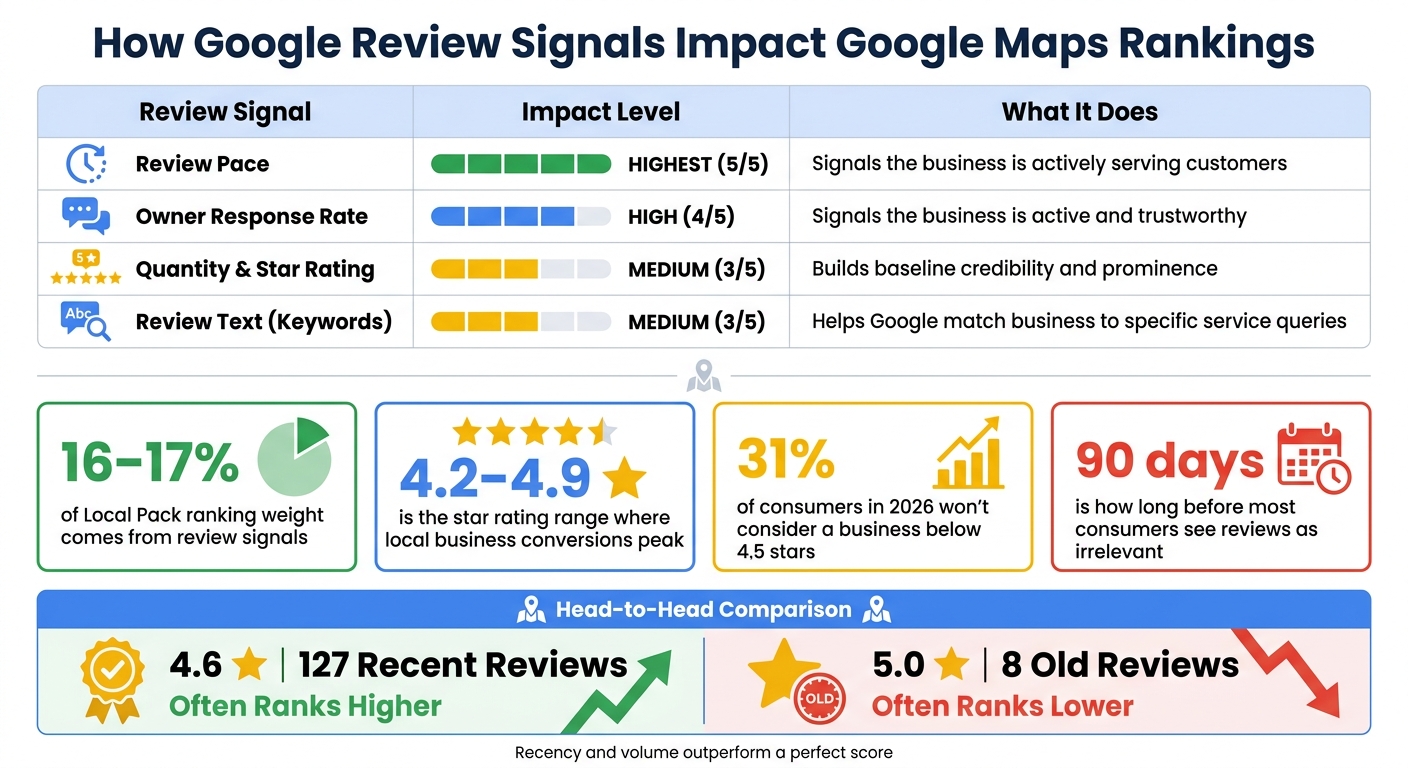
How Google Review Signals Impact Google Maps Rankings
Not every review metric does the same job.
A profile with a 4.6 rating and 127 recent reviews will often beat a 5.0 rating with 8 old reviews in Google Maps. That tells you something simple: volume, timing, and steady activity matter more than a perfect-looking score on its own.
Recency matters a lot for one big reason. More than two-thirds of consumers see reviews older than 90 days as irrelevant [4]. So even if a business has a perfect 5.0, that score can feel stale if it comes from a small batch of old reviews. By contrast, a 4.6 with a steady stream of recent feedback looks more believable. On top of that, local business conversion rates tend to peak when the rating falls between 4.2 and 4.9. A flawless 5.0 can actually look less credible to users [5][11].
That’s why a steady pace of 5 to 15 new reviews per month usually does more for visibility than a one-time review push that disappears after a few weeks. A regular flow of new reviews signals that real customers are interacting with the business right now.
The words inside reviews matter too.
When customers describe the service in their own language, Google can connect those service details and location cues to relevant searches. That can strengthen the Relevance signal [5][11]. So instead of pushing people toward canned wording, ask open-ended questions that get them to explain what happened in their own words.
Owner responses help in a different way. They show that the business is active, add new text to the profile, and can make the listing feel more trustworthy to people who are deciding whether to click [5][4].
Here’s the plain-English version of what these signals can help with, and where they hit a wall.
| Signal | Helps visibility by | Cannot do |
|---|---|---|
| New-review pace | Signaling an active, current business | Compensate for a weak or incomplete profile |
| Review count | Building baseline prominence | Override proximity or category mismatch |
| Star rating | Meeting credibility thresholds | Guarantee a top-3 Local Pack position |
| Review text (keywords) | Connecting the profile to specific queries | Replace accurate categories and services |
| Owner responses | Signaling engagement and adding fresh text | Recover a profile with policy violations |
Next, separate the review signals that help ranking from the mistakes that cancel out their value.
Even a stack of strong reviews won't beat proximity or a weak profile.
Proximity is the first limit. If one business is 0.5 miles away, it can outrank a competitor that's farther out even if that competitor has more reviews [5][1]. Distance sets a hard ceiling. More reviews don't change that.
GBP quality is the next limit. Your Google Business Profile matters more than review volume. Signals like your primary category, secondary categories, service descriptions, photos, and hours carry about 2x the ranking weight of reviews [3][1][8]. So if your category is too broad or your service details are thin, reviews won't bail you out. And when your profile is weak, review keywords lose value because Google has less context to match against your listed services [3].
Put simply: reviews can strengthen a strong profile, but they can't fix a weak one.
Once you see those limits, the bigger danger becomes clear. A lot of review tactics people use are against policy.
Some reputation tactics don't just fall flat. They can put your profile in danger.
Review gating means screening customers first, then sending only happy customers to Google while pushing unhappy customers to a private form. Google has banned this since 2018. It can lead to bulk review deletion or even profile suspension [5][2][13].
Incentivizing reviews is just as risky. If you offer a discount, free item, or any other reward in exchange for a Google review, you're breaking Google policy. That also applies to reviews from employees, family members, or vendors. On top of that, FTC rules allow civil penalties of up to $53,088 per violation [7].
Sudden review spikes can also trip spam filters [5][2].
And stuffing owner replies with keywords like a sales page? That doesn't help either. There is no confirmed direct ranking credit for that kind of response [2][10].
This is where a lot of review plans go off the rails.
| Common Belief | What Actually Happens |
|---|---|
| A 5.0 rating with 6 reviews always beats a 4.6 with 200 reviews | Conversion rates peak between 4.2 and 4.9 stars; a perfect 5.0 can look manipulated [5][3] |
| More reviews help, but they do not overcome proximity | Proximity is a hard ceiling; reviews only help you compete within a specific geographic radius [1][7] |
| Replies help trust, not ranking alone | Responses show engagement, but there is no confirmed direct ranking credit for keyword-stuffed replies [2][10] |
| Review gating is standard reputation management | Gating is an explicit policy violation that can lead to the permanent removal of all reviews or profile suspension [5][13] |
| Review count helps, but it cannot override proximity or a weak profile | Review velocity and recency carry more weight than lifetime totals [3][1] |
| Incentivizing reviews is fine if I disclose it | Google prohibits all incentivized reviews regardless of disclosure; the FTC also imposes penalties [6][7][2] |
That points to the next move: set up a review process that brings in steady, policy-safe feedback.
The key is to make this part of your routine, not a one-off push.
A steady flow of reviews works better than a burst of reviews followed by nothing. That stop-and-go pattern can trip spam filters, and it tends to carry less ranking weight than steady weekly activity [5][10].
Timing matters too. Ask right after a good experience, like when the technician finishes the job or the check is dropped. Keep it simple: use one direct Google Review link across every touchpoint, including texts, emails, receipts, QR codes, invoices, and printed cards.
It also helps to ask one open-ended question, such as, "What problem did we solve today?" That usually leads to more specific, natural feedback. And it does that without telling customers what to say.
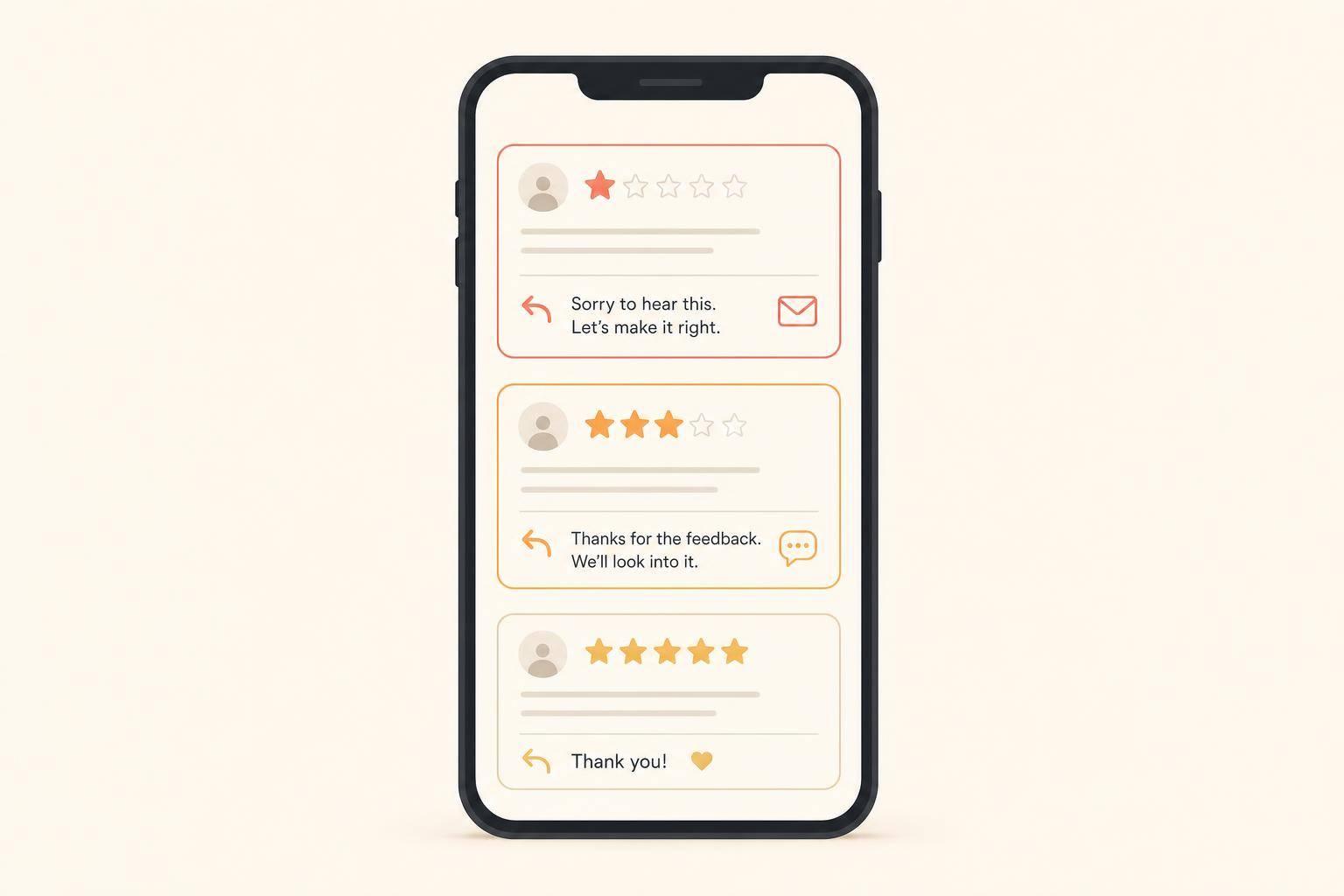
Once reviews start coming in, respond quickly and stay consistent. Reply to every negative review and at least half of your positive ones. Since 19% of consumers expect a same-day reply [1], set aside one block each week for responses so nothing slips through.
For positive reviews, short is fine. Thank the customer and mention the service in a natural way, like, "Glad we could help with your roof inspection."
For negative reviews, keep your cool. Acknowledge the issue, show that you take it seriously, and move the next step offline with a phone number or email. That way, future readers can see you're taking responsibility instead of dodging the problem.
Then track whether the system is leading to newer, stronger reviews. Watch calls, direction requests, and website clicks from your Google Business Profile. Alongside that, keep an eye on:
Check those numbers against your top three local competitors every quarter. That gives you a clearer picture of whether your review process is helping your Google Maps presence or just keeping you busy.
A steady, policy-safe review process is what turns reviews into more visibility. Build a repeatable ask sequence, respond on a set schedule, and track the numbers that tie review activity to actual Google Maps performance. Reviews tend to work best when the rest of your local SEO strategy is already in good shape.
Changes from new reviews usually start affecting Maps rankings within 1 to 3 months. In some cases, fast responses or major profile changes can show an effect within a few days to 4 weeks.
The full impact of a steady flow of reviews often takes 3 to 6 months to level out. Reviews that come in on a regular basis tend to work better than short bursts, because Google keeps re-checking recent activity.
Yes. If your business keeps getting low ratings or harsh feedback, people may see it as less prominent and less trustworthy. That can hurt your position in local search results. And if your average rating drops below 4.0 stars, you may also become less visible to people who filter for higher-rated businesses.
A small number of negative reviews is normal. In fact, they can make your profile feel more real. Instead of trying to get them removed, focus on softening their impact with professional, empathetic replies that address the issue behind the complaint.
Before you ask for more reviews, fix the way you collect and manage them.
Set up a steady, policy-compliant review process tied to completed work. Don’t use fake reviews, incentives, or review gating. And reply to every review fast.
You also need to fix repeat problems with service, communication, or scheduling that are driving poor feedback. If customers keep having bad experiences, getting more reviews won’t help your visibility.
The goal is a steady flow of reviews over time, not short bursts.
Discover strategies to elevate your business.