Yes - if I only care about Google, I still need to keep Yelp in good shape. Yelp is not my main local channel, but it can still affect clicks, calls, and trust when people search my business name, check Apple Maps, or use AI tools for local picks.
Here’s the short version:
If I want the simple rule, it’s this: use Google for growth, and use Yelp to avoid losing people who were close to choosing me.
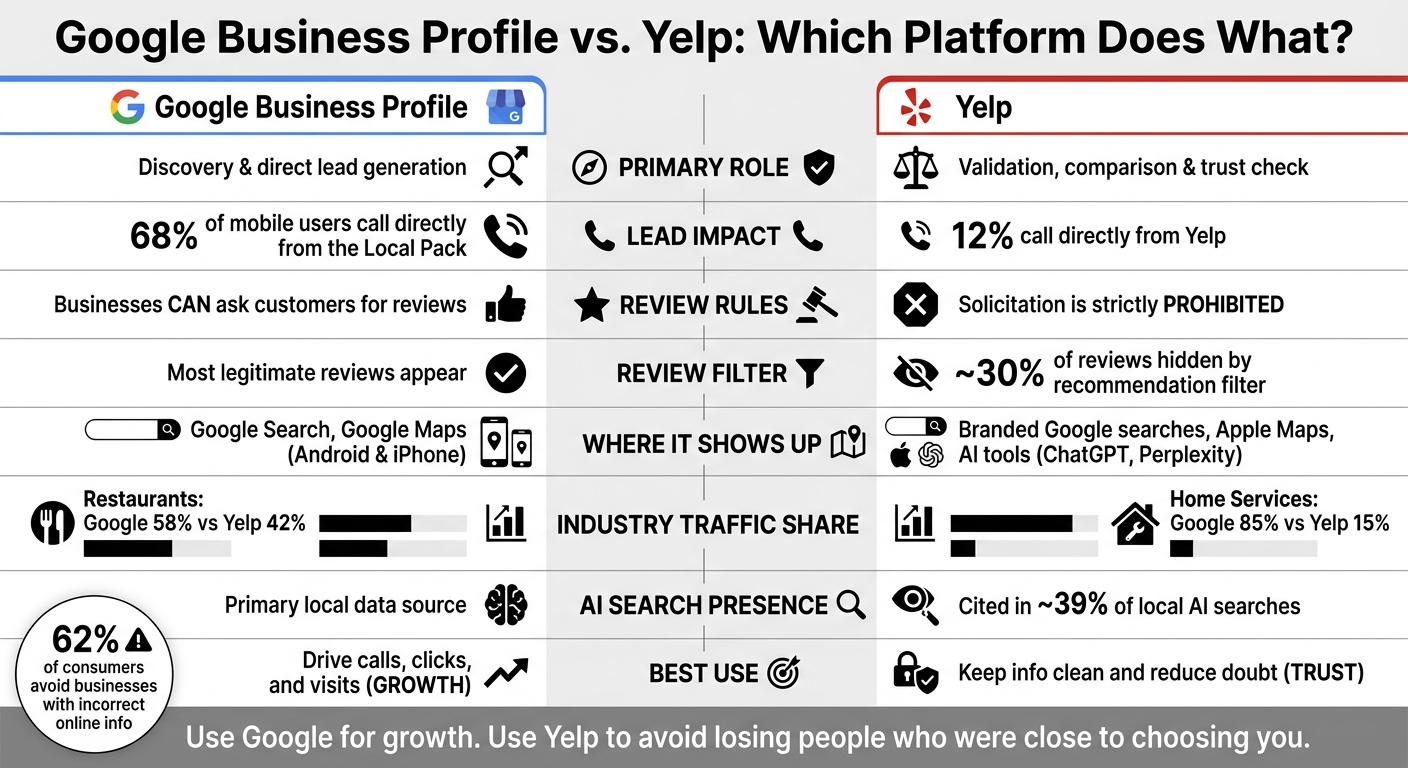
Google Business Profile vs. Yelp: Which Platform Does What?
| Area | Google Business Profile | Yelp |
|---|---|---|
| Main job | Discovery | Trust check |
| Lead impact | Higher | Lower for most businesses |
| Review requests | Allowed | Not allowed |
| Where it shows up | Google Search and Maps | Google brand searches, Apple Maps, AI tools |
| Best use | Drive calls, clicks, and visits | Keep info clean and reduce doubt |
My takeaway: I don’t need to treat Yelp like Google. But I also shouldn’t ignore it, because a weak Yelp page can get in the way of Google-first results.
Google may be the main focus, but Yelp still shapes what people see when they double-check your business. If someone searches for your business name on Google, your Yelp listing can still appear near the top of the organic results [3]. That means branded searches often turn into a quick detour from Google to Yelp.
And that detour matters.
If someone lands on a Yelp profile with old info or a weak, ignored rating, they may stop right there. No call. No click. No appointment. Mixed ratings can chip away at trust and make people pause when they were ready to act.
Yelp also matters for Apple users. On iPhone, Yelp supplies data to Apple Maps and Siri [3][4]. So even if your Google Business Profile looks perfect, Yelp can still shape what part of your audience sees.
Your name, address, and phone number need to match exactly across every platform. This isn't a small detail. 62% of consumers say they'll avoid a business if they find incorrect information online [2]. A bad phone number or wrong business hours can cost you leads on the spot.
Yelp also acts as a citation source for search systems. If the details on Yelp don't match your Google Business Profile, that sends a mixed signal to algorithms trying to confirm your business info [8]. The fix is simple: claim the listing and make sure your name, address, phone, hours, categories, and website match Google exactly.
This matters even more now because 45% of consumers use AI platforms for local recommendations [8]. Many of those tools license Yelp's database directly. So if your Yelp profile is wrong, ChatGPT or Perplexity may repeat the wrong facts about your business, even when your Google profile is spotless.
| Factor | Google Business Profile | Yelp |
|---|---|---|
| Primary role | Discovery and direct lead generation | Validation, comparison, and trust check |
| Search impact | Directly influences Local Pack rankings [3][5] | Ranks in organic results, often on Page 1 [3] |
| Review rules | Businesses can ask for reviews [3] | Solicitation is strictly prohibited [3] |
| Review filter | Most legitimate reviews appear | Aggressive recommendation filter hides about 30% of reviews [5] |
| Mobile reach | Google Maps on Android and iPhone | Powers Apple Maps star ratings and reviews [3][4] |
| Direct calls | 68% of mobile users call from the Local Pack [5] | 12% call directly from Yelp [5] |
Put simply, Google helps people find you, while Yelp helps them decide whether to trust what they found.
When Yelp is accurate, it backs up your Google-first work. When it's messy, it adds friction.
That leaves one question: when does Yelp deserve active attention instead of basic maintenance?
Yelp doesn't need the same level of effort for every business.
For most companies, basic upkeep is enough. Keep the profile correct, check reviews now and then, and make sure nothing looks off. But in some cases, Yelp does more than sit in the background. It can bring in leads, shape buying choices, and affect how people compare you with nearby options.
That usually happens with consumer-facing businesses where people shop around before they buy. Think restaurants, bars, beauty salons, spas, and boutiques. In those categories, Yelp can still shape conversion, not just reputation [3][2][7]. The numbers show the gap by industry. For restaurants, Yelp drives 42% of review-influenced traffic decisions, while Google accounts for 58% [3]. For home services, Yelp's share drops to 15%, with Google at 85% [3].
Location matters too. In big U.S. metro areas like San Francisco, New York, Los Angeles, and Chicago, Yelp tends to matter more because the competition is tougher and more mature. It's common to see competing businesses with 50+ recommended Yelp reviews in those markets [9]. On top of that, Yelp city list pages often rank on page one of Google [3][1].
For food, hospitality, home services, beauty, and automotive businesses, Yelp often deserves more than a quick monthly check.
A few simple signals can tell you when Yelp should move up your list. If you see any of these, it's worth paying closer attention:
The split is pretty simple: Is Yelp sending leads, or does the profile just need to stay correct?
| Factor | Basic Maintenance | Active Management |
|---|---|---|
| Best fit | B2B, professional services, niche specialties | Restaurants, salons, spas, metro home services |
| Primary use | Prevent misinformation from costing trust | Drive leads and local visibility |
| Photos | 1–5 photos, such as a logo or storefront | 20+ high-quality photos of work, space, and team |
| Review response | Check monthly; respond to major complaints | Respond to all reviews within 24–48 hours |
| Updates | Correct hours or phone when they change | Monthly updates to services, menus, and attributes |
| Lead tools | Basic contact info only | Enable "Request a Quote" or "Book Now" features |
Don't decide based on habit or guesswork. Track calls, quote requests, and bookings from Yelp. If the leads are there, give it active attention. If not, basic upkeep may be all you need.
Next, focus on fixing the profile problems that most often cost leads.
If Yelp isn't a lead source, keep it in maintenance mode. For referral-driven services like accounting, consulting, and law, the goal is simple: don’t lose people who look you up before reaching out. That calls for a basic setup, not hands-on day-to-day work.
Claim your listing. Then make sure your main business details match your Google Business Profile. Add 5–10 real photos, including your exterior, interior, team, and work. Also include a short description that says what you do and who you serve.
Accuracy matters more than most people think. Yelp data can show up in AI assistants, so a wrong profile can spread bad information about your business even if Yelp sends you zero direct traffic [8]. And 62% of consumers will avoid a business if they find incorrect information online [2].
One thing to avoid: never ask customers to leave you a Yelp review. Yelp's recommendation software filters out about 25% to 30% of legitimate reviews, often the ones that seem solicited [10]. Put your review efforts into Google instead, where asking is allowed.
Check Yelp once a quarter to confirm your hours, contact details, photos, categories, and service area. If anything major changes, update it right away - a new phone number, a move, or different hours.
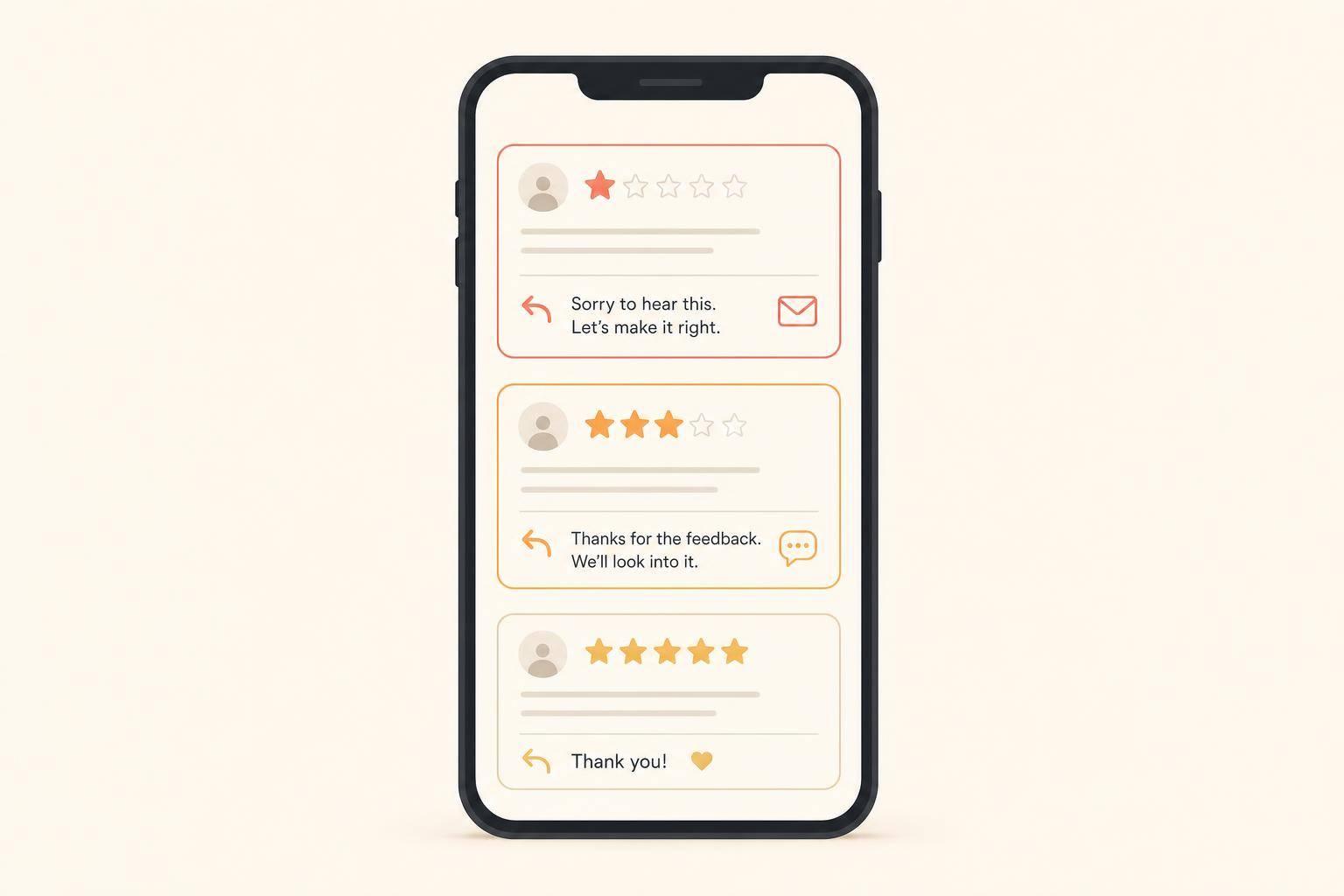
Take a look at new comments too, and reply in a professional way, especially when the feedback is negative.
If Yelp starts sending leads or starts causing problems, move to the cleanup workflow next.
If Yelp is already showing up for branded searches or affecting calls, stop treating it like a set-it-and-forget-it listing. At that point, it’s a customer-facing page, and it needs cleanup.
Start with the issues that create doubt fastest: mismatched NAP data, a big rating gap between Google and Yelp, unanswered negative reviews, and not enough real photos. Add current exterior, interior, team, and finished-work photos.
Apple Maps uses Yelp ratings in many categories, so a neglected Yelp profile can keep your stars from showing for iPhone users. That’s a trust problem, even if your Google presence is doing just fine.
Start by searching your business name on Google. If Yelp shows up on page one, treat it like a live touchpoint, not some listing sitting in the background. Then work through this sequence:
Use this workflow only for Yelp pages that show up in search and affect customer decisions.
Google should still be your main local marketing priority. Even so, Yelp still matters as a trust layer. It appears in branded searches, feeds star ratings to Apple Maps, and is cited in about 39% of local AI searches through tools like ChatGPT and Perplexity [6]. Keep your Yelp info accurate, respond to reviews, and check the profile quarterly. Keep Google first, keep Yelp accurate, and put in extra effort only when Yelp starts driving leads or getting in their way.
Yes - but only in an indirect way.
Yelp doesn't directly affect your Google Maps rankings. Still, people may look at your Yelp page before they decide whether to trust your business. If they see wrong hours, old photos, very few reviews, or complaints that never got a reply, that can create doubt and hurt conversions.
It can also look odd when your Yelp profile and Google Business Profile don't match. Those conflicts can send up red flags for customers.
So make sure you:
A messy Yelp page won't push you down in Google Maps on its own. But it can absolutely cost you clicks, calls, and customers.
Actively manage Yelp if your business depends on reviews - think restaurants, hotels, home services, beauty, or automotive shops - especially if you're in a big U.S. city where competition is fierce.
If Yelp is clearly driving calls, website visits, or bookings, it deserves regular attention. If it sends little traffic and most customers come through referrals or Google, basic upkeep is usually enough: claim your profile, make sure the details are correct, and keep it up to date.
First, claim your business page through Yelp for Business.
Then check the basics. Your business name, address, phone number, website, and hours should match your Google Business Profile exactly. Even small differences can create confusion.
After that, fill out every relevant profile field and pick the right primary category. Add at least 10 high-quality, real photos so people can get a clear sense of your business.
Finally, respond to existing reviews in a professional way. A calm, polite reply shows people you pay attention and take customer feedback seriously.
Discover strategies to elevate your business.