Want more leads for your Bay Area business without spending on ads? Focus on organic strategies that boost your visibility in local searches and build long-term trust. Here's how:
These steps help you connect with local customers who are ready to act, without relying on paid ads.

Google Business Profile Impact Statistics for Local Businesses
A fully completed Google Business Profile can make a big difference in how your business is perceived online. It shows up prominently in both search results and Google Maps, which can boost your credibility [3][6]. Businesses with complete profiles are 2.7 times more likely to be seen as trustworthy and can get 7 times more clicks compared to incomplete profiles [3][6].
To get started, head to business.google.com to claim or create your profile. Once you've set it up, you'll need to verify it. The verification process can be done via a postcard (which takes 5–14 days) or through other options like phone, email, or video [2][3]. Avoid making changes to your business name, address, or category while waiting for the postcard, as this could delay the process [3]. After verification, take the time to optimize your profile with accurate details and appealing visuals to improve your local search visibility with a comprehensive SEO strategy.
The primary category you choose for your business is critical - it directly impacts your local search ranking [2]. Be as specific as possible. For instance, instead of selecting "General Contractor", go for "Kitchen Remodeling Contractor." You can also add up to nine secondary categories to cover related services, but your primary category is the most influential [3].
Consistency is key when it comes to your NAP (Name, Address, Phone). Even minor differences, like using "St." instead of "Street" or "#100" instead of "Suite 100", can confuse Google's algorithm and hurt your ranking [3]. To further establish your local presence, use a phone number with a local area code rather than a toll-free number [2][3].
If you have a physical storefront, list your address. For mobile businesses, you can hide your address and set up to 20 service areas [2][3]. Make sure to fill out every field, including business hours. Use the "Special Hours" tool for holidays to avoid upsetting customers who might show up when you're closed [2].
Photos can make a huge difference in attracting customers. Profiles with photos see 42% more requests for directions and 35% more clicks to their website compared to those without [2][6]. To get the most out of your profile, aim to upload at least 20 high-quality photos [5]. Here's a breakdown of what to include:
Stick to real images - stock photos can hurt your credibility [2]. Use JPG or PNG formats with a resolution of at least 720px x 720px, and keep the file size between 10 KB and 5 MB [4]. For an added boost, geo-tag your photos with your location and aim to upload 2–3 fresh images every month [2][3][5].
When crafting your 750-character profile description, focus on clearly stating what your business offers and the specific Bay Area locations you serve. This approach helps you connect with local customers more effectively, as 67% of searches in the Bay Area include location-specific terms beyond just the city name [1].
Start with your main service and list the neighborhoods or cities you cover. For instance, instead of something generic, write: "Emergency plumber serving San Francisco, Oakland, and Berkeley; same-day service in SOMA, Mission District, and Pacific Heights." This mirrors how locals search for services, making it easier for them to find you.
End your description with a strong call-to-action like, "Call now for a free estimate" or "Visit our North Beach location today." Keep the language simple and conversational, as voice search usage in the Bay Area is 40% higher than the national average [1]. Avoid overloading the description with too many keywords, as this can make it harder to read and may hurt your search rankings.
To capture local searches effectively, use the "Service + Location" format throughout your description. Bay Area residents often search for phrases like "San Francisco plumber", "Oakland coffee shop", or "emergency electrician SOMA." Including these exact terms in your profile ensures you appear in relevant search results.
Neighborhood names matter, too. Locals strongly identify with areas like Pacific Heights, Hayes Valley, North Beach, Marina, Richmond, Sunset, Nob Hill, and the Mission District. If your business has a physical location, mention nearby landmarks or transit stops that locals recognize. For service-based businesses, list the neighborhoods or cities you frequently serve. Don’t forget to consider commuter habits - many people search for services near their workplace during the day and near their home in the evening [1]. This dual approach helps you stay visible to a wider audience.
Leveraging customer reviews is more than just a way to build trust - it’s a powerful tool to boost your local search rankings. Google’s algorithm factors in the volume and recency of reviews to determine “prominence,” which influences whether your business appears in the coveted Map Pack [7]. Simply put, the more frequent and recent your reviews, the better your chances of climbing the local rankings. This approach works hand-in-hand with other local SEO strategies.
Reviews also directly impact revenue. Businesses with over 50 reviews see a 35% increase in revenue, and every additional star rating can drive revenue up by 5–15% [7]. Starting in 2026, Google’s AI Overviews will pull from review content and sentiment to answer queries like “most trusted plumber near me” [7]. Reviews mentioning specific services, employee names, or neighborhoods (like those in the Bay Area) can also boost your profile’s relevance for those targeted keywords.
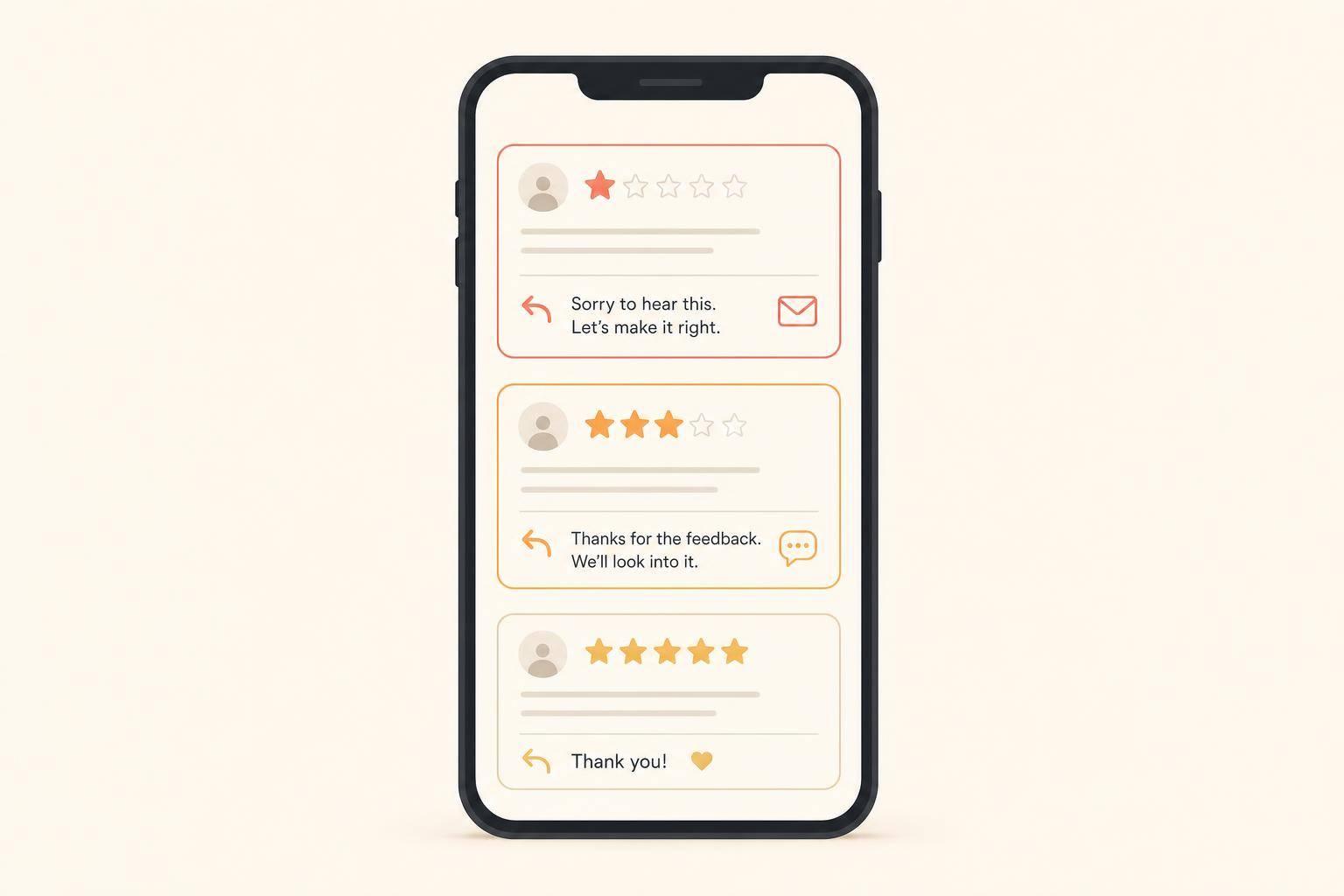
But here’s the kicker: responding to reviews is just as important as collecting them. Replying to all reviews - whether glowing or critical - is a confirmed ranking signal [7]. Businesses that engage with customer feedback not only rank higher but also win trust. In fact, 70% of searchers read responses to negative reviews before making a decision, and 89% of customers are more likely to choose a business that actively replies to all feedback [8].
The magic of reviews doesn’t stop at collecting them - it’s about managing them effectively. Timing is key when requesting reviews. Sending a text message 2–4 hours after completing a job is ideal, as SMS messages boast a 98% open rate and click-through rates 8–12 times higher than email [7]. Sending requests too soon or waiting over 24 hours can lead to fewer responses. Always include a direct link to your Google review form to make the process as simple as possible - this small step can increase completion rates by 40–60% [7].
When asking for reviews, focus on authenticity. Let customers know their feedback helps improve your business and assists others in making informed decisions. Steer clear of offering incentives like discounts or credits, as Google’s stricter policies (starting in 2026) could result in profile suspensions within 48 hours for incentivized reviews [7].
Responding to reviews is where you can really shine. Personalize your replies by addressing customers by name and referencing the specific service they received. For negative reviews, acknowledge the issue, offer a solution, and invite the conversation offline with direct contact details - all while keeping a professional tone. Research shows that 67% of customers expect a response within 24 hours [7], so setting aside time twice a week for review management can make a big difference. These steps not only strengthen your reputation but also complement the profile optimization strategies discussed earlier.
Keeping your Google Business Profile active with regular posts is a smart way to stay visible. In 2026, AI tools like ChatGPT and Gemini pull information directly from recent posts to answer user questions about promotions or business updates [9]. If your posts are more than 30 days old, they lose relevance in these AI-generated responses. This means consistent updates are crucial - not just for staying on Google’s radar but also for engaging with local audiences. Much like optimizing your profile details or encouraging reviews, posting regularly can boost both local engagement and organic reach.
Here’s a compelling stat: businesses that post weekly for at least six months see profile views increase by 20% to 40%, while phone calls from their Google listing rise by 10% to 20% [10]. Even direction requests can go up by 15% to 25% just from regular activity [10]. Posts remain visible for about seven days before being archived [10], so aiming for 2 to 3 posts per week is a solid strategy [9][10].
But here’s the thing - quality matters more than quantity. Drew Johnson from Renew Local puts it best:
"Consistent posting outperforms erratic bursts. A business posting 3x/week for 12 months straight beats a business posting 7x/week for 2 months and then going silent for 6" [9].
Google provides four post types - Updates, Offers, Events, and Products - each designed for specific purposes like sharing news, promoting discounts, highlighting events, or showcasing products [9][10]. The trick is to be specific. Vague posts like "We offer great service!" won’t get much attention from Google or AI engines. Instead, include details like prices, product names, or location-specific information. For example, instead of saying "Spring Special", go for something like "Save $50 on HVAC tune-ups in Palo Alto - valid through May 15, 2026."
To make your posts even more effective, tailor them to local events and promotions. Use the "Event" post type to connect with your community. For instance, try posts like "Outside Lands Special: 15% off for festival-goers" or "Free tech consultations during SF Tech Week" [1]. These hyperlocal touches help you reach nearby customers who are actively searching for services in their area.
Timing and presentation are just as important as content. The best time to post? Between 8:00 AM and 11:00 AM, Tuesday through Thursday mornings [9]. Keep your posts brief - 2 to 4 sentences max. Start with the value you’re offering and finish with a clear call to action. Always include a Call-to-Action button like "Call Now", "Book", or "Learn More" to turn viewers into customers [10][11]. And forget stock images - use real photos of your team or your work. AI engines tend to deprioritize generic-looking content [9][10].
For variety, rotate your content each month. Include a mix of post types: one highlighting a service, one offering an educational tip, one promoting a deal, and one sharing a team or community update [10]. This keeps your profile fresh and gives AI engines more diverse information to use. With 89% of Bay Area residents owning smartphones and voice search usage 40% higher than the national average [1], your posts need to perform well on mobile screens, where most local searches happen.
Once you've fine-tuned your profile and started posting consistently, the next step is to track your progress. Without reliable data, you're left guessing. Thankfully, Humble Help offers free tools - including a Business CRM, an Analytics Dashboard, and Milo AI Marketing Coach - that let you see exactly how people are finding and interacting with your business.
Here's a key stat: 48% of local-intent searches lead to a profile interaction within 24 hours [12]. By tracking your data, you can figure out if those searches are turning into calls, direction requests, or website visits. The Analytics Dashboard provides essential traffic and visibility metrics at no cost, while Milo AI gives you clear, actionable advice to improve your performance [14].
The Analytics Dashboard is designed to answer one critical question: what's working? It highlights the metrics that matter most, like how customers are finding your business and which channels are driving the most interest [14]. You’ll get an overview of traffic patterns, visibility trends, and lead generation data - all in one place.
This information is more than just numbers. For example, businesses that include photos on their profile see 45% more direction requests and 31% more website clicks [12]. The dashboard helps you see whether efforts like uploading quality photos or posting updates are paying off. Reviewing your performance every quarter allows you to compare metrics against any changes you’ve made and adjust your strategy as needed [14]. These insights can guide your next steps and help you focus on what truly drives results.
Once you’ve reviewed your metrics, Milo AI Marketing Coach steps in to help you take action. This tool eliminates the guesswork by offering simple, step-by-step recommendations tailored to your profile’s performance. Whether it’s improving your reviews, adding photos, or posting more frequently, Milo pinpoints exactly where you should focus your efforts [14].
What makes Milo even more convenient is its integration with the Analytics Dashboard and CRM. Everything you need - recommendations, tracking, and lead management - is in one place [14]. This is especially helpful for small business owners juggling multiple responsibilities. Plus, optimizing your profile can boost visibility in both traditional search results and newer AI-driven discovery tools. Research shows that 76% of sources cited in Google AI Overviews rank in the top 10 traditional search results [13]. With all your leads funneled into the free CRM, you can stay organized and turn local search traffic into paying customers more efficiently [14].
Generating more leads without relying on ads isn't about quick fixes - it’s about creating a lasting system that works for you 24/7. A well-optimized Google Business Profile taps into high-intent local searches from people actively seeking your services in your area [15][1].
Focus on optimizing your profile, gathering reviews, sharing updates, and monitoring results to build a steady flow of leads. As Caresa Hope, Founder of HopeSpring Digital, explains:
"When combined with steady reviews, clean citations, and clear local SEO strategy, it becomes a powerful engine for long-term, organic growth" [15].
These strategies set the stage for consistent success in local search. Regular maintenance is crucial - spend a few minutes each week responding to reviews, adding fresh photos, and posting updates. These small efforts can significantly improve your local rankings. Especially in competitive markets like the Bay Area, where mobile and voice searches dominate, staying visible in local search results is critical [1].
To take it a step further, leverage tools like Humble Help's Analytics Dashboard, CRM, and Milo AI Marketing Coach to streamline the process. These resources, mentioned earlier, remove the guesswork and help turn your online traffic into paying customers.
The work you put in today can fuel a system that generates leads for months, even years. That’s the true power of organic lead generation.
It usually takes anywhere from a few weeks to a few months to see a noticeable boost in leads after optimizing your Google Business Profile. The timeline largely depends on how actively you manage your profile - things like regularly updating it, responding to reviews, and ensuring all information is accurate play a big role in driving results.
If your Google Business Profile verification is taking longer than expected or has been denied, start by double-checking Google's verification guidelines. Make sure all the details on your profile are accurate and fully completed. Carefully follow each step in the verification process, and if your request was denied, identify and fix any problems that might have led to the issue. This can help increase the likelihood of your verification being approved.
To gather more Google reviews the right way, focus on creating a reliable system for requesting feedback and connecting authentically with your customers. Politely ask happy customers to leave a review, and make it easy for them by providing clear instructions or links. Always respond to reviews - whether they’re positive or negative - to show you value customer input. Avoid shortcuts like offering rewards or purchasing reviews, as these go against Google’s guidelines. Instead, concentrate on delivering top-notch service that naturally inspires customers to share their experiences, helping you grow your reputation while staying within the rules.
Discover strategies to elevate your business.