At Humble Help, we handle the hard work for Bay Area businesses by ensuring their GBP remains active, accurate, and optimized. Here's what we do every month:
Small issues with Google Business Profiles (GBP) can pile up over time. Something as minor as an outdated phone number or a suggested edit changing your business category can gradually hurt your local search rankings.
At Humble Help, maintaining profile accuracy isn’t a one-time task - it’s a routine. Each month, the team verifies essential details like the business name, primary and secondary categories, website URL, and service areas to ensure they align with your branding. Special and holiday hours are updated at least 7 days in advance to avoid triggering Google's spam filters [7]. For Bay Area businesses, this process also considers local events. For example, a San Francisco restaurant might adjust its hours or service areas during Fleet Week or the San Francisco Marathon [8].
Once updates are made, the team ensures their accuracy is preserved through ongoing NAP (Name, Address, Phone) monitoring.
Globally, over 15 million edits are made to Google Business Profiles each month [5]. These changes can happen without your direct input. That’s why Humble Help performs weekly checks to catch and correct suggested edits before they go live. Unchecked changes - like incorrect categories or addresses - can lead to a soft suspension, making your profile disappear from local search results.
The team also cross-references NAP data with major directories like Apple Maps, Yelp, and Bing Places. Inconsistent information across platforms can weaken Google’s trust in your profile, which may negatively affect your Map Pack rankings [11]. Duplicate listings are another issue they address, as these can split review equity and create ranking instability.
"From a Local SEO perspective, the critical data points are categories, phone numbers, website links, and address consistency." - Hasan Cagli, PostPlanify [5]
To ensure thorough monitoring, Humble Help uses a combination of specialized tools.
Routine maintenance relies on tools like the Google Business Profile Manager for bulk updates and Google Maps for manual verifications. These tools help confirm that map pins are correctly placed and duplicate listings are identified [9][10]. Humble Help also uses its Analytics Dashboard, which turns raw Google data into actionable insights. Instead of just tracking views, the focus is on intent-based actions like calls and requests for directions [5][2].
| Task Frequency | Tasks |
|---|---|
| Weekly | Review suggested edits, monitor Q&A, and upload new photos [2][7] |
| Monthly | Validate NAP data, check performance metrics, and confirm hours accuracy [2][3] |
| Quarterly | Audit categories and attributes; review user permissions [2] |
| Ongoing | Clean up citations on directories like Yelp, Apple Maps, and Bing [6] |
Monthly updates play a crucial role in Humble Help's GBP (Google Business Profile) strategy, working alongside regular data checks and review management. An active GBP not only keeps a business visible but also engages local customers effectively. In contrast, inactivity can lead to a significant drop in visibility.
"GBP posts are a freshness signal - post or get buried. Profiles that haven't been updated in 30+ days start losing impressions." - JohnPaul Williams II, Founder, J Williams Designs [1]
Humble Help focuses on four main types of posts to keep GBP profiles fresh and engaging:
Humble Help avoids adding phone numbers directly into post descriptions to prevent Google rejections. Instead, every post includes a clear call-to-action button like "Call now", "Book", or "Learn more" to encourage customer interaction [14][15].
In competitive markets like the Bay Area, generic posts simply don’t cut it. Humble Help ensures every post is tailored with a strong hook within the first 100 characters (the part that appears in Google search results). Posts also include local keywords, relevant content, and a clear call-to-action [18]. For instance, a plumbing company in San Mateo County might get a post titled, "Water heater issues in San Mateo? Here's what to check first", instead of a generic maintenance tip.
Seasonal relevance is another key factor. Content aligns with local trends, such as fog-season reminders for HVAC clients or summer event promotions for East Bay restaurants. Authenticity also matters - real photos of staff and job sites consistently outperform stock images in engagement [18]. Clients are encouraged to provide short 30–60 second video clips to build a strong content library [21].
Humble Help uses the native GBP dashboard to schedule posts in monthly batches. Drafts are planned with Milo AI Marketing Coach, ensuring content is locally relevant and optimized to drive calls and direction requests [4][17][20]. Performance is monitored through Humble Help's free Analytics Dashboard, which links post activity to measurable results like calls and website clicks [4].
"Consistency beats volume; a steady weekly cadence outperforms sporadic bursts." - Digital Estate Media [15]
Listings with recent posts see 21% more user interactions - including calls, direction requests, and website clicks - compared to profiles that remain dormant [20]. Up next, Humble Help applies the same level of care to managing reviews and maintaining client reputations every month.

GBP Review Management Approaches: Manual vs. Hybrid vs. Fully Managed
Reviews play a huge role in local search rankings. By 2026, Google's algorithm attributes 17% of local pack ranking factors to review signals, making them the second most important factor after the business profile itself [24]. Add to that the fact that 93% of consumers say online reviews shape their buying decisions [24], and it’s clear that ignoring reviews - or failing to respond to them - can seriously hurt a business.
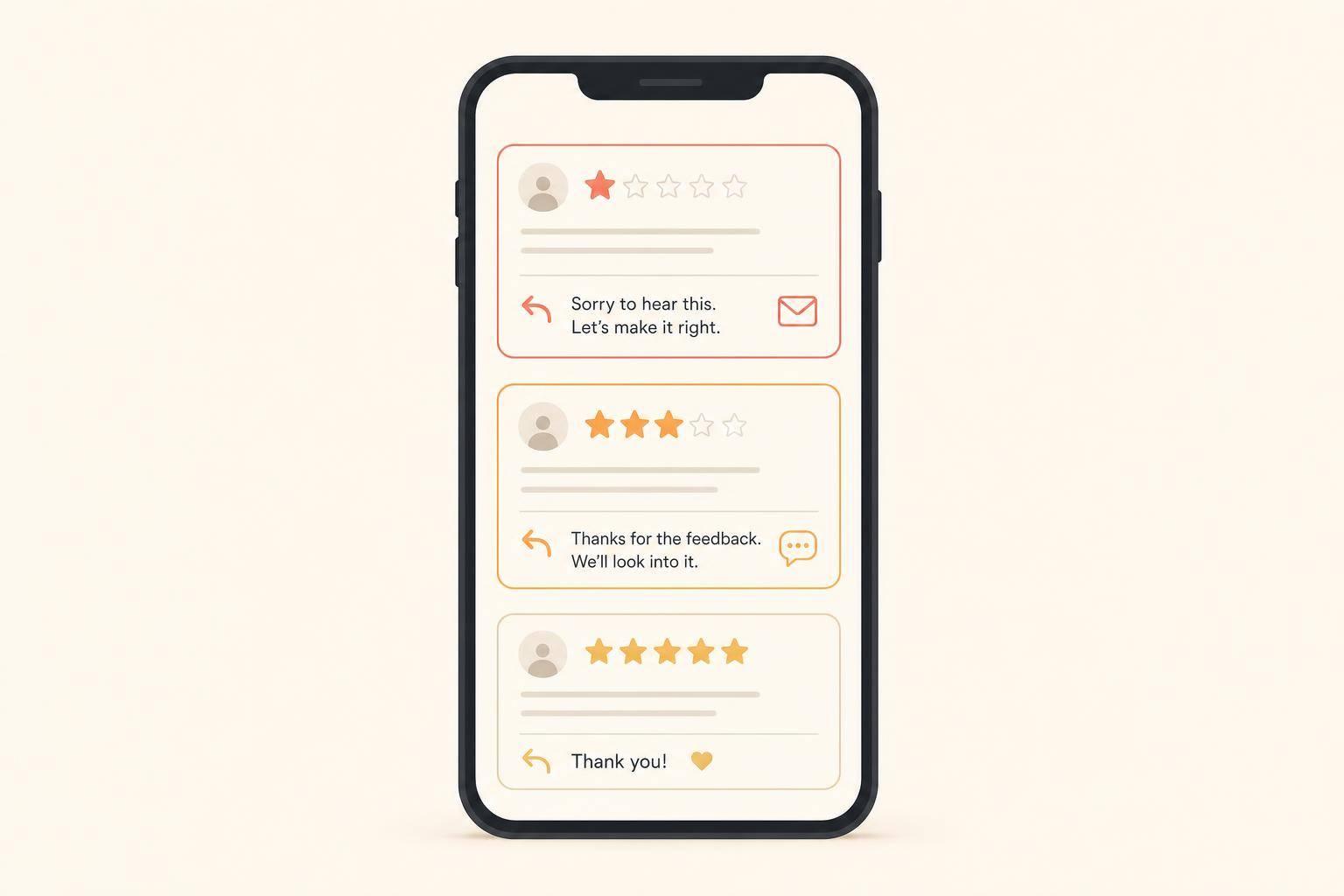
Humble Help simplifies the process by centralizing all incoming reviews, even for businesses with multiple locations [22][25]. From there, a two-tier response system kicks in: positive reviews get personalized, automated replies within minutes, while negative reviews are flagged for manual attention [16].
Google's ReviewReplyState system discourages overly generic responses [23]. To comply, Humble Help uses AI to draft replies tailored to the specific review - mentioning details like the service provided or the employee involved. However, every response is reviewed by a person before posting. For negative feedback, Humble Help uses the HEARD framework - Hear, Empathize, Apologize, Resolve, and Diagnose - to craft thoughtful responses [24]. Any sensitive matters are shifted to private channels, such as phone or email, to avoid messy public disputes.
"A two-week-old, unanswered one-star review is louder than the review itself." - Adrian Crismaru [22]
Fast responses deliver measurable results. For example, after implementing a two-tier system, Lakeview Climate Control, an HVAC company, reduced their average response time from 6.2 days to just 18 minutes. Over three months, their star rating jumped from 3.7 to 4.2, and their Google Business Profile (GBP)-attributed leads soared by 217%, climbing from 6 to 19 per month [16]. Additionally, 73% of unhappy customers are willing to give a business another shot if their concerns are addressed promptly, while 54% may even update their negative reviews after a successful resolution [30].
Humble Help doesn’t just respond to reviews - it actively helps businesses gather new ones. The focus isn’t on sheer numbers but on recency and consistency. In 2026, Google places more weight on fresh reviews, meaning a profile with 80 recent reviews can outrank one with 200 older ones [23].
"A profile with 80 reviews where five came in the last 30 days now consistently out-ranks a profile with 200 reviews where the most recent one was eight months ago." - Jacob Anderson, Logos Web Designs [23]
Humble Help’s Business CRM automates review requests via email and SMS, sending them within 24 hours of a completed service - when customer satisfaction is at its peak [26][27]. These requests include direct Google review links, making it as easy as possible for customers to leave feedback. The fewer clicks required, the higher the likelihood of follow-through [24]. SMS is especially effective, with conversion rates of 18–25%, compared to just 4–8% for email [28]. To avoid triggering Google’s spam detection, the goal is a steady flow of 4–8 new reviews per month rather than large, sudden spikes [28][29].
Here’s a quick comparison of different review management approaches:
| Approach | Time Investment | Response Quality | Response Speed | Risk Reduction | SEO Impact |
|---|---|---|---|---|---|
| Manual Management | High (hours per week) | Inconsistent | Slow (avg. 6+ days) | High (missed reviews) | Minimal |
| Hybrid (AI + Human) | Moderate (minutes/day) | High (AI-drafted, human-refined) | Fast (minutes-hours) | Low (automated alerts) | Strong |
| Fully Managed Service | Low (owner oversight) | Professional & on-brand | Immediate (SLA-backed) | Lowest (proactive monitoring) | Maximum |
For small business owners, especially in the Bay Area, finding time to monitor reviews, craft thoughtful replies, and track feedback can be overwhelming. Hybrid and fully managed solutions help bridge the gap, saving time while improving local reputation and search rankings. These strategies work hand-in-hand with a broader GBP approach to enhance visibility and customer trust.
Securing a strong position in the local Map Pack isn't a one-and-done task - it requires consistent effort. Humble Help zeroes in on key areas that align with Google’s monthly ranking signals. For instance, they recommend keeping the primary category highly specific (e.g., "Residential Electrician" instead of the broader "Electrician") and adding location-focused keywords to the Services tab. A good example might be "Electrical Panel Upgrade San Jose." Additionally, aligning the website's service pages with what’s listed on the Google Business Profile (GBP) ensures consistency.
"Google does not experience your business in isolated parts. It sees a network of signals... If those signals support each other, rankings tend to strengthen." - Up North Media [12]
Regular updates to the profile also matter. Uploading 2–5 new photos and posting 2–4 times each month signals to Google that the business is actively engaged. In 2026, GBP signals make up about 32% of the local pack ranking algorithm [33]. These efforts directly tie into the metrics Humble Help tracks monthly to improve rankings.
Humble Help uses data from GBP Insights and its proprietary Analytics Dashboard to evaluate performance. They focus on four key metric categories:
| Metric Category | What's Tracked | Why It Matters |
|---|---|---|
| Visibility | Geo-grid rank, top 3 share, Discovery impressions | Helps measure reach across neighborhoods, not just near the business location |
| Engagement | Calls, direction requests, website clicks | Reflects actual customer interest and intent |
| Trust | Review velocity, star rating, response time | Indicates reputation strength for both Google and potential customers |
| Conversion | UTM-tracked leads, form submissions, booked appointments | Links GBP activity to revenue outcomes |
Discovery searches - when users search by service or category instead of the business name - are especially important. Growth in this metric means the profile is reaching new, untapped customers [31][32]. UTM-tagged links, like ?utm_source=google&utm_medium=organic&utm_campaign=gbp, provide a clear way to track leads back to GBP activity [32][13]. These metrics serve as the foundation for monthly strategy adjustments.
Consistent updates and fresh content are just the start. Monthly data analysis is what drives meaningful strategy tweaks. For Humble Help, reports are more than summaries - they’re tools for decision-making.
"A local SEO report is not a screenshot folder. It is a decision document. If the report does not change what gets done next month, it is decoration." - Diakachimba Agency [32]
For example, if the data reveals high profile views but few calls, the solution might involve refining the business description or improving the call-to-action. If a competitor outranks the client in a specific area, geo-grid heatmaps can pinpoint visibility gaps - sometimes just a few miles away - and guide adjustments, such as adding localized service keywords or increasing posts targeting that area [32]. Seasonal businesses like HVAC or landscaping also benefit from year-over-year comparisons to identify real growth trends, as month-over-month data can be misleading [32].
Managing a Google Business Profile (GBP) is not a one-and-done task - it demands consistent effort. As Marija Azhderska from the Localith Team explains:
"Visibility drops when updates lag, trust erodes when reviews go unanswered, and brand consistency breaks when each location improvises its own process." [2]
Humble Help steps in every month to handle essential tasks like verifying data, posting localized updates, responding to reviews, refreshing photos, and monitoring performance. This regular upkeep ensures Bay Area businesses stay visible, attract customers, and remain competitive.
The numbers back this up. Profiles left untouched for 30 days see a decline in visibility, while businesses landing in the top 3 Map Pack positions enjoy a 30–40% increase in monthly calls. These improvements compound over time, building momentum across 3 to 12 months [1].
The key is treating GBP management as an ongoing process. Weekly responses to reviews, monthly updates to content and data, and quarterly audits of categories help maintain a profile's effectiveness. Humble Help takes it a step further by linking GBP activity to measurable business outcomes. Through UTM tracking and its free Analytics Dashboard, they connect profile engagement directly to leads, calls, and appointments [21][34].
For small businesses in the Bay Area, this structured approach transforms a Google listing into a dependable source of local customers. Humble Help's methodical strategy ensures these profiles deliver results month after month.
You might start seeing early indicators of progress - such as more search impressions or higher profile engagement - within just 2–4 weeks of consistent effort. However, noticeable ranking boosts and steady growth in local leads usually take around 3–6 months to materialize. In particularly competitive markets, this timeline can stretch to 6–12 months. Staying consistent is crucial - pausing your monthly efforts could slow down your progress or even set you back to square one.
Google Business Profile suspensions occur when a profile breaks the rules or displays questionable activity. Some typical reasons include adding extra keywords to the business name, listing addresses that aren't allowed (like P.O. boxes or virtual offices), having duplicate profiles, or providing inconsistent business details. Other triggers can be frequent or large-scale edits, working in industries prone to spam, or having a manager linked to a suspended account.
To show how Google Business Profile (GBP) generates leads, try using attribution techniques. For example, add UTM parameters to the GBP “Website” URL. This allows you to track sessions, calls, or form submissions directly tied to your profile. For phone leads, set up call tracking and log those calls into your CRM. This way, you can measure booked jobs and revenue based on their source. By enabling revenue tracking, you can link the entire funnel - from booked jobs to invoiced revenue - within your reporting dashboards.
Discover strategies to elevate your business.