No - AI search is not killing Google reviews. It is making them matter more. If I run a local business, I need to know this: AI tools now often decide which businesses get mentioned before people click anything. And those tools lean on reviews, profile data, and signals from across the web.
Here’s the short version:
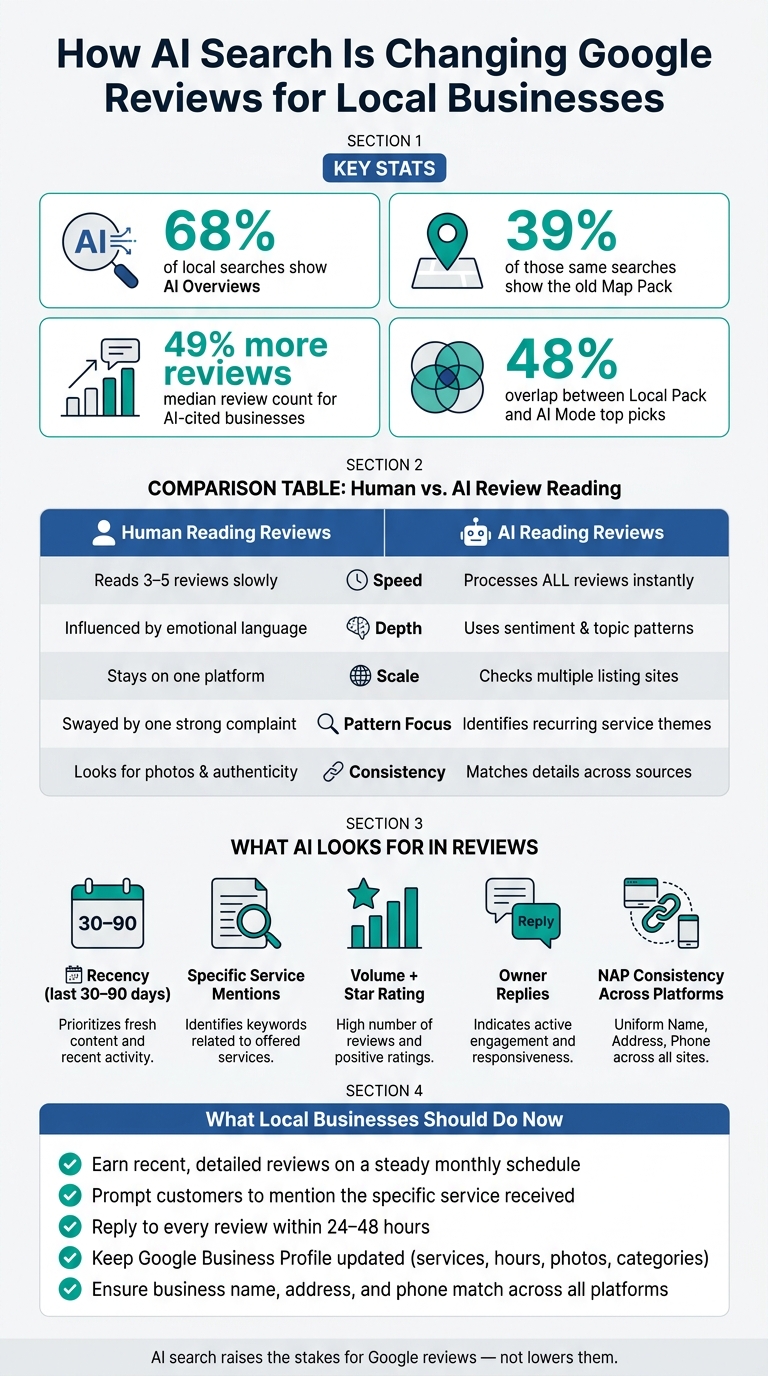
A few numbers stand out:
That means I can’t assume strong Map Pack rankings will carry me everywhere.
| Topic | What changed with AI | What I should do |
|---|---|---|
| Review visibility | Fewer people may read long review lists | Make each new review specific and useful |
| Ranking signals | AI looks at patterns, not just star ratings | Get steady recent reviews |
| Trust signals | AI compares data across sites | Keep business info matching everywhere |
| Profile strength | GBP data feeds AI answers | Update services, hours, photos, and categories |
| Review management | Replies add context | Respond to every review, good or bad |
Bottom line: if I want more calls, direction requests, and bookings from search in 2026, I need a steady flow of recent reviews, clear service mentions, active replies, and clean business listings. That’s the core shift this article explains.
AI Search vs. Local Pack: How Reviews Impact Local Business Visibility in 2026
Google ranks local businesses based on relevance, distance, and prominence. Reviews mostly influence prominence, which means they affect rankings, not just buyer trust.
Star rating and review count both matter. But in many cases, volume and recency matter more than a perfect 5-star score with very little recent activity.
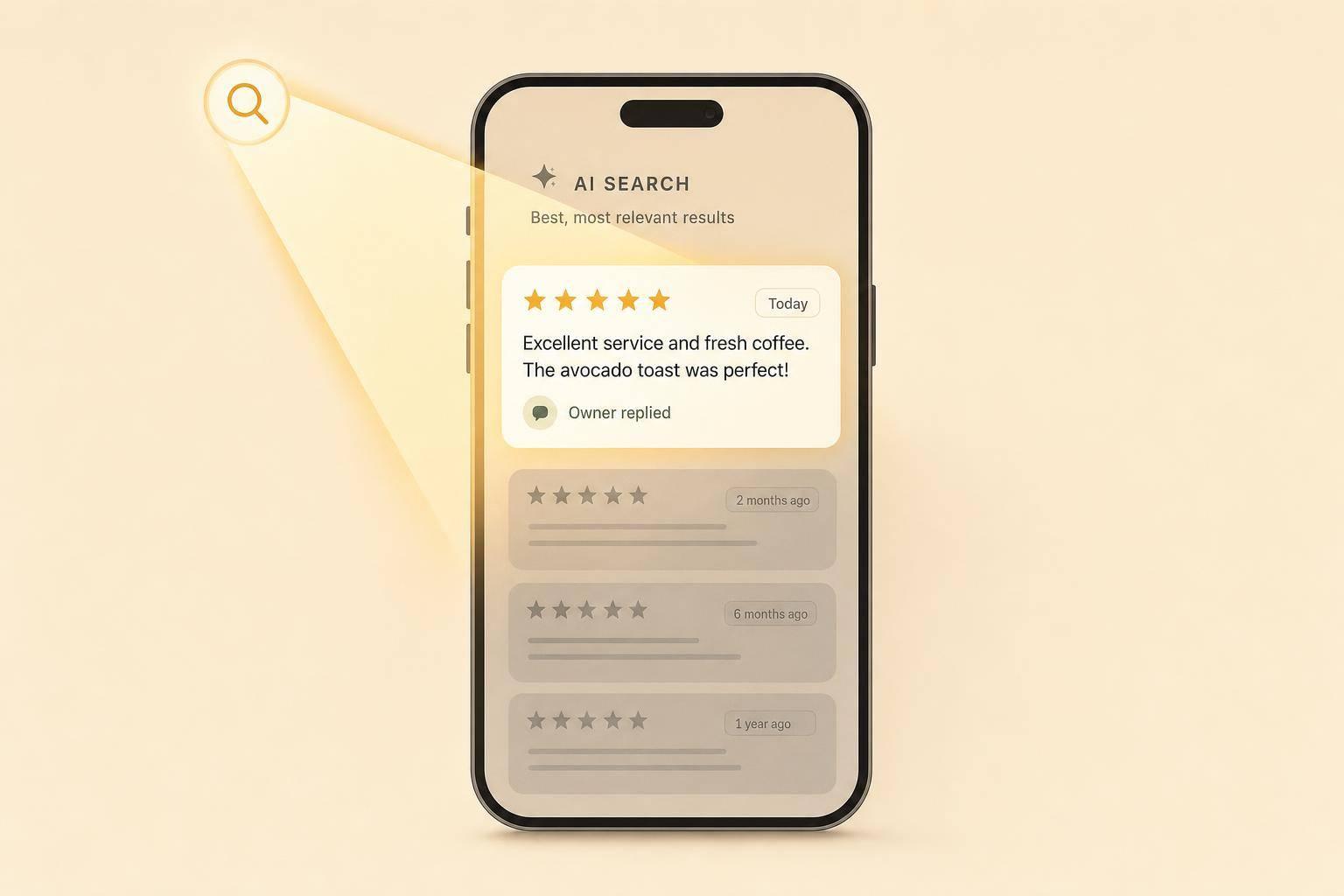
Review velocity plays a big part here. Fresh reviews tend to matter most. A steady flow of new feedback tells Google the business is active. Reviews posted in the last 30 to 90 days tend to carry the most weight [8].
Review text matters too, especially when customers mention services, products, neighborhoods, or nearby cities [6][1]. Those details help Google connect a business to local searches. If people keep mentioning the same service and the same area, that sends a pretty clear signal.
Owner responses matter as well. When a business replies to reviews, it shows the profile is active and being managed [1][3]. Put together, these signals help Google judge whether a business looks current, trusted, and relevant in its local area.
Take two plumbers in the same city. One gets a steady stream of recent reviews, and those reviews mention jobs like drain cleaning, water heater repair, or emergency service. The other has fewer reviews, most of them older, and they don't say much.
Google is more likely to show the first plumber for local searches tied to those services. Why? Because the review recency and review text give Google stronger relevance signals.
The main point is simple: Google tends to reward businesses that look trusted right now, not just businesses that were rated well a long time ago. Those same signals are also the ones AI systems compress, compare, and surface in their own recommendations. The next step is looking at how AI reads those signals a bit differently from people.
Most people read reviews in a pretty simple way: glance at the star rating, read a few recent comments, then decide. AI handles reviews differently. Instead of sampling a handful, it scans all of them and turns repeated themes into a summary.
That shift changes what matters most. Star ratings still count, of course. But detail, consistency, and recency carry more weight.
The gap is straightforward: people skim, while AI looks for patterns across a large set of reviews.
| Feature | Human Reading Reviews | AI Reading Reviews |
|---|---|---|
| Speed | Slow; scans 3–5 reviews | Instant; processes all reviews |
| Depth | Surface-level; influenced by emotional language | Analytical; uses sentiment and topic patterns |
| Scale | Limited to one platform | Checks other listings and review sites |
| Pattern focus | May be swayed by one strong complaint | Identifies recurring service themes |
| Consistency check | Looks for photos and authenticity signals | Checks for matching details across sources |
Specific details give AI clearer proof. A review that mentions the service, a staff member, or the result gives the model something concrete to work with [2][7]. Recent reviews also help AI read the business as active [8].
AI may cut down how often people click through to read individual reviews. But for local businesses, the more important point is this: strong, specific, and recent reviews can help your business get mentioned in the AI answer itself.
If AI can support your business with confidence, it is more likely to include you in the summary. And that kind of visibility now reaches more searches than the old local pack does [5].
The day-to-day takeaway is simple. A weak or stale review profile doesn't just hurt rankings. It also gives AI less reason to mention your business at all.
Once AI starts checking multiple sources, one strong Google profile isn't enough by itself. AI compares Google reviews with other public listings to see whether the same story shows up across the web [3][10]. If your business looks strong on one platform but much weaker on another, that mismatch can lower confidence.
That's why steady reviews and accurate business data matter more now. When your Name, Address, and Phone (NAP) details match across platforms, Google and AI are more likely to treat your business as one trustworthy entity [7][5].
The next move is simple: set up a system you can repeat. That’s how you turn customer feedback into review signals that AI can actually read and use.
Go for a steady stream of reviews each month instead of short bursts. Six recent reviews can carry more weight than 50 reviews from two years ago [3].
Timing matters too. Send a short review request right after the job, ideally within 24 hours. At that point, the work is still fresh in the customer’s mind, so they’re more likely to respond.
Your follow-up message should hint at the kind of detail you want. Mention the exact service in your note. For example: "Thanks for choosing us for your AC repair today." That small detail often nudges customers to mention the service in their review [4].
You can also steer them toward the details that matter most, like:
It also helps when the person who did the work asks for the review. If the technician or staff member makes the request, response rates can improve [1].
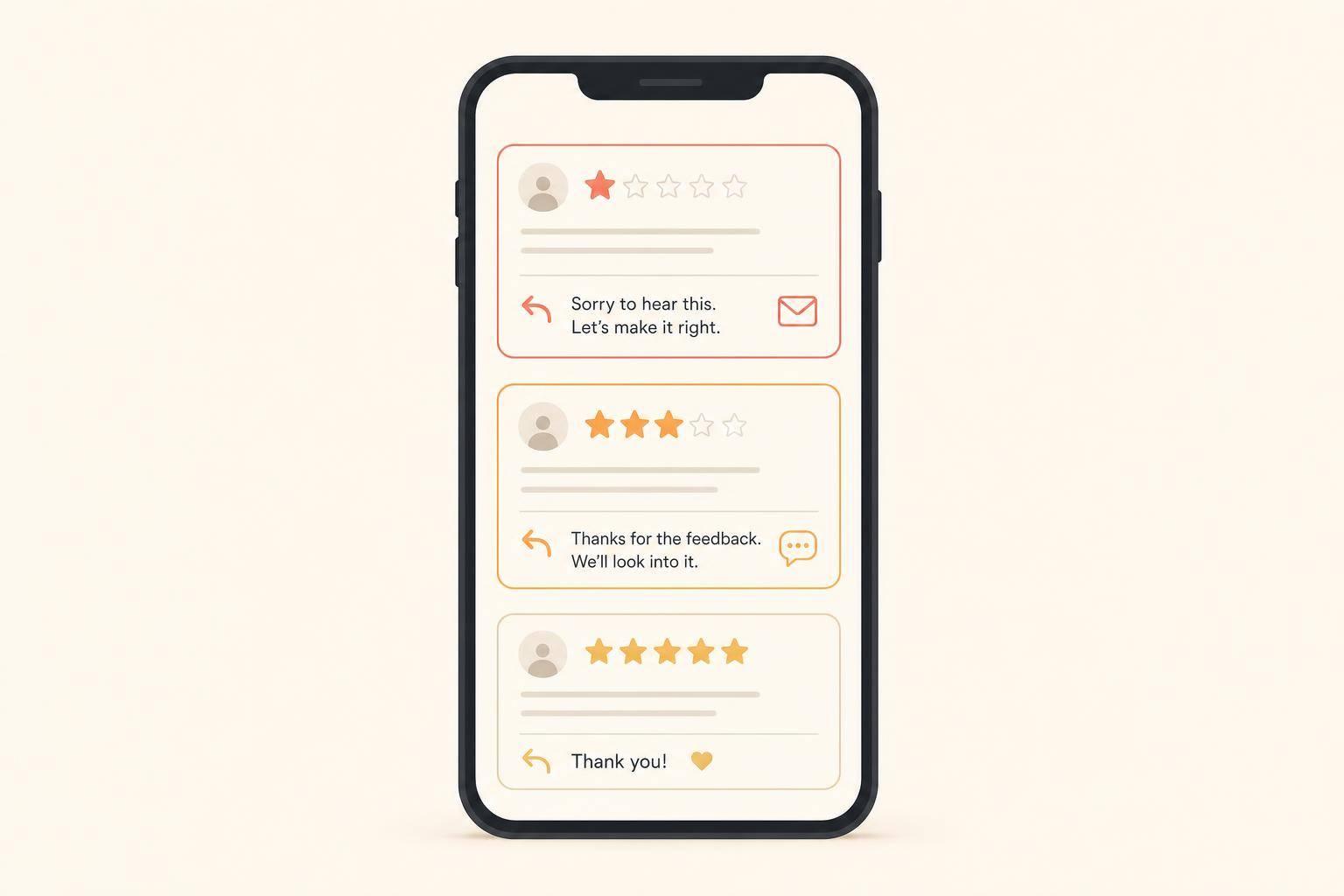
Owner replies do more than look polite. They add context and build trust. AI can read those replies as added content to confirm what your business does and where it works [2][6]. If your reply mentions the service and location, that gives AI one more signal that your business is active and paying attention.
Reply to every review promptly for 30 days [1][11]. If a review is negative, stay calm and focus on solving the problem. That does far more for your name than silence or an argument.
Reviews are only part of the picture. Your Google Business Profile (GBP) also needs to stay up to date. AI pulls structured data from your profile, including categories, services, hours, and photos, then uses that data in local summaries [3][5]. Check it every quarter.
The table below shows which actions affect which signals:
| Review Action | Primary Signal Improved | AI Impact |
|---|---|---|
| Steady monthly review flow | Recency & volume | Signals an active, reliable business |
| Prompting for service details | Keyword richness | Gives AI specific services to cite |
| Responding to all reviews | Engagement & trust | Adds owner-verified context to your profile |
| Fixing NAP inconsistencies | Entity confidence | Increases the chance of being cited in AI summaries |
| Adding service photos | Geographic legitimacy | Helps AI verify your local presence |
Once your Google reviews are coming in at a steady pace, make it easy for customers to leave feedback on other platforms too. A QR code at checkout that links to your review options is a simple way to do that [3].
AI search doesn't make Google reviews irrelevant - it raises the stakes. Instead of showing people a long list of reviews to scan on their own, AI often sums them up. That means the raw signals behind those reviews matter even more. Google reviews aren't going away; they're turning into machine-readable reputation signals. And that shift changes how businesses show up.
The numbers make the point. AI-cited businesses have a median 49% more reviews than businesses that aren't cited [9]. At the same time, only 48% of top Local Pack results overlap with AI Mode's top picks [9]. So ranking well in local search no longer means you're set everywhere. AI search and the Local Pack don't always favor the same businesses.
The response is pretty simple:
Stale reviews can throw AI summaries off and cause them to repeat old claims. In AI search, reviews that are recent, specific, and well managed can become a serious visibility asset.
There’s no one-size-fits-all number here. The right target depends on your industry and your location.
A simple way to find your baseline is to search your service and city on Google, then look at the top three local results. Compare their review counts. That gives you a practical benchmark based on what’s happening in your market.
In many cases, the gap between average and dominant can be in the hundreds of reviews. But consistency matters more than chasing a big total. A good goal is at least five new reviews per month, with recent, detailed feedback that mentions specific services.
Not automatically.
A profile with only perfect reviews can feel a little too polished, and AI systems usually see one or two negative reviews as normal.
What matters most is how you respond. A professional, thoughtful reply shows that someone is paying attention and cares about customers. AI visibility is more likely to drop when there’s a pattern of negative feedback, complaints that sit unanswered, or a profile that looks ignored.
Focus on detailed reviews, not just star ratings. AI reads the review text to find patterns and figure out what your business actually does.
The best reviews mention things like the service performed, location or service area, the customer’s problem, the timeline, and the outcome. Natural mentions of staff, neighborhoods, or specific results give AI more context about your expertise, relevance, and credibility.
Discover strategies to elevate your business.