Google's AI Overviews, powered by its Gemini models, are transforming local search by summarizing key business information directly at the top of search results. These summaries highlight 3–4 businesses, pulling data from sources like Google Business Profiles, customer reviews, websites, and third-party platforms. By 2026, they appear in over 60% of searches, reshaping how businesses gain visibility and attract leads.
Key Takeaways:
With AI Overviews now driving much of local search traffic, Bay Area businesses must ensure their digital presence is clear, consistent, and easy for AI to reference. Taking these steps can help secure a spot in these highly visible summaries.
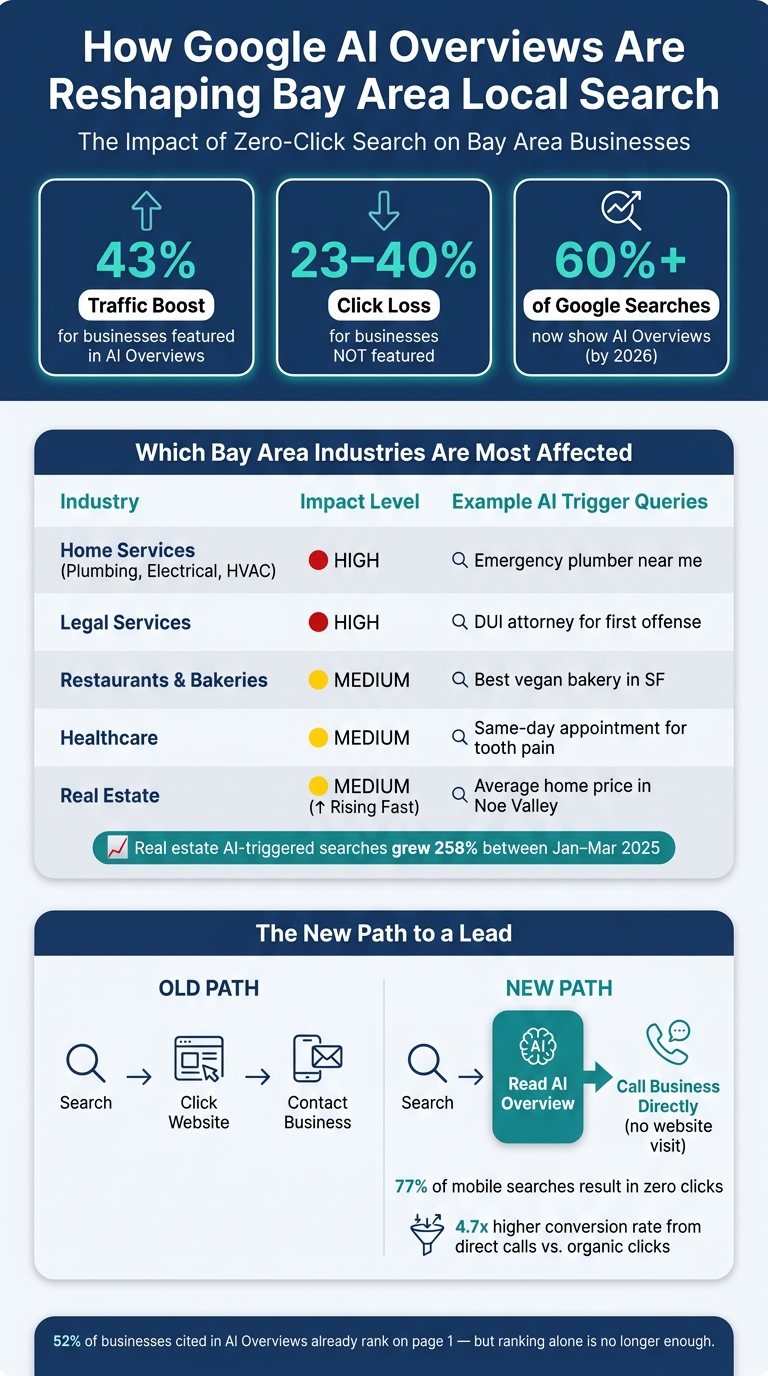
AI Overviews Impact by Industry: Bay Area Local Search 2025
To grasp how AI Overviews are reshaping local search, it's essential to understand how they gather and process information. These overviews rely on multiple sources to determine which businesses to highlight. Google's AI pulls data from your Google Business Profile (GBP), website content, structured schema markup, and even third-party platforms like Yelp, Reddit, and specialized directories [2][3].
Unlike the Local Pack, which mainly focuses on proximity, AI Overviews prioritize businesses that effectively address specific customer needs [2][5]. For instance, a plumbing company in Oakland with detailed service descriptions and specific customer reviews, such as "fixed a burst copper pipe in under two hours", is more likely to be featured than a closer competitor with minimal online information.
Interestingly, about 52% of businesses cited in AI Overviews are already ranking on the first page [5][3]. However, being on the first page isn't enough. Google's AI validates the information by cross-referencing it with third-party mentions to ensure accuracy and trustworthiness before including a business in its recommendations [5].
The most significant change brought by AI Overviews isn't about rankings - it's about how users behave after searching. With 77% of mobile searches resulting in zero clicks [6], many potential customers bypass websites entirely, opting to call businesses directly. These direct actions convert at a rate 4.7 times higher than traditional organic clicks [6]. For Bay Area businesses, this means website traffic might decline, even as phone inquiries remain steady or increase. This shift makes it harder to measure AI's impact using standard analytics tools.
"AI Overviews are showing up more and more for local searches, giving people direct answers without ever having to click. In local search, that means someone can search, read the recommendation, and call a business… without visiting a single website." - Jacob Statler, ProRankTracker [5]
The way this affects businesses varies by industry, as shown below.
The impact of AI Overviews isn't uniform across industries. Businesses that cater to urgent or high-trust needs are seeing the biggest changes.
| Industry | Impact Level | Common AI Trigger Queries |
|---|---|---|
| Home Services (Plumbing, Electrical, HVAC) | High | "Emergency plumber near me", "cost of AC repair in San Jose" |
| Legal Services | High | "Personal injury lawyer reviews", "DUI attorney for first offense" |
| Restaurants & Bakeries | Medium | "Best vegan bakery in SF", "outdoor dining near Oakland" |
| Healthcare | Medium | "Dentists that accept Medi-Cal", "same-day appointment for tooth pain" |
| Real Estate | Medium (rising fast) | "Average home price in Noe Valley", "best neighborhoods for schools in San Jose" |
Home services and legal firms are feeling the most disruption because their queries are often urgent and high-intent, making them prime candidates for AI-generated answers. Real estate, however, is quickly catching up. AI-triggered searches for real estate grew by an astonishing 258% between January and March 2025 [6], signaling rapid changes even in industries that were less affected initially.
For Bay Area businesses in these sectors, the search-to-customer path is becoming shorter. Those featured in AI summaries are capturing a larger share of leads, emphasizing the importance of optimizing online profiles and content to stay competitive. The upcoming sections will dive into how businesses can adapt to these changes effectively.
Getting your Google Business Profile (GBP) in top shape is crucial if you want to stand out in AI-driven local searches. GBP acts as the main source of structured data that Google’s AI uses to create search summaries. Megan Michelakos, Co-Founder of Trebletree, emphasizes this point perfectly:
"Your Google Business Profile (GBP) is the structured data that powers it all - and if it's missing details, AI just skips you." [7]
Businesses with complete profiles see 7x more clicks and are viewed as 2.7x more credible compared to those with incomplete profiles [7]. This advantage becomes even more pronounced with AI Overviews in play.
Start with the basics. Your business name should reflect your actual name - no keyword stuffing like "Best Plumber San Francisco - Fast & Affordable." Google flags these practices, and they can harm your visibility. Make sure your NAP data (Name, Address, Phone) is consistent across all directories, from Yelp to Apple Maps to Bing Places. Even small inconsistencies, like using "St." instead of "Street", can lower the trust score AI assigns to your business [1].
Choose a primary category that directly reflects your main service, and add secondary categories for other key offerings. For example, a San Jose HVAC company might use "HVAC Contractor" as the primary category and "Air Conditioning Repair Service" and "Furnace Repair Service" as secondary ones. If you don’t have a physical storefront, hide your address and clearly define your service areas to appear in searches for the neighborhoods you serve.
Don’t forget to link your social media accounts, such as Facebook, Instagram, and LinkedIn, to boost your profile’s credibility [7].
Once these core details are in place, you can focus on fine-tuning your profile even further.
Use the 750-character description to clearly explain what your business does, who it serves, and where it operates. Be specific and include examples like “offering 24/7 emergency plumbing in San Francisco” to give AI the context it needs. Google’s AI prioritizes descriptions that answer potential customers’ questions rather than just listing keywords [1].
Take advantage of Google’s new AI-powered "Suggest description" tool, which drafts text based on your profile and website data [8]. Use this as a starting point, but tweak it to include hyper-local details the AI might miss. Additionally, create individual service listings with short, clear descriptions. These listings act as extra signals to help AI connect your business to relevant searches.
Your profile details are important, but customer reviews and Q&A sections play a huge role in signaling your reliability and service quality. Google’s AI scans reviews for specific details about services, locations, and outcomes to determine how confidently it can recommend your business [2].
"A review that says 'Fixed our boiler same day, arrived within 2 hours, explained the fault clearly' is far more useful to Google's AI than 'Great service, 5 stars'." - Get AI Visible [2]
When asking for reviews, encourage customers to include details about the service they received and their neighborhood. Aim for 40+ detailed, service-specific reviews to hit what researchers call a "High Impact" visibility tier for AI-driven results [2]. When responding to reviews, naturally mention your service type and location. These responses act as additional engagement signals for Google’s AI.
The Q&A section is another powerful tool. Add common customer questions and provide clear, concise answers in 2–4 sentences. This straightforward format makes it easy for AI to extract and use the information in search summaries [2].
Once you've fine-tuned your Google Business Profile, the next step is making sure your website content complements AI Overviews. While your profile grabs AI's attention, your website provides the details that seal the deal. Google's AI looks for clear, concise passages that can be easily included in summaries. Structuring your site to make this information accessible is key [10].
Google's AI Overviews are triggered by 98% of informational queries [9]. Think of questions like, "What’s the cost of roof repair in San Francisco?" or "Best HVAC services in SoMa." To stand out, your service pages need to address these questions directly and avoid burying answers in lengthy paragraphs.
The best strategy? Use an answer-first structure. Start each page with a concise, 60–100 word response directly under your H1 heading. Follow this with H2 and H3 subheadings that reflect actual customer questions, each paired with a short 2–4 sentence answer. Oleg Kovalev, Founder & Partner at ASP Marketing, emphasizes:
"Passages matter more than pages. A 3,000-word article with one clean 80-word answer paragraph can outperform a shorter page where the answer is buried." [11]
For Bay Area businesses, consider creating landing pages for specific neighborhoods like the Mission District, SoMa, or the Financial District. Tailor the content to address local, seasonal needs - for example, catering demands during Pride Week. Adding structured data, such as FAQPage and LocalBusiness JSON-LD schema markup, can make these pages about 2.5 times more likely to be cited in AI Overviews [11]. This approach helps establish your local relevance and authority.
Once your content is in place, consistent citations are essential for boosting your site's authority. Brand-owned content makes up 47% of AI Overview citations, while affiliate channels and publishers account for 84% of all earned media sources cited [9]. To strengthen your trust score, ensure your Name, Address, and Phone number (NAP) are consistent across all directories. Also, make sure AI crawlers have full access to your site via robots.txt [2][10].
To go a step further, aim to get mentions on respected local platforms or community websites. Citations from trusted local sources can significantly enhance your credibility.
Highlight detailed reviews from your Google Business Profile directly on your website. Focus on testimonials that mention specific neighborhoods, services, or outcomes. For example, a review like "our kitchen remodel in the Castro" or "same-day response in Palo Alto" provides valuable geographic and service context for AI [2][12].
Guy Sheetrit of Over the Top SEO explains:
"A page cited in an AI Overview can appear at the very top of the page - above the #1 organic result - even if it ranks #8 or lower in traditional organic listings." [10]
This shows how impactful a well-placed testimonial or case study with local details can be. By showcasing specific reviews, you can elevate your content's visibility in AI summaries, making this one of the most effective updates you can implement right now.
Here’s a straightforward guide to help Bay Area businesses carve out a spot in AI-driven search results. These steps build on the optimization strategies discussed earlier.
Start by assessing your current position. Open an incognito browser window and search for your core service alongside your city (e.g., "plumber SoMa San Francisco"). Look for your business in the results - are you mentioned, or are competitors dominating? [1]
Next, perform searches on platforms like Gemini, ChatGPT, and Perplexity. Identify which competitors are consistently cited as trusted sources. Pay close attention to the sources these AI tools rely on: nearly half (47%) of AI Overview citations come from pages that rank below position #5 in organic search [1].
"Being the closest business to the searcher is not enough on its own. Your business profile, your website content, your reviews, and your proof all have to do more of the heavy lifting." - Richard Kastl, Founder, Your Web Team [4]
Also, verify the consistency of your business’s NAP (Name, Address, Phone number) across directories. Even small inconsistencies can weaken the trust signals that AI systems use to validate your business (refer back to the optimization steps in the previous section) [1].
Once you have a clear understanding of your standing, focus on the updates that will deliver the most impact.
After identifying gaps, prioritize updates based on their potential impact. The table below highlights tasks that offer the greatest return on effort:
| Task | Effort | Impact |
|---|---|---|
| Update GBP categories & services | Low | High |
| Fix NAP inconsistencies across top 50 directories | Medium | High |
| Add LocalBusiness schema to your site | Medium | High |
| Launch a consistent review request system | High | High |
| Create district-specific landing pages | High | Medium |
Start with tasks that require minimal effort but deliver big results - like updating your Google Business Profile (GBP) categories and fixing NAP inconsistencies. Then, move on to medium-effort tasks such as adding schema markup and creating a system to regularly request reviews. Businesses cited in AI Overviews experience a 43% increase in traffic, while those left out see a 23% decline [1]. Shifting from "invisible" to "cited" can make a measurable difference.
Once these critical updates are in place, focus on maintaining your visibility with regular follow-ups.
Visibility in AI-driven search isn’t a one-and-done effort. It requires consistent upkeep. A great way to kick things off is with a 30-day sprint. During this period, fully update your Google Business Profile, start sending review requests after every job via text or email, and enhance your top five service pages with local proof and FAQs [4].
After completing the sprint, transition to a monthly routine to sustain visibility. Use tools like Search Console to track performance and monitor changes in branded search volume, calls, and direction requests from your GBP. These metrics provide insight into whether your AI visibility is driving leads [4].
For ongoing management, tools like Milo AI can help you identify priorities without needing deep SEO expertise. Pair it with Local Falcon to track local rankings and measure shifts in visibility month by month [4]. The goal isn’t to achieve perfection - it’s to stay consistent while your competitors fall behind.
Google's AI Overviews have taken center stage in search results, showing up above paid ads, the Local Pack, and traditional organic listings. This means businesses featured in these overviews grab attention before users even start scrolling. With AI Overviews now appearing in over 60% of all Google searches [1], this isn't some distant trend - it’s already shaping which Bay Area businesses are getting calls and clicks today.
Here’s the silver lining: most local competitors haven’t adapted yet. As of 2026, there’s still time to act and gain an edge before others catch on. Staying competitive in the Bay Area market means taking immediate steps to adjust to this shift.
"AI Overviews are not a separate channel to optimize for - they are the outcome of getting every foundational local SEO signal right, consistently, across your entire digital presence." - GMBMantra [1]
To stay ahead, start by focusing on your Google Business Profile. Ensure it’s fully optimized, maintain accurate and consistent NAP (Name, Address, Phone) data, use structured schema markup, and encourage detailed customer reviews. These actions help AI identify and prioritize your business for local searchers. Importantly, semantic completeness - making your content clear and easy for AI to interpret - now outweighs traditional domain authority [1].
The shift to Generative Engine Optimization (GEO) doesn’t require a complete overhaul, but it does demand precision and consistency. Businesses that make their digital presence easy for AI to understand and reference will consistently outperform others, regardless of how long they’ve been around. Keep refining your online signals to stay visible and relevant in this rapidly evolving AI-driven search landscape.
Discover strategies to elevate your business.