If your Google Business Profile is weak, you can lose local traffic even with a good website.
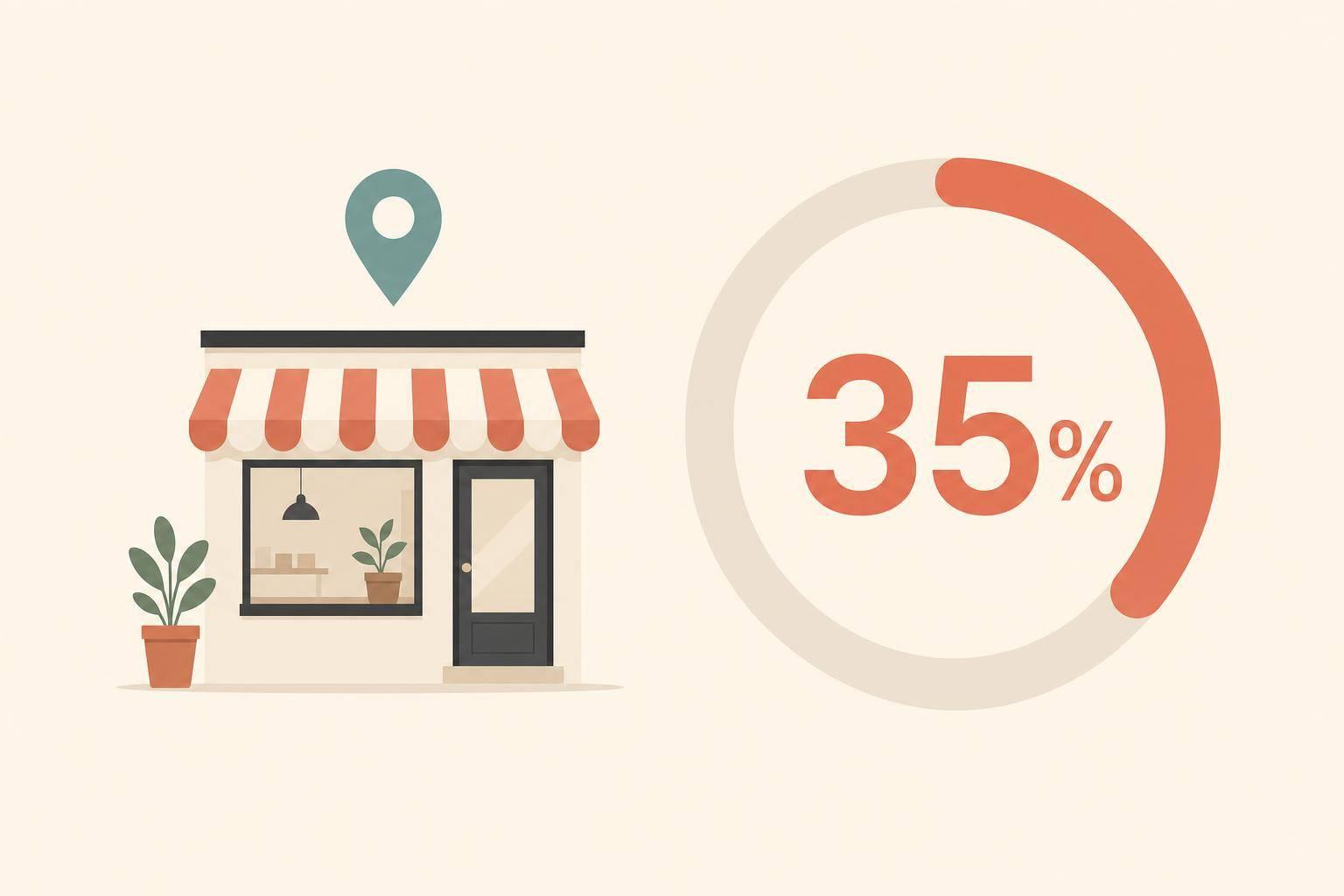
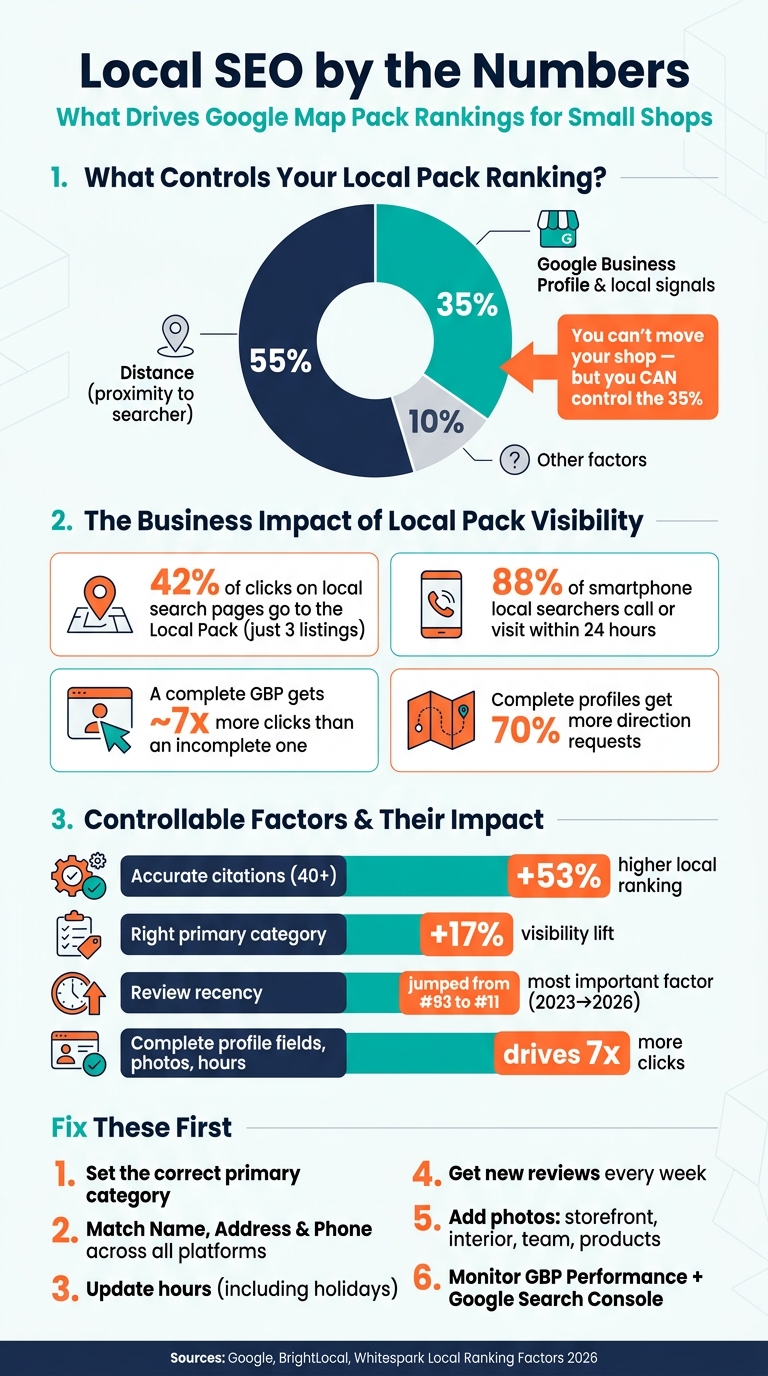
When I boil this down, the point is simple: about 35% of Local Pack ranking comes from Google Business Profile and related local signals, while distance drives about 55%. I can’t change where a customer stands when they search. But I can fix the parts a shop owner controls: category, hours, reviews, photos, and business details.
Here’s what that means in plain terms:
So the issue is not just ranking. It is calls, map taps, store visits, and missed sales.
If I were fixing this fast, I would start here:
This article makes one point: for a small shop, local search is often the shortest path from Google to the front door.
Local SEO by the Numbers: What Drives Google Map Pack Rankings
Local ranking share matters because it decides whether nearby searchers see your business or someone else’s first. And when a person searches for “bakery near me” or “emergency plumber open now,” they’re often ready to act right away.
That’s why the Local Pack matters so much for a small business. Those three map listings at the top of Google get prime attention. For many searches, the Google Business Profile is the first place people see a phone number, address, and hours [6].
The Local Pack gets roughly 42% of all clicks on a local search results page [2]. That means just three listings take a huge share of attention. For a plumber taking urgent service calls, a retailer looking for weekend foot traffic, or a caterer waiting on quote requests, landing in those top spots can lead to more calls, more direction requests, and more visits.
The speed of response is striking too. 88% of smartphone users who run a local search visit or call the business within a single day [2]. In many cases, the search ends right on the profile, without a website visit at all [6].
Take two bakeries in the same area. One keeps its Google Business Profile complete and up to date. The other leaves details missing or outdated.
The gap adds up fast. A complete Google Business Profile gets roughly 7 times more clicks than an incomplete one [5]. It also gets 70% more direction requests [5].
On the ground, that can mean more phone calls, more people asking how to get there, and more walk-ins. In most cases, those gains come from the basics done well: profile setup, reviews, photos, and local relevance.
Google ranks local results using three main signals: relevance, distance, and prominence. The catch is that you can only control part of that.
Relevance is how closely your profile matches what someone searched for. Distance is how far the searcher is from your business. Prominence is about trust and authority - things like reviews, local backlinks, and consistent business details across the web.
Proximity makes up about 55% of the local pack ranking decision [1][5]. And no, you can't pick up your storefront and move it closer to every customer. For most small shops, the best path is to improve the signals Google can check from your profile and online presence. Those signals also tie straight to calls, direction requests, and in-person visits.
Once you understand those three signals, the next step is figuring out which parts of your profile have the most weight.
Your primary category is the strongest signal most owners can control. It tells Google what kind of business you are and which searches you should show up for. If that category is too broad or just plain wrong, your profile may miss the searches that matter.
Review velocity matters too. In 2026, review recency jumped from the 93rd most important factor to the 11th [7]. That means a steady flow of new reviews can matter more than having a big pile of old ones.
A full profile tends to get more engagement than a thin one [4][5]. That includes filling out your services, products, and attributes. Photos matter too. Profiles with lots of photos get far more clicks than sparse listings [5]. Hours also play a part. If Google can show that you're open when someone is searching, that can help both visibility and customer convenience [7][3].
A lot of owners lose ground in simple ways.
The biggest one is picking a vague primary category. If you choose "Store" instead of "Hardware Store", or "Contractor" instead of "Roofing Contractor", Google has less to work with. It may not connect your profile to the right searches. Fixing a mismatched primary category can lift local visibility by about 17% within weeks [5].
Another common problem is inconsistent name, address, and phone details. When those details don't match across the web, Google's trust in the business can slip. Businesses with 40 or more accurate citations rank 53% higher in local results [2].
Special hours are another easy place to stumble. If your profile says you're closed when you're open - or open when you're closed - you can lose visibility for high-intent "open now" searches. Updating special hours takes only a few minutes, and the ranking effect can show up fast [7][3].
These are usually the first things worth fixing before you spend time on anything else.
Use a few simple tools to figure out which local signal is dragging your profile down.
The fastest way to check whether your profile is doing its job is the Performance tab in Google Business Profile. It shows how people found you and what they did next, like calls, direction requests, and website clicks.
The main split to watch is Discovery vs. Direct searches.
If Discovery impressions are low, one of the first things to check is your primary category. It may not match what you do, or it may be too broad.
If impressions look fine but actions are weak, the problem is often trust and completeness. A thin profile can still show up in search and then lose the click.
Google Search Console helps you see which queries are sending people to your site. That gives you a way to compare website traffic with demand showing up in your GBP listing.
To find local traffic, filter the Performance report for queries that include:
One practical step: link your Google Business Profile to a dedicated location page and add tracking tags to the URL. That makes it much easier to see which clicks came from the profile in your reports.
Reviews tell you a lot about trust, recency, and whether you're replying to customers. Those signals feed straight into prominence. Trying to track all of that by hand across sites gets messy fast.
What helps most is a simple system that flags two things:
Review recency is now the 11th most important local ranking factor, up from 93rd in 2023 [7]. So a steady stream of new reviews can matter more than a big total that hasn't changed in months.
Use these signals as a quick triage guide across the article's core levers - relevance, trust, and completeness:
| Diagnostic Signal | First Fix |
|---|---|
| Low Discovery impressions | Audit and correct your primary category |
| High impressions, low actions | Add photos and complete missing fields |
| New reviews are slowing | Start a consistent review request cadence |
| Missing or wrong hours | Update hours, including holidays |
These diagnostics show you where to start first.
The diagnostics in the previous section show where things are going wrong. Start with the fixes that matter most, especially the fields Google uses to sort and label your business.
Fix your primary category first. That single field tells Google what you do, and it affects which searches you can show up for.
Then clean up your core business details across the web. Your name, address, and phone number should match on Google, Apple Maps, Yelp, Bing, and your website. No small differences. No old phone numbers. No old suite numbers.
Your hours matter too. Keep them current, including holiday hours and special hours. If someone sees one thing on Google and finds something else in person, trust drops fast.
Once those basics are in good shape, move to trust signals.
Start asking for a few new reviews each week. It doesn’t need to be a big campaign. A steady flow is better than a sudden spike.
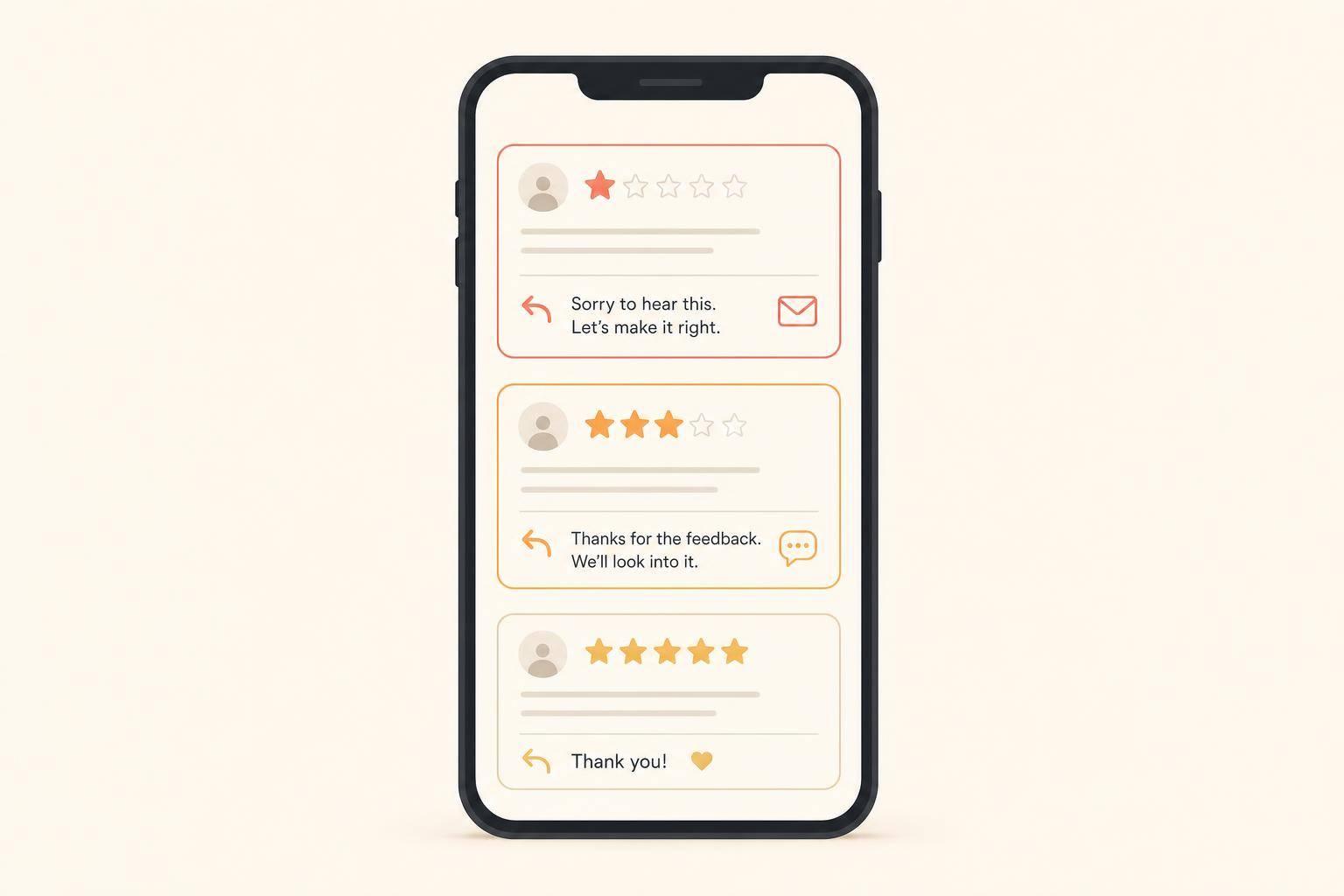
Reply to reviews within 48 hours when you can. That response pace shows Google the business is being actively managed [4].
Photos help too. Add clear images of your:
Then upload new photos each month. It’s a simple habit, but it can help lift click-through rates over time.
GBP changes often lead to measurable results pretty fast. You may see early ranking movement within 2 to 4 weeks after optimization. Bigger, longer-lasting gains usually show up in 1 to 3 months if you keep working at it consistently.
Some fixes can move the needle even faster. For example, correcting your primary category may help within a few days. But if you're in a tough market or need more reviews, stronger progress can take 3 to 6 months.
Yes, but distance from the searcher is a major fixed factor that you can’t directly change. Many top Local Pack results go to businesses within 1 to 3 miles of the person searching.
What you can work on is relevance and prominence. Keep your Google Business Profile accurate, earn steady reviews, and make sure your categories match local search intent.
If your profile is unverified, duplicated, or suspended, fix that first. Until that’s sorted out, nothing else matters.
Otherwise, focus on the basics that move the needle:
Discover strategies to elevate your business.