Before you spend on Google Ads, make sure your Google Business Profile (GBP) is optimized. A poorly maintained profile wastes ad dollars and hurts your visibility. Here's what you need to do:

Google Business Profile Audit Checklist for Small Businesses
Start by ensuring you have control over your Google Business Profile. It's not uncommon for Bay Area business owners to discover that a former employee, web agency, or even a family member claimed the profile, leaving them locked out.
To check, search for your business name on Google. If the Knowledge Panel shows "Own this business?" or "Claim this business", it means your current account doesn't have control. However, if you see an "Edit profile" button while signed in, you already have access. Once verified, head to the "Owners and managers" section and remove any accounts that no longer need access.
If someone else manages the profile, you can request ownership at business.google.com/add. The current owner has three days to respond [1]. Be cautious - Google Business Profile is completely free. If anyone asks for payment to verify or reinstate your profile, it's a scam.
Your NAP - Name, Address, and Phone number - needs to match perfectly across all online platforms, including your Google Business Profile, website, Yelp, and Facebook. Even small inconsistencies, like using "St." on one platform and "Street" on another, can hurt your search rankings [4].
"NAP consistency (name, address, phone) across all directories is a baseline requirement." - Vaza.ai [4]
To check for discrepancies, search your business name and phone number online. Note any variations and decide on a single, consistent format - for instance, always using "Ste." instead of "Suite" - and apply it everywhere.
Accurate business hours and service area details are critical to avoid frustrating customers. Imagine your profile says you're open until 6:00 PM, but you actually close at 5:00 PM on Fridays. Customers showing up at the wrong time could leave disappointed, leading to negative reviews. Double-check that your hours reflect your actual schedule, including weekends and any holiday adjustments [5].
For businesses that operate on the go or from home, clearly define your service area to avoid potential profile suspension [6].
Once these foundational details are verified, you're ready to move on to optimizing categories, attributes, and services in Step 2.
Your primary category is one of the most important ranking signals for your Google Business Profile (GBP). The trick is to be precise - specific categories like "Italian Restaurant" outperform broader ones like "Restaurant" when it comes to relevant searches. As Lead Oracle AI explains:
"The category that captures the highest-value search intent is the right primary category, not the category that sounds most comprehensive." [7]
In addition to your primary category, Google allows you to add up to nine secondary categories. Surprisingly, many Bay Area businesses leave these slots empty, missing out on valuable opportunities. For example, a plumber in San Jose might set "Water Heater Installation Service" as the primary category and include secondaries like "Drainage Service" and "Gas Installation Service" to cover a wider range of search intents. To get ideas, open an incognito browser, search for your service, and study the top three businesses in the Map Pack. Note which categories they’re using that you might have overlooked.
Once your categories are set, move on to fine-tuning other profile details to further improve your visibility.
Attributes are the small but powerful checkboxes in your GBP dashboard - options like "wheelchair accessible", "women-owned", "free estimates", or "outdoor seating." These act as filters for search results. For instance, if someone in the Bay Area searches for a "women-owned coffee shop near the Mission District" and you haven’t toggled that attribute, your profile won’t show up. Many businesses overlook 5–10 relevant attributes, so take the time to go through every option and enable everything that applies to your business.
Your business description is another area where details matter. With 750 characters available, focus on highlighting your key services and location in the first sentence, as that’s what’s most visible. For example, a yoga studio in the Sunset District might write: "Offering beginner and advanced yoga classes in San Francisco's Sunset District, with evening and weekend sessions for working professionals." This approach packs in a service, a neighborhood, and a target audience - all in one concise sentence.
Once you’ve nailed your categories and attributes, the next step is to optimize your services and ensure your booking options are seamless.
The services section is often underutilized. Instead of simply listing something like "Haircut", add a 2–3 sentence description for each service. Mention specific techniques, hair types, or price ranges to capture more search queries. For retail businesses, don’t forget to populate your product catalog. A detailed catalog can push individual items directly into search results, increasing click-through rates.
Finally, test your booking link to make sure it directs users to a location-specific page rather than your homepage. Broken or misdirected booking links can quietly hurt your conversions. Worse, if your response times consistently exceed 24 hours, Google might disable the messaging feature altogether [7].
Photos play a big role in your Google Business Profile (GBP) ranking. According to a 2026 study, they account for 20% of your ranking weight [10]. Businesses with at least 20 high-quality photos get 35% more clicks and 42% more direction requests compared to those with fewer images [10]. Think of your photo gallery as your visual storefront - it showcases your offerings, location, and identity.
Here’s a quick guide on what to upload:
| Photo Category | Recommended Quantity | Purpose |
|---|---|---|
| Exterior | 3–5 | Helps customers find your entrance and parking |
| Interior | 5–10 | Highlights atmosphere, cleanliness, and professionalism |
| Team/Staff | 3–5 | Builds trust and personal connection |
| Products/Services | 5–10 | Displays quality and variety of what you offer |
| Video | 1+ per month | Has double the ranking weight of static photos [10] |
Rename your image files with descriptive keywords before uploading. For example, use "san-jose-plumber-water-heater-installation.jpg" instead of "IMG_4823.jpg." When shooting exterior photos, aim for early morning or late afternoon to capture the best lighting. To keep your profile fresh, upload one new photo each week [9].
Once your visuals are in top shape, focus on keeping your profile active with regular updates.
Google Posts expire after seven days, and inactive posts can make your profile feel outdated. Profiles that post at least twice a week rank 23% higher than those that don’t [10]. Sticking to a simple schedule can help: post on Monday to highlight a promotion, Thursday to share a business update, and Saturday to announce upcoming events.
Keep these tips in mind for your posts:
Tanner McCarron, Founder of Dyad Marketing, explains:
"Google's 2026 algorithm puts serious weight on profile activity, and businesses that post weekly see higher visibility than profiles that go quiet for months at a time." [11]
To maintain this momentum, actively engage with customer reviews.
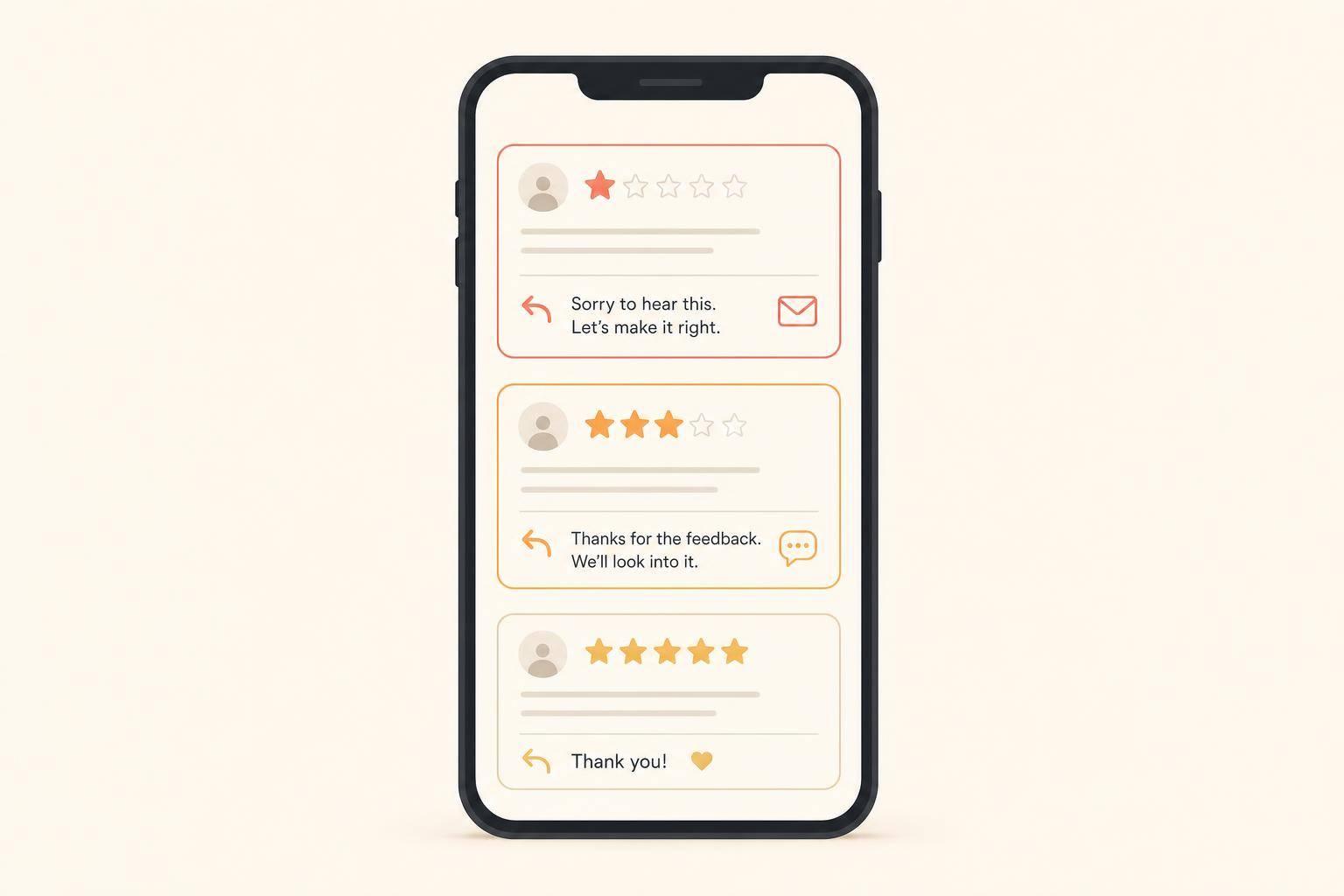
Your reviews are often the first thing potential customers notice, and they’re a key trust signal for Google’s ranking. Focus on review velocity - frequent and recent reviews show that your business is active and relevant [11].
To encourage reviews ethically, follow up with customers after a visit or service via email or SMS, asking them to share their experience. Avoid buying reviews, as Google penalizes businesses that do [8].
When responding to reviews, aim to reply within 24–48 hours [11]. For positive reviews, thank the customer by name and reference a specific detail they mentioned. For negative reviews, acknowledge the issue, apologize sincerely, and suggest continuing the conversation offline. Always write responses as if future customers will read them - because they likely will [11].
If you come across a review that violates Google’s policies (like hate speech or obvious fake content), report it with one detailed explanation instead of flagging it multiple times.
Before diving into advertising, take a close look at your Google Business Profile (GBP) dashboard's Performance tab, which offers up to six months of data [12]. Key metrics like calls, website clicks, direction requests, and search queries provide valuable insights. For instance:
As Claire Carlile, a Google Business Profile Platinum Product Expert, points out:
"It's not just a question of knowing where to look to access the most useful data, but how to interpret it and use that insight to plot a suitable course of action." [13]
One thing to note: the "Calls" metric only tracks mobile calls. This means if your audience tends to use desktop devices and dials manually, your actual call volume could be higher than what GBP reports [12]. To ensure accurate data, double-check your website link and tracking setup before moving forward.
Your GBP website link should direct users to the most relevant page - usually your homepage or a location-specific landing page - not a generic contact page. Matthew Edwards, Founder of Mars Digital, emphasizes the importance of this:
"The most important things our agency looks for when performing an audit is missing and inaccurate information... We're talking about incorrect phone numbers or old website URLs that don't exist anymore." [15]
To track traffic effectively, attach UTM parameters to your GBP URL, such as ?utm_source=google&utm_medium=organic&utm_campaign=gbp. This helps you differentiate between organic and ad-driven traffic [15]. Additionally, ensure your Name, Address, Phone number, and Website (NAPW) details are consistent across your GBP, website, and other directories. Inconsistencies can confuse both Google and potential customers [15].
For basic insights, the free Performance tab in GBP is a great starting point. But if you need a more detailed analysis, tools like AgencyAnalytics - which offers a 14-day free trial - can consolidate GBP insights, keyword rankings, and call tracking into one easy-to-use dashboard [15]. This ensures you’re fully informed about your numbers and can maximize the effectiveness of your ad spend.
With your data reviewed, links verified, and tracking set up, your GBP is ready to assess ad performance. These steps complete your profile audit, setting the stage for a successful advertising campaign.

Maintaining a high-performing Google Business Profile (GBP) requires ongoing effort. This means keeping your core business details accurate, selecting the right categories and attributes, using engaging visuals, encouraging reviews, and monitoring performance regularly. Businesses with well-maintained profiles enjoy higher click-through rates, which is crucial in a landscape dominated by mobile and voice search. Neglecting your profile can put you at a disadvantage against competitors. Every step of your audit - from verifying ownership to tracking performance - helps keep your GBP effective and relevant.
"Getting Yogolandia on Google was absolutely key. It truly legitimizes you as a business. It's free, there are photos, and we've gotten phenomenal reviews." - Yogolandia Yogurt and Botana Bar [8]
With the basics covered, follow these steps to keep your profile optimized and working for you.
Start by verifying ownership and ensuring your Name, Address, and Phone (NAP) information is consistent. Then, move on to refining categories, updating visuals, and analyzing performance data. Once your profile is polished, plan for a monthly review to double-check essential details like hours, service areas, photos, and links [2][3]. Managing this yourself typically takes 5–10 hours each month [3]. If that's more than you can handle, professional GBP management services are available, costing around $125–$400 per month per location [3].
Use your audit checklist regularly to keep your profile current and ready for ads. Leverage the GBP Performance tab to track key metrics like direction requests, calls, and search queries. This data will give you a solid foundation to measure success before investing in advertising.
Before diving into Google Ads, it's crucial to make sure your Google Business Profile (GBP) is in top shape. Start by confirming that your profile is both claimed and verified. Double-check that your business name, address, and phone number (NAP) are consistent across all platforms. Any inconsistencies here can confuse potential customers and even hurt your visibility.
Next, ensure every detail on your profile is accurate and fully filled out. This includes selecting the right categories for your business, which helps Google understand what you offer and match you with the right audience.
Don't forget about customer reviews - responding to them shows you're engaged and helps build trust. Regularly posting updates, especially with photos, can also boost your profile's visibility. A well-maintained GBP ensures your ad spend isn't wasted on an incomplete or outdated profile.
Picking the right primary category for your Google Business Profile is crucial for boosting local SEO. This category acts as the cornerstone of how Google understands your business and connects it with potential customers.
Be specific. Instead of opting for a broad or generic category, choose one that directly reflects your main service or product. For example, if you own a bakery specializing in gluten-free options, don’t just select “Bakery.” Go for something like “Gluten-Free Bakery” if available. This not only improves your visibility in local searches but also ensures that the people finding your profile are the ones looking for exactly what you offer.
Remember, the more accurate and relevant your category, the better your chances of standing out to the right audience.
To monitor leads from your Google Business Profile (GBP) in Google Analytics, you’ll need to use UTM parameters. These tags help track where your traffic is coming from.
Start by using a URL builder to add UTM parameters to your GBP links. Include details like:
Once your URLs are tagged, update your GBP with these new, customized links. Afterward, head over to Google Analytics. Navigate to Acquisition > Campaigns to see the traffic data and evaluate how well your leads are converting.
Discover strategies to elevate your business.