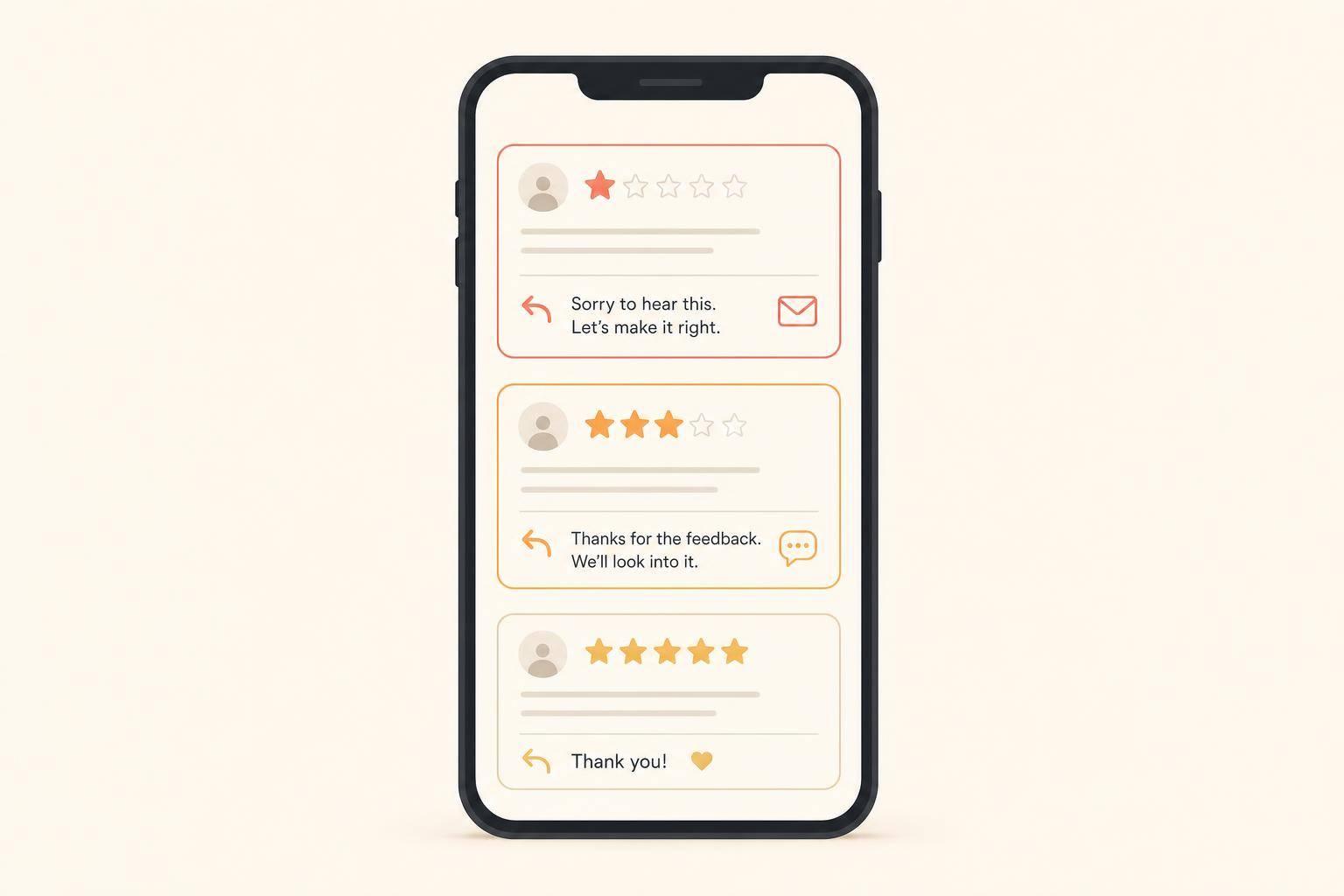
Customer reviews can make or break your business. They influence trust, drive local search rankings, and even boost revenue. Yet, most businesses hesitate to ask for them. Here's the good news: 77% of customers are willing to leave a review if asked, but fewer than 30% of businesses actually do it.
To make the process smooth and natural:
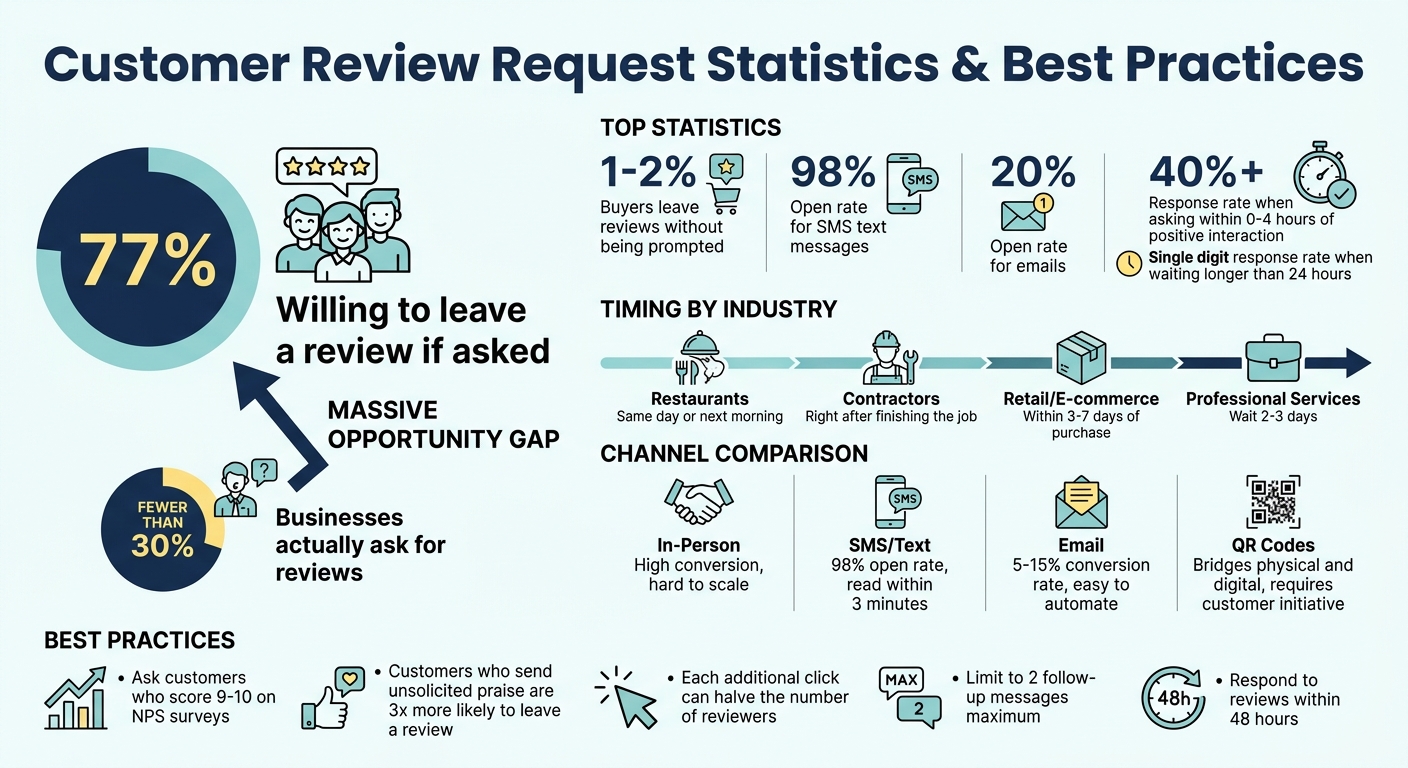
Customer Review Request Statistics and Best Practices
The secret to great reviews starts long before you ask for them. You can’t cover up a bad experience with clever phrasing, but exceptional service? That speaks for itself. Pair it with the right approach, and you’ll turn happy customers into enthusiastic reviewers.
Before you even think about asking for reviews, make sure you’ve truly earned them. A successful review request is built on the "3 C's": Commitment (delivering quality service), Communication (being transparent), and Consistency (offering a smooth, reliable experience) [4]. When you nail these, customers are more inclined to reciprocate. A review becomes their way of saying "thank you" for a job well done.
Here’s something many businesses overlook: customers whose problems are resolved effectively often leave the most impactful reviews [1]. Why? Their stories have a natural arc - from frustration to resolution. If you’ve successfully turned a tough situation around, that’s the perfect moment to ask for a review. Just make sure the issue is fully resolved first - asking while a support case is still open can come off as tone-deaf and might even backfire.
Before making your request, try a quick satisfaction check like, “Are you happy with your order?” [6]. A positive response means you’re good to go. If not, it’s your chance to address concerns privately before they turn into public complaints.
Once you’ve ensured a strong customer experience, the next step is identifying the customers most likely to leave glowing reviews.
Focus your efforts on customers who have already expressed satisfaction. Here’s why: only 1% to 2% of buyers leave reviews without being prompted [3]. But when you ask the right people at the right time, those numbers can skyrocket.
Keep an eye out for cues like direct compliments (“You’re amazing!”), social media shoutouts, repeat purchases, or customers reaching milestones with your service. These are your best bets. In fact, customers who send unsolicited praise are three times more likely to leave a review than those you approach out of the blue [3]. Another great indicator? A 9 or 10 score on a Net Promoter Score survey. These customers are already fans - you just need to ask.
Timing is everything. Ask within 0 to 4 hours of a customer expressing happiness, and you could see response rates soar above 40% [3]. Wait longer than 24 hours, and those numbers drop to the single digits. The key is to strike while the positive emotions are fresh. A happy customer in the moment will write a more detailed and heartfelt review than one trying to recall their experience weeks later.
Asking for reviews can feel awkward, but it doesn’t have to be. In fact, research shows that 77% of consumers are willing to leave a review when prompted [1]. The key lies in how you ask. When done thoughtfully, requesting a review can feel like a natural part of delivering great service. Here’s how to do it right.
Begin by expressing gratitude. A simple "thank you" sets the right tone and builds on the positive experience your customer just had. For example, you might say: "Thank you - I'm so glad we were able to fix your AC before the weekend. Would you mind sharing your experience in a review? I can send you the link right now." This approach feels genuine and keeps the conversation flowing naturally.
Instead of directly asking for a glowing review, position it as a request for feedback that could help others. For instance, rather than saying, "Can you leave us a 5-star review?" - which might feel transactional - try something like: "Your experience could really help other homeowners make the right decision." This phrasing shows you value their input and highlights how their feedback benefits others, not just your business [1][8].
Timing matters. The best time to ask for a review is immediately after a positive interaction. Whether it’s after a compliment, a completed service, or resolving an issue, striking while the memory is fresh increases your chances of getting a review [1][7]. Here are some timing tips for different industries:
Now that you’ve got the timing and approach down, the next step is choosing the right channel to ask for reviews. Different channels have different strengths: for instance, SMS texts boast an impressive 98% open rate, while emails average closer to 20%.
In-person requests are often the most effective because they tap into a customer’s immediate gratitude. A simple, “Would you mind leaving a quick review? I can text you the link right now,” during checkout or after completing a service can work wonders. However, this method isn’t easy to scale and relies on team members consistently remembering to ask.
Text messages are incredibly effective for follow-ups. With a 98% open rate and most texts read within three minutes, SMS is perfect for same-day outreach after a service or purchase. Just make sure you have permission to text your customers, and keep the message short, including a direct link and a thank-you.
Email is a solid option for e-commerce or professional services, where customers expect more formal communication. While email conversion rates are typically between 5% and 15%, it’s less intrusive and easy to automate for large customer lists.
QR codes are a handy way to connect physical interactions with digital reviews. You can print them on receipts, table tents, or invoices, allowing customers to scan and leave a review on the spot. While this method relies on the customer taking the initiative, it works particularly well in restaurants, retail stores, or at service counters.
| Channel | Best For | Pros | Cons |
|---|---|---|---|
| In-Person | Retail, service businesses | Builds personal connection; high conversion rate | Hard to scale; staff must consistently ask |
| SMS/Text | High-touch services, quick follow-ups | 98% open rate; immediate visibility | Requires customer consent and a valid phone number |
| E-commerce, professional services | Easy to automate; professional tone | Lower open rate (20%); may land in spam | |
| QR Codes | Restaurants, physical stores | Simple for walk-ins; bridges physical and digital | Relies on customer initiative |
Once you’ve identified the best channel for your business, automation tools can make the process even smoother.
Automation ensures no customer slips through the cracks. It’s especially useful since 77% of customers are willing to leave reviews, but fewer than 30% are asked manually [1].
For example, Humble Help's free CRM can send automatic review requests triggered by events like marking a job “complete” or 30 days after a purchase. Another option is Glow Social ($49/month), which not only automates review requests but also tracks and responds to Google reviews [2]. Sending a text or email within two hours of a positive interaction is a great way to catch customers while their experience is still fresh.
"The businesses with 100+ Google reviews didn't run a campaign. They ask every single customer, every single day." - Kathleen Celmins, Founder, Glow Social [2]
A single follow-up is usually enough. If there’s no response, send a polite reminder 3–5 days later. Sending more than one reminder can feel pushy and might harm the relationship [1].
Every extra step in the review process reduces the likelihood of customers following through. In fact, each additional click can halve the number of potential reviewers [2]. That’s why sharing a direct link to your Google review page is so important.
To generate this link, go to business.google.com, select your business, and click "Get more reviews." Copy the URL and consider shortening it with a tool like g.page/yourbusiness/review [2]. Platforms like ReviewGen.ai can also help you create direct Google review links and QR codes instantly [1].
Include this direct link in texts, emails, and printed materials. The easier you make it for customers to leave a review, the more likely they are to do so.
How you ask for a review can make all the difference. While 77% of consumers are open to leaving a review when asked, fewer than 30% of businesses actually ask consistently [1]. Here are some scripts to help you get started, which you can tweak to match your style and situation.
The best time to ask in person is right after a positive interaction. If a customer just complimented your work, that’s your golden opportunity. Start by expressing gratitude, explain why reviews are helpful, and make the process simple. For instance, after receiving a compliment, you could say: "Thank you so much! Your feedback on Google would really help our small business. Can I send you the link via text?" [1]
At checkout or when handing off a completed project, keep it straightforward: "I’m so glad you’re happy with everything. We’re working on growing our online presence, and honest reviews go a long way. There’s a QR code right here that’ll take you directly to our Google page." [1]
For long-term clients, personalize your message by acknowledging your relationship with them: "You’ve been such a loyal customer, and a review from someone like you would mean a lot. No pressure - but if you ever have a moment, we’d really appreciate it." [1]
If in-person requests aren’t possible, digital channels can be just as effective. Here’s how to craft messages for different platforms:
If your first request doesn’t get a response, send a polite reminder after 3–5 days [1]. Update the subject line to something engaging, like "Still happy with the results?", and respect their time:
"Hi [Name], just checking in - hope everything’s going well with [specific reference]. If you have a moment, we’d really appreciate a review. It means a lot to our team. [Link]" [1]
Limit yourself to two messages. After the second follow-up, stop. Sending more risks coming across as pushy and could harm the relationship [1][7]. A single, well-timed reminder can double your chances of getting a review, but overdoing it can backfire [1].
Asking for reviews is easier than you think - customers are more willing than you realize. The truth is, most people are happy to share their feedback, yet many businesses simply don’t ask [1].
To make your review requests effective, focus on three key elements: timing, gratitude, and simplicity. Reach out to customers during a "success moment" or within four hours of a positive interaction - this can boost response rates to over 40% [3][5]. Always start with a heartfelt thank-you, and make it easy for them to leave a review using direct links or QR codes [5][1]. Personal touches matter too - requests tailored to the customer’s specific experience are 3–4 times more effective than generic mass emails [1].
"Specificity is the antidote to desperation." - ReviewGen.AI [1]
Incorporate these strategies into your daily workflow to make review requests a natural part of your process.
Pick a method that fits your business best - whether it’s a verbal request at checkout, an SMS for salons, or an email for online stores - and try it out this week [1]. Set up a direct Google review link, print a QR code on receipts, or schedule a follow-up reminder 3–5 days after service. Remember: even an imperfect ask is better than not asking at all [1].
Make review requests a habit, not an afterthought. Respond to every review within 48 hours to show customers their feedback matters and to encourage others to leave reviews [1]. Consistent, timely responses build trust and keep the momentum going. Start small, stay steady, and watch your reviews grow as asking becomes second nature.
Asking for feedback can be a great idea, but it’s important to handle it carefully. Feedback gives customers the opportunity to share their honest thoughts - whether positive or more critical. If you notice a customer seems dissatisfied, it’s best to address their concerns first. Alternatively, you can frame your request in a way that highlights how much you value their input. This approach not only helps you gather useful insights but also keeps the conversation respectful and comfortable for everyone involved.
To ask for a review in a way that feels natural, timing and tone are key. Reach out for feedback when the customer is likely to be happy - such as right after they’ve completed a purchase or received a service they’re pleased with. Use genuine, friendly language that shows you value their opinion. Instead of making it sound transactional, explain how their input could help others. By framing it as a chance to share their experience, you'll make the request feel more like a favor than a chore, avoiding any unnecessary awkwardness.
To get your direct Google review link, head to your Google Business Profile. From there, you can create a link or even a QR code that takes customers straight to your review form. Share it through email, printed receipts, or digital messages to make leaving feedback as easy as possible. The simpler the process, the more likely customers are to leave reviews, boosting your chances of gathering valuable feedback.
Discover strategies to elevate your business.