
Deciding whether to hire a digital marketing agency in San Francisco can feel overwhelming, but asking the right questions simplifies the process. Here's what you need to know:
Key takeaway: A good agency will combine local expertise, measurable results, and a clear connection to your business goals. Use these five questions to make an informed choice.

San Francisco Digital Marketing Agency Pricing Guide for Small Businesses
Industry-specific experience can save you time and money. When an agency is familiar with your field, they already understand the market, the customer base, and the strategies that deliver results. Shana Haynie from Hearst Bay Area sums it up well:
"The more familiarity an agency has with companies in your industry, the quicker they should be able to produce results." [3]
Every industry has unique needs. What works for a medical device company might flop for a university or a local bakery [3]. Take, for example, MacroHype's collaboration with a San Francisco bakery. They increased website traffic by 150%, secured the top search result for "best bakery in San Francisco", and boosted both foot traffic and online orders [9]. That success came from understanding the local food culture, not applying generic marketing strategies.
Without relevant experience, you could end up paying for their learning curve. Agencies unfamiliar with your industry might waste time experimenting, while your budget gets drained. On the other hand, those with expertise in your sector - whether it's retail, healthcare, nonprofits, or B2B tech - can hit the ground running. Creative Click Media, for instance, has worked across over 120 industries and boasts a 95% client retention rate [5]. Their broad experience translates into consistent, effective results.
Ask for case studies and references that back up their claims. Look for measurable results like increased traffic, leads, or revenue. For instance, Softtrix helped an electrical supply company achieve a staggering 12,000% increase in website traffic through targeted marketing efforts [8]. These are the kinds of numbers that demonstrate real expertise.
Request references from businesses similar to yours in size and scope. If you own a boutique retail shop, a case study about a Fortune 500 company might not be relevant. Don’t just rely on the agency’s website for reviews - check platforms like Google, Yelp, and Glassdoor [3]. Agencies with strong reputations often have ratings above 4.5 stars. For example, MacroHype holds a 4.9/5 rating based on over 600 third-party reviews [9].
Also, confirm that your account will be managed in-house. This reduces the risk of miscommunication and ensures your brand message stays consistent [3]. These steps will help you gauge whether the agency can handle your industry’s specific challenges.
The agency should clearly explain how they tailor strategies to your industry. As Shana Haynie advises:
"Make sure the organization you choose to represent your brand is capable of telling you the difference between a strategy they would execute for a medical device company versus a university." [3]
Different industries require distinct approaches. Nonprofits, for example, might focus on donor acquisition, while retail businesses emphasize conversion optimization [6][7]. Financial services companies must prioritize compliance and data security in their online strategies [7]. If an agency can’t articulate these distinctions, they may lack the experience you need.
The best agencies also understand your audience’s behavior. For a San Francisco business, this could involve hyper-local strategies targeting neighborhoods like SoMa, the Mission, or the Financial District [5][7]. Finally, ask the agency to outline the KPIs they would track for your business. These metrics should align with your actual goals - like cost per acquisition for retail or donor retention rates for nonprofits - rather than focusing on vanity metrics like social media followers [3]. This level of understanding ensures the agency is equipped to improve your visibility and return on investment.
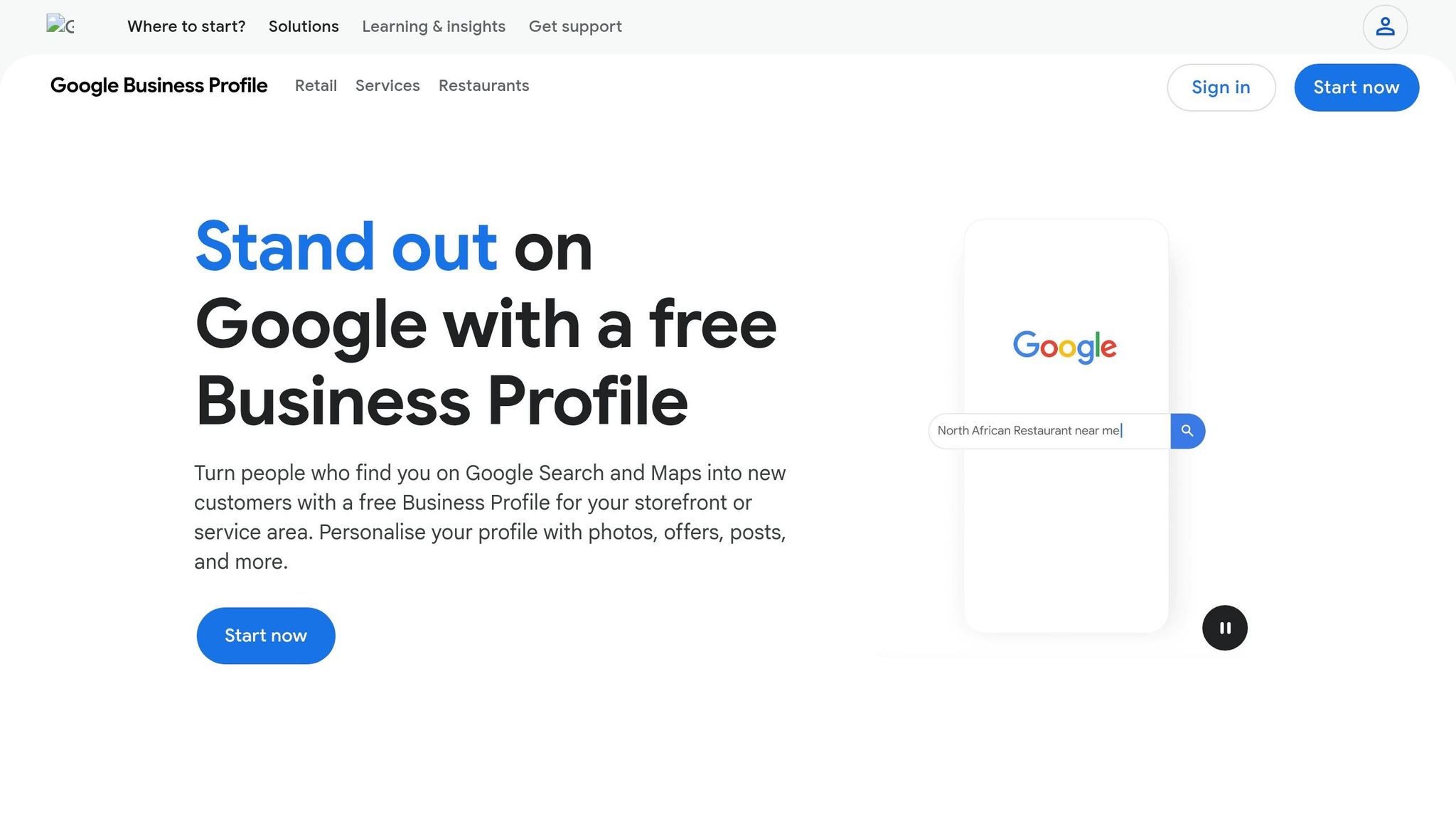
Local SEO expertise is a must for capturing the Bay Area market. For small businesses in San Francisco, being visible in local searches can be a game-changer - nearly half of all searches with local intent lead to a store visit within 24 hours [12]. To succeed, you’ll need an agency that excels in both Google Business Profile (GBP) optimization and broader local SEO strategies. While these two areas overlap, they serve different purposes, and you’ll need both to thrive. As Erik Fiala, Co-founder of Contentbase, points out:
"Local SEO is especially important because it directly targets customers in your geographic area." [11]
In competitive markets like San Francisco, strong local SEO capabilities are non-negotiable. Businesses here often compete not just across the city but within specific neighborhoods - think SoMa versus the Mission or Nob Hill versus the Financial District. That’s why it’s critical to choose an agency that understands the nuances of both GBP and local SEO.
Your Google Business Profile is a cornerstone of local search rankings. When users search for terms like "coffee shop near me" or "plumber in San Francisco", Google relies heavily on optimized profiles to deliver results. Russ Shumaker from Hearst Bay Area puts it simply:
"A well-optimized Google Business Profile can make all the difference between being discovered and overlooked." [12]
A top-notch agency will handle everything from verifying your profile to ensuring your Name, Address, and Phone number (NAP) are consistent across the web. They’ll also select the most relevant business categories, upload high-quality photos of your office, team, and work, and use Google Posts to share updates and promotions [15, 16, 17]. Did you know profiles with 20 or more photos get 35% more clicks than those with fewer images? [14]
Managing reviews is another critical piece. A good agency will actively solicit positive feedback while addressing negative reviews quickly and professionally. This not only builds trust with potential customers but also signals to search engines that your business is active and engaged [15, 16].
Beyond GBP optimization, a well-rounded local SEO strategy includes citation building, local keyword targeting, and neighborhood-focused tactics. These efforts ensure your business stays visible to local customers and maintains a strong online presence. An agency should also make sure your business information is consistent across platforms like Yelp, Yellow Pages, and the San Francisco Chamber of Commerce [2, 19].
| Local SEO Service | Key Activities | Impact on Visibility |
|---|---|---|
| GBP Optimization | Category selection, photo updates, Google Posts, accurate citations | High – Key driver for Maps and local pack |
| Citation Building | Listings on Yelp, SF Chamber of Commerce, and industry-specific sites | Medium – Validates business location/NAP |
| Review Management | Soliciting feedback, responding to reviews | High – Builds trust and improves rankings |
| On-Page Local SEO | Local keyword targeting, neighborhood landing pages (e.g., Mission, SoMa), LocalBusiness schema markup | Medium – Boosts organic search ranking |
| Local Link Building | Collaborations with local bloggers or media outlets | High – Strengthens local authority |
Don’t forget to ask about their tools and past results. A capable agency will have tools for tracking rankings and analyzing links, and they should be able to share case studies showing measurable outcomes - like increased foot traffic or more local leads [15]. Also, check if they use local San Francisco phone numbers instead of toll-free ones. This small detail reinforces your local relevance to both customers and search engines [14].
Clear, measurable reporting is a must. For small businesses, knowing exactly how your marketing dollars are performing is non-negotiable. Transparency in reporting isn't just helpful - it’s critical. Haydn Fleming, Chief Marketing Officer at 2Point Agency, highlights this point:
"Look for weekly/bi-weekly meetings, and have access to the team members if there's any questions." [17]
Before committing to an agency, ask about the tools they use and how often they report. A trustworthy agency will rely on industry-standard platforms like Google Analytics 4 (GA4) for tracking website traffic and conversions, and Looker Studio for visual dashboards. They should also use tools tailored for local search, such as monitoring your Google Map Pack rankings or tracking "near me" search queries. Bill Urciuoli, SVP of Innovation at Eicoff, underscores the value of robust reporting tools:
"With Improvado, we provide clients with a comprehensive view across channels. It's been a game changer for evaluating results." [6]
The right metrics reveal the real story of your business growth. Agencies should focus on data that affects your bottom line, not just surface-level stats like social media followers. For local businesses, this means tracking metrics such as foot traffic from your Google Business Profile, clicks-to-call, direction requests, and conversion rates from organic search [5][16]. One agency in San Francisco reported a 95% client retention rate by prioritizing ROI-focused, measurable outcomes [5].
| Metric Category | Key Data Points to Track |
|---|---|
| Website Metrics | Organic traffic, page load speed, bounce rates, mobile-friendliness [10] |
| Search Visibility | Keyword rankings, Map Pack position, "near me" query volume [15][16] |
| Lead Generation | Total leads, conversion rate, cost per lead [15][10] |
| GBP Engagement | Clicks-to-call, direction requests, photo views, map visibility [5][16] |
Ask for a sample report during your consultation. This will give you a sense of how the agency presents data and whether it aligns with your business goals. Reports should focus on metrics that matter to you - whether that’s driving more foot traffic, increasing online sales, or generating phone inquiries [17]. Also, ensure the agency uses GA4 to track specific conversion events like form submissions or product purchases [4][8].
Understanding these metrics helps you gauge the agency’s overall value and how their pricing aligns with your goals.
Consistent, transparent reporting builds trust and reinforces confidence in the agency’s strategies.
How often an agency communicates is just as important as what they report. Agencies typically offer weekly updates or detailed monthly reports, depending on your needs [3][17]. Shana Haynie from SFGate puts it succinctly:
"Measuring and reporting on the success of each campaign is the most crucial part of marketing." [3]
Demand live dashboard access instead of static monthly PDFs. The best agencies provide both scheduled reports and real-time access to your data. Platforms like Looker Studio allow you to monitor performance as it happens [6][16]. Additionally, a clear communication plan should outline when you’ll receive updates, through which channels, and who your primary contact will be [3]. For local service businesses, ask if the agency includes call tracking in their reports. This helps identify which marketing channels drive the most phone inquiries [16]. If an agency avoids sharing their strategies or performance metrics openly, consider it a serious red flag [1].
Real-time access boosts decision-making and trust. In 2025, Yodel Mobile introduced real-time reporting platforms, enabling clients to view campaign performance instantly. Data Analyst Kasia Pasich noted this approach sped up insights and improved data management [6]. Automated reporting tools simplify the process by consolidating data from multiple channels, saving time and delivering faster insights. For businesses competing in fast-paced markets like San Francisco, quick access to actionable data can be a game-changer.
This level of transparency not only helps you assess ROI but also ensures the tools align with your budget and objectives.
Once you've nailed down your performance metrics, it's time to make sure your budget matches the pricing structure of the agency you're considering.
Knowing your budget upfront saves time and avoids misunderstandings. Before you even start scheduling meetings, figure out what you can realistically spend each month. A good rule of thumb? Healthy businesses usually allocate 5% to 12% of their gross revenue to marketing. If you're in a growth phase, this could go up to 12% to 20% [19]. For example, if your small business earns $300,000 annually, you might spend around $1,250 to $3,000 monthly for steady operations - or up to $5,000 if you're scaling aggressively.
San Francisco agencies tend to charge more due to higher costs and specialized talent. As a Tier 1 city, agencies here often price their services 40% to 60% above the national average [18]. Additionally, most agencies (78% as of 2026) use retainer-based pricing, which offers predictable costs and supports continuous services like SEO or social media management [18]. Rob Andolina, a Paid Media Strategist at Clicks Geek, puts it plainly:
"Digital marketing pricing isn't mysterious because it's complex. It's mysterious because agencies know the moment they publish rates, they'll be compared purely on price rather than value." [20]
Understanding standard pricing helps you avoid both overpriced and suspiciously cheap options. Monthly retainers for small businesses in San Francisco typically range from $1,500 to $5,000 for basic single-channel strategies. If you're looking for multi-channel growth plans, expect to pay $5,000 to $10,000 per month [24–26]. For project-based work, like a website redesign or a campaign launch, fees usually fall between $2,500 and $10,000 or more [24,28]. Hourly consulting rates can range from $150 to $400+ per hour [24,25].
Be clear on what you're paying for. Many agencies charge a management fee that doesn’t include the actual ad spend for platforms like Google or Meta [19]. PPC management fees, for instance, often run between $1,500 and $5,000 per month or 10% to 20% of your total ad budget [19]. Keep an eye out for additional costs like setup fees (typically $500 to $5,000), software subscriptions (around $500 to $2,000+ per month), and revision overages (about $150 to $500 per instance) [25,33]. Always request an itemized proposal that outlines costs by service and clarifies whether ad spend and tool subscriptions are billed separately [24,25,28].
These pricing benchmarks give you a solid foundation for evaluating whether an agency's services are worth the investment.
The best agency isn’t the cheapest - it’s the one that delivers results. Maya W from Local-SEM puts it best:
"The most expensive agency isn't the one with the highest monthly fee, it's the one that charges you any amount of money a month and delivers zero results." [19]
To make sure the numbers work for you, try running a break-even analysis before signing on the dotted line. Start by calculating your profit margin per customer and figure out how many new customers you’d need to cover the agency’s fees. Compare this to the $4,000 monthly "opportunity cost" of doing it yourself (40 hours at $100 per hour) [20]. For example, if your average customer brings in $500 in profit and the agency costs $3,000 per month, you’d need at least six new customers to break even.
If you're unsure about committing to a long-term contract, suggest starting with a three-month trial. This gives you time to assess communication, strategy, and initial results [20]. Keep in mind that many digital marketing efforts, especially SEO, require three to six months to show measurable ROI [25,28]. To protect yourself, make sure the contract includes a 30-day exit clause in case the agency underperforms [30,1].
Once you've reviewed an agency's technical expertise and budget compatibility, it's time to determine if their vision aligns with your business goals.
The right agency creates strategies tailored to your objectives. Whether you're aiming to drive more foot traffic to your San Francisco storefront, boost online bookings, or improve local search visibility, their approach should reflect your specific needs. As Shana Haynie, Co-Founder of Hearst Bay Area, puts it:
"If you are not in alignment on what victory looks like, your agency partner will not be able to deliver the results you expect." [3]
A good agency will ask detailed questions about your goals during the initial consultation and identify where your target audience is most active. For example, if you run a B2B accounting firm in the Mission District, they should explain why platforms like LinkedIn and a focused local SEO strategy are more effective than spreading efforts thin across every platform. Additionally, they should define clear key performance indicators (KPIs) linked to measurable outcomes, such as lead generation or booking conversions, instead of focusing on superficial metrics.
Depth of strategy is crucial. Agencies with real expertise will explain how marketing tactics differ across industries. For instance, a medical device company requires a different approach than a university. If an agency suggests hyper-local search terms like "emergency plumber SOMA" or "B2B accountant Mission District" instead of generic phrases like "near me", it’s a sign they understand the nuances of San Francisco’s market.
The questions you ask during consultations can reveal how well an agency understands your business needs. Here are some examples:
If an agency struggles to explain how their KPIs tie back to your revenue, it might indicate a lack of focus in their strategy.
You should also inquire about their communication plan and how they handle client relationships. Ask about meeting frequency (weekly or bi-weekly is common), who your main point of contact will be, and how many accounts that person manages. Ideally, an account manager should oversee client budgets around five to seven times their annual salary - if they’re managing too many accounts, you may not get the attention you need. Additionally, request examples of past successes and challenges. Honest, detailed answers are a sign of a realistic and well-thought-out growth plan.
Transparency and a customized strategy are key, but there are red flags to watch for. Be cautious of agencies that make unrealistic promises, like guaranteeing immediate rankings or overnight results. These claims often rely on outdated "black-hat" tactics, such as keyword stuffing or buying backlinks, which can harm your reputation in the long run [1].
An agency's unwillingness to share reporting methods, tools, or specific strategies during the evaluation phase is another warning sign. Vague plans or a heavy focus on vanity metrics - like impressions or clicks without tying them to ROI - can indicate poor strategic thinking. As Haynie advises:
"Agencies that are only concerned with vanity metrics are not going to be able to demonstrate ROI. This is a red flag and a sign of poor strategic thinking." [3]
Lastly, if an agency lacks case studies or testimonials, it could mean they’re inexperienced and using your account as a trial run. If that’s the case, their pricing should reflect the risk you’re taking.
Start by assessing your needs and defining your goals - whether you’re looking to boost foot traffic, increase online bookings, or improve local search rankings. Once you’ve clarified your objectives, focus on five key questions to guide your decision: Does the agency have relevant industry experience backed by case studies? Are they skilled in local SEO and Google Business Profile optimization? Do they provide clear and transparent reporting? Does their pricing align with your budget? And finally, is their strategy compatible with your vision? These questions are essential for finding the right partner.
It’s a good idea to compare at least three to five agencies, ensuring they offer tailored strategies and measurable KPIs tied directly to revenue. Look for agencies that ask thoughtful questions about your business, clearly explain their approach, and connect their proposed metrics to growth. As Shana Haynie from Hearst Bay Area puts it:
"Choose the partner who best represents your brand culture, has a vision for the future (yours and theirs), and whom you feel you can trust the most" [3].
Decide whether a full-service agency or a specialized firm better suits your needs. Full-service agencies like Thrive or Hearst Bay Area can handle everything from SEO to video production, making them ideal for integrated, multichannel campaigns [13][2]. On the other hand, specialized firms often excel in specific areas. For example, Ruby Street Digital helped a skincare brand grow from $0 to over $100,000 in monthly revenue through optimized Facebook and Instagram ads in 2024 [21]. If your goals are highly focused, a specialist might offer a stronger return on investment.
Budget is another critical factor. Your investment should align with expected returns, but don’t let price alone dictate your choice. Projects can start at $1,000, while comprehensive campaigns may cost $10,000 or more. Be cautious of agencies offering overly cheap solutions, as they often deliver subpar results [4][3].
Ultimately, your decision should balance strategy and trust. Trust your instincts during consultations. If an agency makes unrealistic promises, is vague about reporting, or fails to connect their work to measurable growth, it’s best to look elsewhere. The right partner will be transparent, ask insightful questions, and demonstrate a solid understanding of San Francisco’s competitive local market.
The choice between a local San Francisco agency and a remote one ultimately comes down to your specific priorities.
Local agencies bring a deep understanding of the San Francisco market. They’re well-versed in local SEO strategies, have strong connections within the community, and make in-person communication much more convenient. If your business relies heavily on local engagement, this could be a big advantage.
On the other hand, remote agencies often offer a wider range of experience and may come with cost savings. However, they might not have the same level of insight into the nuances of the San Francisco market.
Your decision should hinge on what matters most to you: local expertise and face-to-face availability or cost-effective, remote collaboration with a broader perspective.
Most websites begin to notice SEO results within 3 to 6 months. However, the timeline can shift based on several factors, such as your site's domain age, the quality of backlinks, and the level of competition in your industry. These elements play a significant role in determining how quickly you see progress.
It's crucial to clarify ownership of your accounts and data before working with an agency. Your accounts and data should always remain your intellectual property. This ensures you maintain control over your assets and provides reassurance that the agency isn't outsourcing your work to third parties. Always confirm this upfront to avoid potential complications down the line.
Discover strategies to elevate your business.