
Relying only on Facebook for your business's online presence is risky. Declining organic reach (down to just 1.37% in 2026), frequent algorithm changes, and platform dependency can hurt your visibility and revenue. In the Bay Area, where competition is fierce and 89% of residents rely on smartphones, businesses need more than a social media page to thrive.
Here’s what you should focus on instead:
The takeaway? Facebook can complement your strategy but shouldn’t be your only tool. Build a complete digital presence to stay competitive and reach customers wherever they are.
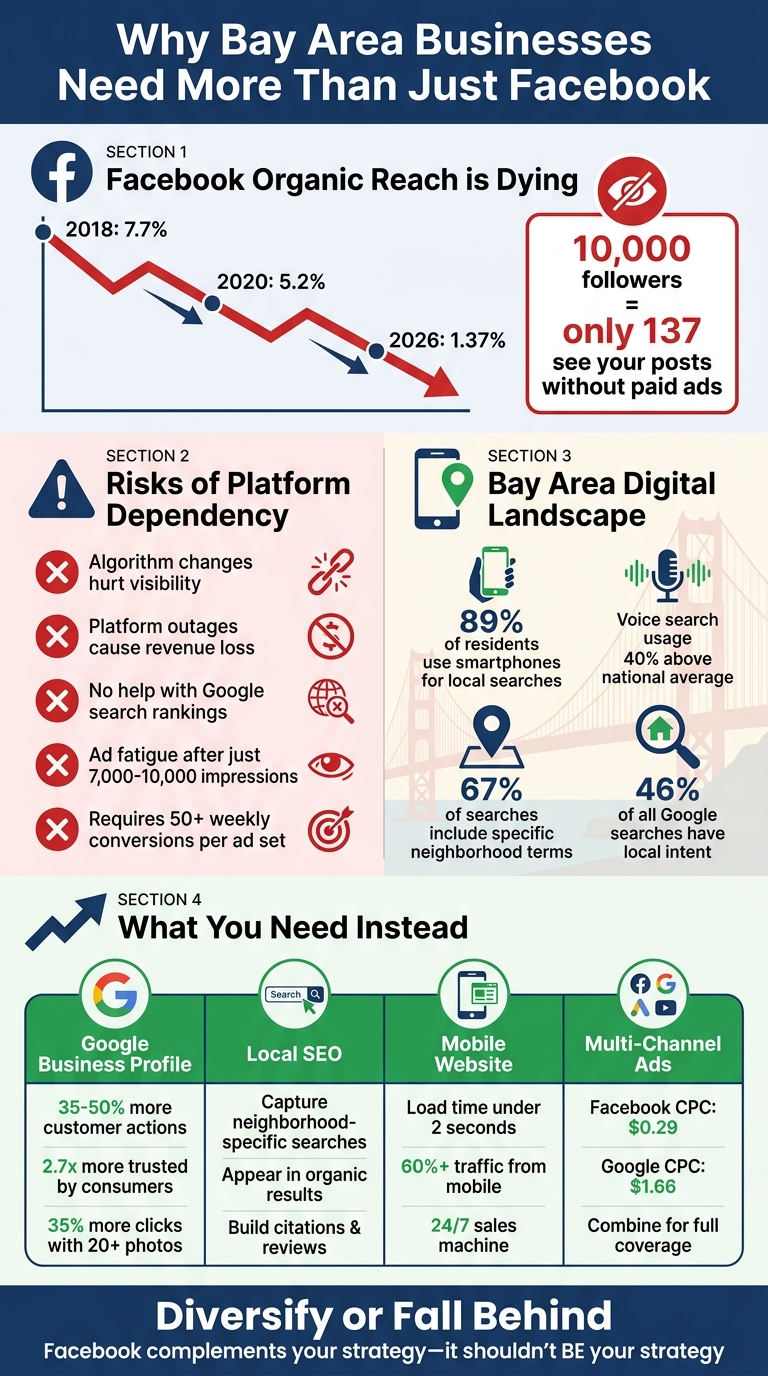
Facebook Organic Reach Decline 2018-2026: Why Bay Area Businesses Need Diversified Digital Marketing
Organic reach on Facebook has taken a sharp nosedive over the years. Back in 2018, it was at 7.7%, dropped to 5.2% in 2020, and by 2026, it’s dwindled to just 1.37% [5][6]. To put it in perspective, if your page has 10,000 followers, only 137 of them are likely to see your posts without paid promotion [5]. This decline stems from Facebook's algorithm shift, which now favors "meaningful interactions" between friends and family over content from businesses.
"Users could expect to see less public content like posts from businesses, brands, and media." – Mark Zuckerberg, CEO, Meta [6]
To complicate things further, Meta now requires over 50 weekly conversions per ad set for proper optimization - a bar that’s tough for many small businesses in the Bay Area to clear [4]. On top of that, ad fatigue sets in much faster than before, with engagement dropping after just 7,000–10,000 impressions, compared to lasting beyond 25,000 impressions back in 2020 [4]. This forces businesses into an expensive cycle of constant ad spending. But the challenges don’t stop there - relying solely on Facebook comes with even bigger risks.
Falling organic reach isn’t the only problem. Depending entirely on Facebook means putting your business at the mercy of external factors. Sudden algorithm updates, policy changes, or even platform outages can cause chaos [8][9]. For instance, a two-day Facebook and Instagram outage in March 2019 led to significant revenue losses for many businesses [9].
Another headache is dealing with unauthorized duplicate pages, which can spread incorrect information or misleading reviews. Fixing these issues often involves weeks of back-and-forth with Meta's Business Support [7][9][10]. Automated moderation can also flag accounts unfairly, and the appeals process is anything but straightforward [9][10]. This level of dependency can leave your business exposed and vulnerable.
On top of these challenges, relying on Facebook doesn’t do much for your visibility on Google. Facebook pages offer little to no value for improving your search engine rankings [7][8]. Google prioritizes optimized websites and Google Business Profiles for local search queries. While your Facebook page might show up for branded searches (like when someone types in your exact business name), it won’t help attract new customers searching for services or products [5][7].
Google users are actively searching for solutions, while Facebook caters more to passive browsing [5]. If your business isn’t showing up in Google search results or on Google Maps, you’re missing out on the 89% of Bay Area residents who rely on their smartphones to find local services [1]. To make matters worse, relying solely on Facebook creates isolated data, which can lead to inconsistencies across platforms like Google or Apple Maps, eroding trust in your business [7]. All of this highlights the need for a more diversified digital strategy to thrive in the Bay Area market.
The good news is, you don’t have to ditch Facebook completely - you just need to stop depending on it as your sole digital strategy. Crafting a well-rounded digital presence means combining tools that work together to connect with customers at every stage of their search journey. Here’s a breakdown of essential tools to help Bay Area businesses build a stronger online presence.
Your Google Business Profile (GBP) is the most critical tool for local visibility. It appears prominently in search results and alongside Google Maps, placing your business in front of customers precisely when they’re ready to act [11]. Whether someone searches for "emergency plumber SOMA" or "best Invisalign SF", an optimized GBP ensures you’re visible [13].
The stats are compelling: 46% of all Google searches have local intent [11], and businesses with complete profiles are 2.7 times more likely to be trusted by consumers [11]. Even better, fully optimized profiles can drive 35-50% more customer actions in just the first 60 days compared to incomplete ones [11]. In the Bay Area, where voice search usage outpaces the national average by 40% [1], showing up in local search results is a must.
Start by claiming and verifying your profile. Choose a specific primary category (e.g., "Antique Furniture Store" instead of just "Store") to access relevant features [11][12]. Keep your Name, Address, and Phone (NAP) consistent across your website, GBP, and directories. Upload at least 25 high-quality photos, as profiles with 20+ images see 35% more clicks [1]. If your storefront is on a busy San Francisco street, include exterior shots to help customers find you easily [14].
Consistency is critical. Even minor variations like "St." versus "Street" or "Suite 100" versus "#100" can confuse Google’s algorithms and hurt your ranking [11]. Use Google Posts to share updates weekly, signaling activity to both users and search engines [11]. Responding to reviews within 24 hours can boost your click-through rate by 12-18% [11].
Once your GBP is optimized, you can expand your reach further with local SEO strategies.
Building on your optimized GBP, local SEO ensures your business appears in organic search results, not just on Google Maps. The goal is simple: make sure Bay Area customers find you when searching for services you offer.
Bay Area search behavior is unique. 67% of local searches include location-specific terms beyond just "San Francisco" [1]. People search for "SOMA web design" or "Mission District coffee shop", targeting neighborhoods where they live or work [1][13]. Service-related searches also peak during commute hours, so it’s worth optimizing for keywords tied to work locations as well as residential areas [1].
"San Francisco local SEO is not about ranking for broad 'near me' terms alone. The real money is in high-intent searches that signal someone is ready to call, book, visit, or buy." – Ankord Media Team [13]
Focus on keywords that combine a problem with a location, like "emergency repair Oakland" or "book consultation SF", to capture ready-to-buy customers [13]. If you serve multiple cities - Oakland, San Jose, Palo Alto - create unique, high-quality landing pages for each location instead of duplicating content with swapped city names [13][3]. Add LocalBusiness schema markup to your site to help search engines pinpoint your location and service areas [3][15].
Don’t forget about Yelp, which remains highly influential in the Bay Area compared to other regions [1]. Build citations on trusted local directories like the Better Business Bureau and local Chambers of Commerce to strengthen your credibility [11][1]. After successful transactions, ask customers for reviews and encourage them to mention specific services and neighborhoods in their feedback [13].
While local SEO drives traffic, your website plays a key role in converting visitors into customers.
Your website is your digital home base. Unlike Facebook or other platforms, you control the experience, data, and rules. A well-designed website complements your local search efforts by turning interest into measurable results like bookings and sales. Think of it as your 24/7 sales machine.
Speed is critical. A one-second delay in page load time increases bounce rates by 7% [17], and successful Bay Area businesses aim for mobile load times under 2 seconds [1]. With over 60% of California web traffic coming from mobile devices [17], your site needs to be mobile-friendly - think thumb-friendly buttons and easily readable text.
"Your website is your digital storefront. A slow, poorly designed, or hard-to-navigate website loses customers to competitors." – ByteZero [17]
Dedicate individual pages to each of your primary services instead of lumping everything onto one generic page. This improves your relevance for specific customer searches and boosts SEO [16]. Include local trust signals like an embedded Google Map on your contact page and use a local Bay Area phone number [17]. Make sure calls-to-action - like phone numbers and booking forms - are easy to find and functional on all devices.
Small businesses typically spend between $1,500 and $2,500 per month on professional SEO and website upkeep, while medium-sized companies may invest $3,000 to $5,000 monthly [18]. The payoff comes from conversion rate optimization (CRO) - tweaks like simplifying forms or reducing friction that help you get the most out of your existing traffic without increasing ad spend.
Facebook works best when it’s part of a broader digital marketing strategy. Each platform plays a unique role in the customer journey. For example, Google is great for capturing demand when users are actively searching for solutions, while Facebook excels at creating demand by introducing your business to potential customers who might need your services later on [19][20].
Pairing Facebook Ads with Google Search campaigns can help you cover both immediate and future customer needs. Google Ads are perfect for capturing people ready to act - like someone searching "emergency plumber near me" - while Facebook Ads focus on building awareness by targeting users based on their interests and location [19][20].
Let’s talk numbers. In the Bay Area, the median cost-per-click on Facebook is about $0.29, compared to $1.66 on Google [20]. For plumbing services, Google clicks average $3.66, while Facebook clicks cost roughly $0.55 [20]. This difference can significantly impact your ad budget.
For businesses spending $1,500 to $3,000 monthly, a smart allocation might look like this:
To make this work, set up the Meta Pixel and use dedicated landing pages optimized for mobile. This is especially important in the Bay Area, where mobile usage is high [1][20]. Also, when creating Facebook ads, skip the stock images. Authentic photos of your team and storefront tend to perform better for local businesses [19].
Paid ads are great for quick wins, but a well-planned content strategy builds long-term brand recognition.
Start with a strong piece of content, like a blog post titled "How to Choose a Contractor in San Francisco." Then, repurpose it:
Geotagging your Instagram posts can increase engagement by 79% [2]. Focus on local topics like "Best Coffee Shops in SOMA" or "Parking Tips for Noe Valley" to boost local search rankings and connect with your community [1][2]. In fact, 67% of local searches in the Bay Area include location-specific terms beyond just "San Francisco" [1].
For a balanced approach, aim for two educational, inspirational, or entertaining posts for every promotional one [21]. Use UTM parameters on your links to track which platforms are driving traffic and conversions [2]. Also, make sure your business details - name, address, and phone number - are consistent across Facebook, Google Business Profile, your website, and local directories. This consistency strengthens your local credibility [3].
To see what’s working, use analytics tools to measure performance across all channels.
Humble Help’s free Analytics Dashboard can show you where your customers are coming from and which marketing efforts are driving results. Pair it with their free Business CRM to track leads from the first interaction to a closed deal. The Milo AI Marketing Coach can also give you step-by-step suggestions for improving your strategy.
AI chatbots are another useful tool, helping you provide 24/7 responses to customer inquiries. This ensures potential customers get the help they need, even outside business hours. Use these insights to refine your strategy, tracking phone calls, form submissions, and in-person visits to see how each channel contributes to your revenue.
Relying only on Facebook in San Francisco's competitive market is a gamble. With its declining reach and constant algorithm changes, businesses that stick to a single platform risk falling behind. Meanwhile, competitors are building more robust strategies that span Google, local directories, and their own websites. A one-platform approach leaves you exposed.
"Local SEO in this environment isn't a set of isolated tactics; it's a coordinated system that ties technical health, on‐page governance, content, local signals, and reputation into a single growth engine." – sanfranciscoseo.ai [3]
To stand out, businesses need a Google Business Profile that's optimized to attract "near me" searches, a fast and mobile-friendly website that converts visitors, and a solid local SEO plan. Facebook can still play a role, but it works best as part of a broader strategy - focusing on brand awareness while Google captures those ready to make a purchase. In the Bay Area, where 89% of residents own smartphones and voice search use is 40% higher than the national average [1], being visible across all platforms is crucial. The key is diversification, as outlined throughout this guide.
Ready to strengthen your digital presence? Here are some steps you can take right away:
If this feels overwhelming, tools like Humble Help can make it easier. Their Analytics Dashboard shows where your customers are coming from, while the Business CRM lets you manage leads from start to finish. Plus, Milo AI Marketing Coach offers step-by-step advice to refine your strategy. These tools help you make smarter decisions without hiring a costly agency. Considering most small businesses spend 6% to 10% of their budget on marketing [23][24], make sure your efforts cover multiple channels - not just one.
Your Google Business Profile is the foundation of your local online presence. By optimizing it, you boost your chances of showing up in local search results and map packs - making it easier for nearby customers to find you.
Here’s what to focus on:
Once your profile is polished, shift your attention to your website. Create location-specific content and dedicated service pages that highlight what you offer in your area. Together, these steps help you stand out locally and connect with more potential customers.
If your business caters to multiple Bay Area neighborhoods - like Mission District, SoMa, or Oakland - and your customers use neighborhood-specific searches such as “cafe in Richmond,” then local SEO is a must. It helps boost your visibility in each area, particularly when customer needs or competition vary by neighborhood. By optimizing for multiple locations, you can attract customers who are ready to take action and maintain a strong foothold in the local market.
If you're just getting started with Facebook and Google Search ads, a typical way to divide your budget is to go 50/50. For instance, if you have $1,500 to spend, you could allocate $750 to each platform. That said, the perfect split really hinges on what you're trying to achieve and who you're targeting. Begin with this even distribution, then tweak it as you analyze results and figure out what works best for your business.
Discover strategies to elevate your business.