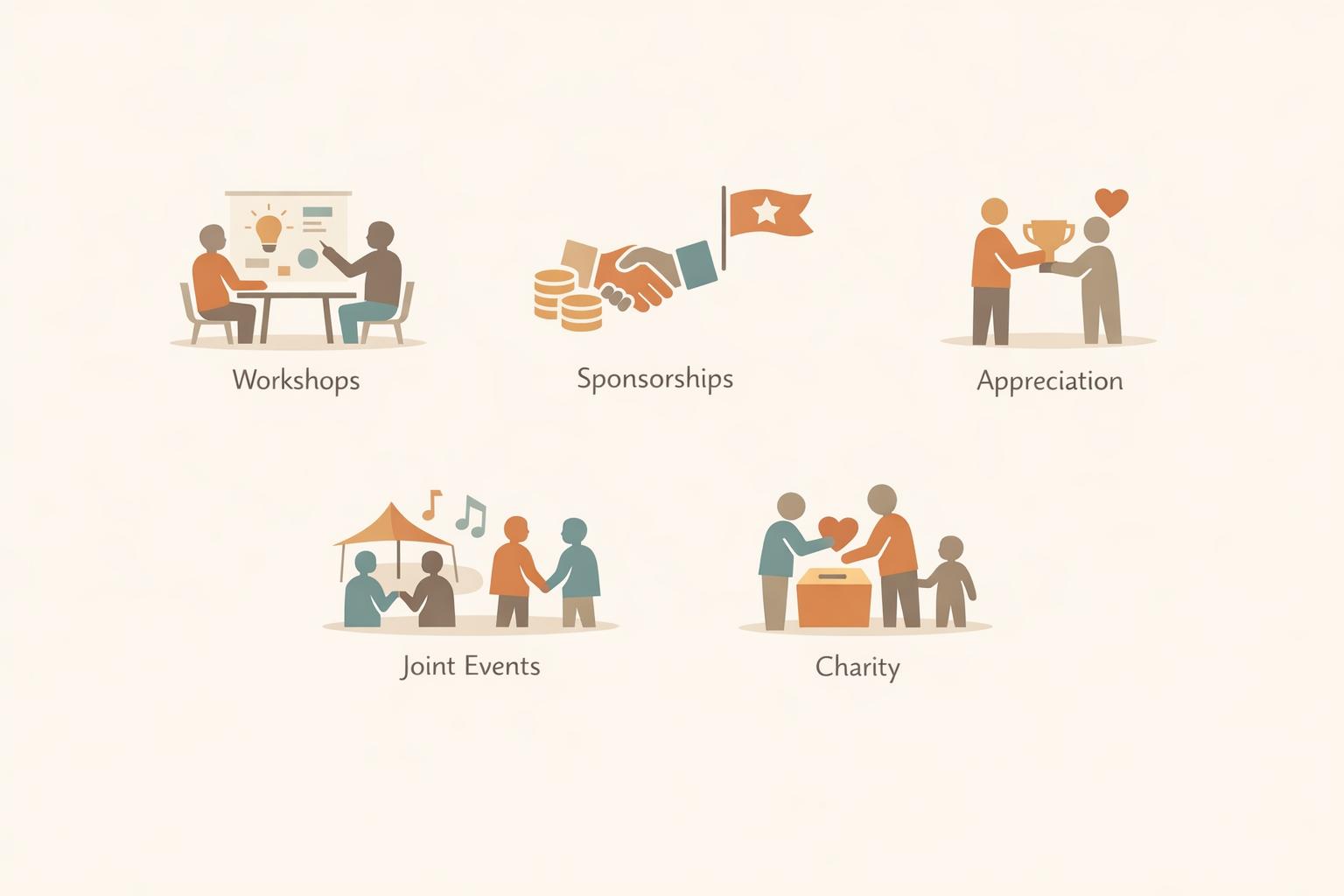
Want to stand out as a small business in your community? Hosting events can help you connect with locals, build trust, and grow your reputation. Here's how:
These strategies don’t just help you promote your business - they make you a trusted part of the community. Whether you’re hosting a workshop or sponsoring a local event, the key is consistency and genuine engagement. Start small, stay active, and watch your reputation grow.
Educational workshops can turn your business into a gathering place for the community. By sharing a skill or offering insights related to your industry, you give people a reason to connect with your business on a deeper level. For instance, a pet supply store might offer basic grooming lessons, a bookstore could host weekly storytime sessions, or a floral shop might organize "bring your own vase" bouquet-making classes.
Take the example of Flower Friends SF, a floral design studio in San Francisco. In June 2025, founder Emily Yates hosted a "Bring Your Own Vase" workshop where attendees designed bouquets using their own containers. The result? Sales tripled that weekend, and the event strengthened local trust in the business [10]. Similarly, in Brighton, Michigan, 2 Dandelions Bookshop introduced weekly storytime events in 2024. Co-owners Jeri Kay Thomas and Jeanne Blazo even partnered with nearby businesses like Great Harvest Bread Company to include bakery tours, creating a well-rounded, engaging experience [9].
Workshops like these not only build strong ties with the community but also position your business as a go-to resource for knowledge and expertise.
Hosting workshops helps establish your business as a trusted local authority. Whether it’s a fitness studio offering free warm-up technique classes or a tech repair shop teaching smartphone troubleshooting, these events show your dedication to helping customers beyond just making a sale.
"There are so many other people doing the same thing that we're doing. You have to think about how you are going to give someone a really special experience."
– Emily Yates, Founder, Flower Friends SF [10]
By offering valuable experiences, you demonstrate expertise while building trust with your audience.
A well-organized workshop can naturally generate buzz. Attendees often share their experiences with friends or post about them on social media, increasing your business's visibility. For example, during the 2024 holiday season, MudFire, a ceramics studio in Georgia owned by Deanna Ranlett, saw a 160% boost in sales thanks to its educational events [10]. These workshops not only drove sales but also helped the business stand out in a competitive market.
Workshops are relatively easy to organize and don’t require a big budget. You can use your existing space and tools, keeping costs low. To maximize attendance, start promoting your event at least 30 days in advance. This gives search engines time to index your event pages, helping you reach a broader audience [3][8]. Platforms like Meetup.com are great for connecting with people already interested in your niche [3]. After the event, follow up with thank-you emails and exclusive discounts to encourage repeat visits [9][2].
"We treat every event as a prototype. It doesn't need to be perfect."
– Jeri Kay Thomas, Co-owner, 2 Dandelions Bookshop [9]
Consistency is key. Hosting monthly or weekly workshops helps create a routine for your customers and keeps your business at the forefront of their minds. To further enhance your digital promotion efforts, you might consider services like Humble Help (https://humblehelp.studio) for tailored marketing strategies.
Regular workshops not only keep your business active in the community but also strengthen your reputation. Up next, learn how sponsoring community events can take your local presence even further.
Getting involved in community events gives your business a chance to connect directly with neighbors and potential customers. Whether it’s sponsoring a block party, a school sports event, or a charity 5K, these gatherings provide unmatched opportunities for face-to-face networking. Interestingly, 94% of consumers prefer supporting local businesses over large chains [12]. By participating, you’re showing that your business cares about the community - not just about making sales. These partnerships naturally build on the connections you create through your own events.
The trick is to align with events that fit your brand. For instance, a fitness studio sponsoring a local race makes perfect sense, while a tax service might find more value in supporting a financial literacy workshop. Both large city festivals and smaller neighborhood gatherings can help you build trust and credibility with the local audience.
In-person interactions tend to build trust faster than online campaigns ever could. Sponsoring an event allows you to showcase your commitment to the community in a tangible way. Plus, if you have the chance to speak or present at a sponsored event, it’s a great way to position yourself as a trusted expert in the area [11].
"Community events and sponsorships mesh perfectly with a hyper-local strategy because they position your brand as an active participant, not just another name in a search result."
– Rank & Scale [2]
Event sponsorships don’t just stop at the event itself - they can significantly amplify your visibility. Your business name might appear on event websites, community calendars, or even local news outlets, which can help build backlinks and local citations [2][6]. With consumer spending on live entertainment up 25% compared to 2019 [4], more people are attending these events, giving your brand additional exposure.
If your budget is tight, there are affordable ways to participate. Instead of financial sponsorship, consider in-kind contributions, like a bakery donating cookies for a school fundraiser. Train your staff to represent your brand at these events and use tools like QR codes or sign-up sheets to collect leads. This approach not only boosts visibility but also helps turn event attendees into loyal customers [2][5].
Supporting community events doesn’t just raise awareness - it strengthens the personal connections you’ve already built. Start by creating an annual event calendar and negotiating benefits like logo placements, booth space, or category exclusivity to maximize your exposure. Even small gestures, like in-kind donations, can deliver meaningful results. Including the name of your city in outreach emails can also increase response rates by 20% when contacting local organizations [11].
If a booth at a big event feels out of reach, think about hosting a pop-up or promotion at your location to take advantage of increased foot traffic. For example, in 2019, FOUND Natural Goods in Bend, Oregon, teamed up with Farewell Coffee Roasters to host a pop-up during the Bend Farmers Market. This collaboration brought in new customers and expanded their reach [9]. It’s proof that even smaller-scale efforts can make a big impact.
Hosting appreciation events is a great way to strengthen your connection with the community. These events - whether it's a casual cookout, an open house, or a free workshop - create an opportunity to thank customers and neighbors in a friendly, non-sales atmosphere. Think of it as a chance to show gratitude while reinforcing those local relationships. When you actively engage with your community, you build trust and loyalty that lasts.
"The community notices us making the effort. They see us working together and that is really helpful."
– Jeri Kay Thomas, Co-owner, 2 Dandelions Bookshop [9]
There’s something about face-to-face interactions that digital campaigns just can’t match. They leave lasting impressions and deepen connections. As Kelly Blazo, Event Coordinator at 2 Dandelions Bookshop in Brighton, Michigan, puts it: "Events bring people in. They remember our space and later return" [9]. Beyond the personal connections, these gatherings can also amplify your visibility. When attendees post photos or check in on social media, your reach extends far beyond the event itself.
The best part? You don’t need a huge budget to pull this off. Partnering with another local business can help share costs and create a win-win situation. For example, a fitness studio could team up with a juice bar, or a bookstore could collaborate with a coffee roaster. Keep things simple by using tools like digital sign-up sheets or QR codes for raffles. These not only make check-ins quick and easy but also help you collect email addresses for future promotions. And don’t forget to plan for contingencies, like having a rain date, to ensure everything runs smoothly.
Next up: learn how teaming up with nearby businesses can take your local impact even further.
Teaming up with nearby businesses can be a win-win. By collaborating on events, you not only combine resources but also demonstrate a shared commitment to your local community. It’s a simple yet effective way to build connections while amplifying your reach.
The key to a successful partnership is finding businesses that align with your values and appeal to a similar audience. For example, a bakery joining forces with an artisanal cheese shop is a natural fit, while a sustainable brand working with a fast-fashion retailer might send mixed messages. A great real-world example comes from 2025, when 2 Dandelions Bookshop in Brighton, Michigan, partnered with a local candy shop for a themed storytime event. Guests enjoyed a lollipop-themed story at the bookstore, followed by a short walk to the candy shop for a tour. The event was a hit, drawing a large crowd and boosting both businesses' standing in the community [9]. Collaborations like this strengthen your reputation while reinforcing ties with local customers.
Joint events can introduce your brand to a fresh audience while splitting marketing costs. Each partner brings their own loyal customers, expanding everyone’s reach. Plus, in-person events leave a lasting impression - 74% of consumers say they think more positively about a brand after attending one [1]. To maximize the impact, encourage attendees to share their experience on social media using a unique hashtag. Photos and posts from the event can keep your brand in the spotlight long after the day is over.
Simplicity is key. Start by drafting a clear agreement that outlines what each partner is responsible for, from promotions to event logistics. If budgets are tight, think about trading services instead of cash - one business could provide the venue, another the refreshments, and a third could handle social media. Co-branded materials, like custom coffee sleeves or raffle tickets, are another easy way to showcase the partnership. If you’re unsure about committing to a full-scale collaboration, test the waters with a one-time pop-up event to see how it goes.
These types of partnerships not only help grow your business but also lay the groundwork for even deeper community involvement, like charitable initiatives.
Hosting charity events is a great way to show your business cares about the community it serves. Whether you're raising funds for a local food bank, sponsoring a youth sports team, or organizing a neighborhood cleanup, these efforts demonstrate your dedication to improving the area. Events like a charitable workout or sponsoring local activities help establish your business as a friendly and reliable neighbor [12][13]. This local focus also strengthens your broader event strategy by building trust within the community.
Getting involved in charitable causes can significantly enhance customer loyalty. Supporting local initiatives shows that your business is about more than just profits - you're genuinely invested in the well-being of the community [4][2]. Charity events, much like educational or collaborative events, help deepen your connection with customers. As Sharon Miller, President of Business Banking at Bank of America, explains:
"Sponsorships... can help bolster a business's reputation and increase customer loyalty by showing the owner is invested in the community" [4].
When people see your business supporting causes like children's hospitals, environmental efforts, or food drives, it creates a sense of trust and encourages them to stick with you.
Charity events aren't just good for the soul - they're great for getting the word out about your business. These events often leave a lasting impression, sparking conversations that lead to word-of-mouth referrals. They also open doors to local media coverage and backlinks that can improve your online presence [3]. Want to keep the buzz alive? Create a unique event hashtag and share photos or updates on social media to amplify your reach even after the event wraps up.
Running charity events doesn’t have to break the bank. Small businesses can keep costs low by offering in-kind donations, like a bakery providing pastries or a restaurant catering for nonprofit events [2][3]. Starting small is completely fine - becoming a drop-off point for a toy or food drive is an easy first step [3]. Free tools like Facebook Events or Eventbrite make it simple to promote and manage your event. Partnering with nearby businesses can lighten the load and help you reach more people [12][13]. To maximize impact, choose a cause that aligns with your brand’s values and resonates with your customers [14][7][15].
For those looking to take their efforts further, services like Humble Help (https://humblehelp.studio) offer practical tools and guidance to promote events online, helping small businesses grow their presence effectively. Together with workshops, sponsorships, and partnerships, charity events form a well-rounded approach to engaging with your community.
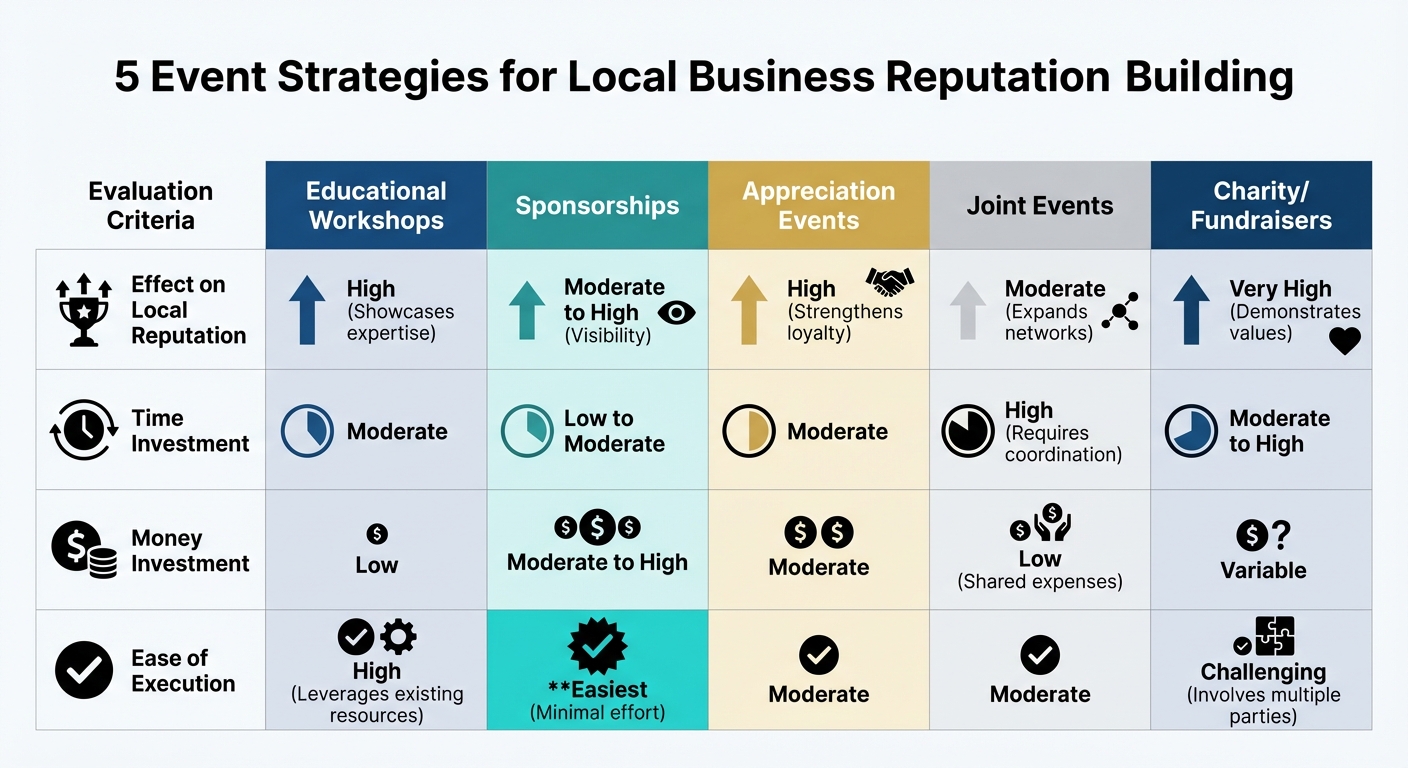
5 Event Strategies for Local Business Reputation Building Comparison
Choosing the right event strategy hinges on your goals and the resources you have at hand. Each option offers distinct advantages for boosting your local reputation, but they differ in terms of the time, money, and effort required.
Sponsorships are often the simplest way to get started. By providing financial support or in-kind donations, you can be part of an event that's already organized, leaving the heavy lifting to the hosts. On the other hand, charity events can significantly enhance your reputation but often demand more coordination. Below is a breakdown to help you weigh your options.
| Event Strategy | Effect on Local Reputation | Time Investment | Money Investment | Ease of Execution |
|---|---|---|---|---|
| Educational Workshops | High (Showcases expertise) | Moderate | Low | High (Leverages existing resources) |
| Sponsorships | Moderate to High (Visibility) | Low to Moderate | Moderate to High | Easiest (Minimal effort) |
| Appreciation Events | High (Strengthens loyalty) | Moderate | Moderate | Moderate |
| Joint Events | Moderate (Expands networks) | High (Requires coordination) | Low (Shared expenses) | Moderate |
| Charity/Fundraisers | Very High (Demonstrates values) | Moderate to High | Variable | Challenging (Involves multiple parties) |
If you're working with a tight budget, starting small can be a smart move. For example, a local bakery could donate pastries as part of an in-kind sponsorship, or you might host a simple open house to connect with the community. These less complex approaches allow you to establish a foundation before diving into larger, more demanding events.
Hosting events gives your business a personal touch within the community. Whether it’s a workshop to showcase your expertise, sponsoring a local festival, or organizing a charity fundraiser, these activities build trust and help keep your business top-of-mind.
It’s not just about one event - ongoing community involvement creates lasting recognition. By showing up consistently, your business evolves from being just another vendor to becoming a trusted and familiar community partner. Regular participation sends a clear message: you’re invested in the community’s well-being and growth[2].
If resources are tight, start small. Something as simple as an open house or donating products to an existing event can help you ease into community engagement without stretching your budget or time too thin[1][5]. As you gain confidence and see results, you can scale up to larger efforts, like teaming up with nearby businesses or hosting major fundraisers.
Every event should mirror your brand’s values and commitment to the community. When your events align with what your business stands for, they naturally connect with your audience on a deeper level[2][16]. The real payoff comes from the relationships you build during these events, so focus on creating meaningful connections rather than chasing secondary perks.
To stay organized, consider creating an annual event calendar that includes local festivals, holidays, and key business milestones[4]. Planning ahead allows you to promote effectively, collaborate with partners, and avoid last-minute stress. By aligning your events with both your brand and your resources, you’ll strengthen your local reputation. Over time, consistent participation cements your place as a valued part of the community.
For more practical tips on using events to grow your local presence, check out Humble Help (https://humblehelp.studio).
To get the word out about a local event, the first step is to pinpoint who you’re trying to reach. Are you aiming to attract nearby residents, loyal customers, or a niche group with specific interests? Once you’ve nailed down your audience, focus on the best ways to connect with them. This could mean leveraging social media, tapping into local newsletters, pinning details on community boards, or teaming up with nearby businesses.
Make sure your messaging stands out by keeping it consistent and engaging. A clear event theme, eye-catching visuals, and a memorable tagline can go a long way. Combine online and offline methods to maximize your reach. Create an event page, post countdown updates on social media, send out email reminders, and hang flyers in places where people are likely to see them. Want to boost attendance? Try offering early-bird discounts or referral perks to get people excited and talking.
If you're running a small business with limited time or resources, tools like Humble Help can make things easier. They offer templates, guidance for local SEO, and automation features to streamline your efforts. With a solid plan and a few helpful tools, you can draw in a great crowd and strengthen your presence in the community.
Collaborating with local businesses can be a smart and cost-effective way to host events while boosting your reputation in the community. One simple approach is through social media cross-promotion - share the same teaser posts or giveaways and tag each other to double your audience without spending extra on ads. You can also split costs on event essentials like flyers, ads, or banners, making it easier to share expenses while spreading the word.
Another clever strategy is a customer promotion swap. For example, you could offer discounts or freebies to customers who present a receipt from your partner business, and they could do the same for you. Some real-life examples of this include pop-up collaborations, like a coffee roaster hosting tastings inside a boutique, or workshop swaps, such as a bookstore hosting a yoga class or a hardware store teaming up with a craft store for DIY demonstrations.
If you’re feeling overwhelmed with planning or promotion, Humble Help provides tools and guidance to make organizing your event easier and more efficient.
Organizing charity events is a meaningful way for small businesses to connect with their community. Whether it’s hosting a food drive, raising funds for a local cause, or organizing a volunteer day, these efforts highlight a business's commitment to giving back. Beyond goodwill, these activities often spark conversations, encourage social media shares, and inspire recommendations - creating that all-important word-of-mouth buzz.
But the benefits don’t stop there. Charity events can bring in more foot traffic, attract coverage from local media, and even boost local SEO rankings. Collaborating with other nearby businesses during these events also helps build stronger community ties. For business owners looking for guidance, Humble Help provides tools and resources to simplify planning and promotion, making it easier to turn good intentions into impactful outcomes.
Discover strategies to elevate your business.