Marketing automation can save time and increase sales, but only if used correctly. Many businesses make avoidable mistakes that hurt their results. Here’s a quick rundown of what to avoid and how to fix it:
Key Stat: Companies using automation for lead nurturing see a 451% increase in qualified leads.
Want better results? Focus on strategy, personalization, and proper tool usage to make marketing automation work for you.
Some businesses see automation as a "set it and forget it" solution. While 69% of marketers use automation [4], this mindset often results in generic, impersonal interactions that frustrate customers [5].
"Automation is great for scaling, but there's still a need for empathy, creativity, and personalized messaging that only humans can provide." - Alonah Gill-Larbie [6]
Automation works well for routine tasks, like email sequences. But when it comes to high-value leads or unique customer needs, human interaction is essential. Over-reliance on automation can also amplify other issues, like poor segmentation.
Bad segmentation is costly. Here's why:
Without proper grouping, your automation efforts won't connect with your audience, costing you both time and money.
Failing to personalize automated campaigns can tank engagement. Today, 73% of business buyers expect tailored interactions [10]. Personalized emails, for example, are six times more likely to convert [11].
Automation without a personal touch feels robotic. Customers notice - and they don’t like it.
Even with personalization, automation won’t succeed without clear goals. A staggering 59% of B2B professionals admit they aren’t fully utilizing their automation tools [4]. Setting measurable objectives and regularly reviewing workflows is key to staying on track [1].
You might have the right tools, but are you using them fully? Many businesses aren’t. In fact, 31% of B2B professionals cite lack of training as the biggest obstacle to effective automation [4].
To make the most of your tools, consider these steps:
Tackle these challenges with targeted solutions:
Tie your automation efforts to specific business objectives. As Peter Drucker famously said, "If you can't measure it, you can't improve it" [12]. Establish SMART goals - like boosting email click-through rates by a specific percentage within a set timeframe. This approach makes it easier to track progress and measure success.
"Goals are broad, objectives are narrow." – Staci Baird [12]
Leverage AI-driven segmentation tools to categorize customers more effectively. These tools analyze massive amounts of data, identifying patterns and predicting behaviors more precisely than traditional methods [13].
Here’s how AI segmentation can transform your marketing:
| Feature | Benefits | Impact |
|---|---|---|
| Real-time Data Analysis | Provides immediate insights into market behavior | Improves responsiveness and strategic decision-making |
| Predictive Analytics | Anticipates future customer actions | Helps create more targeted and efficient campaigns |
| Dynamic Segmentation | Updates customer groups based on live data | Keeps campaigns aligned with evolving customer preferences |
| Automated Data Collection | Continuously gathers and processes data | Minimizes errors and speeds up data analysis |
"AI segmentation allows for more accurate targeting, reflects real-time changes in buyer behavior, and improves ROI." – The Pecan Team [14]
This approach ensures your marketing aligns with customer needs as they evolve.
Boost engagement by automating personalized interactions. The numbers speak for themselves:
Maximize the potential of your automation platform by tapping into features like:
Integrate these tools with your CRM to track customer interactions across touchpoints, giving you a complete view of their journey [15].
Equip your team with the skills they need:
These steps will help you make the most of your automation platform and improve your marketing outcomes.
Choosing the right marketing automation software can make a big difference in your results. On average, these tools deliver a return of $5.44 for every dollar spent over three years [17]. Below, we’ll explore some key options and features to help you make the best choice.
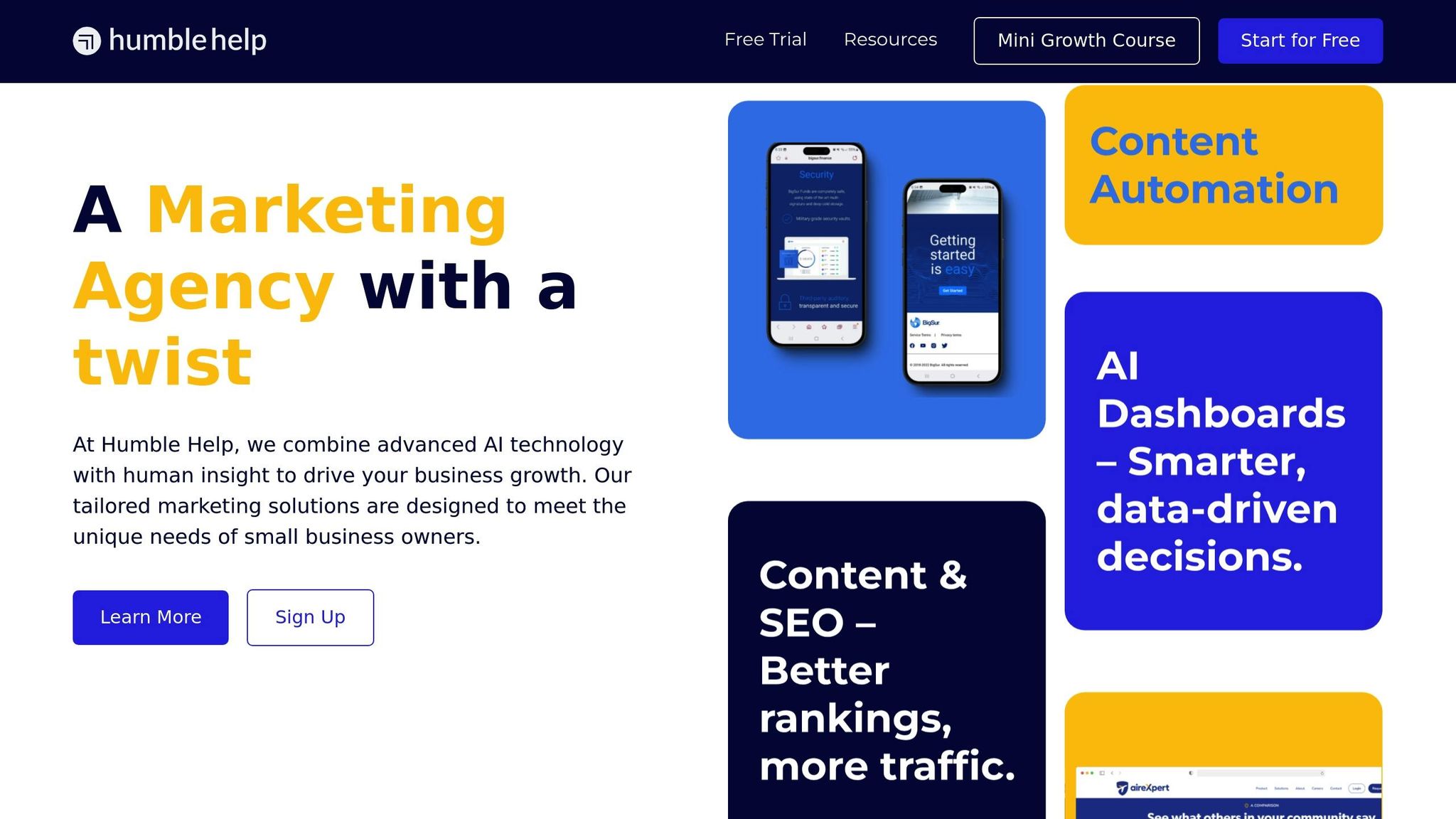
Humble Help provides an AI-powered platform designed specifically for small businesses. Their Brand Boost Package includes:
This platform blends AI with human guidance, making it a great choice for businesses new to automation.
When comparing marketing automation platforms, focus on these important factors:
| Feature Category | Evaluation Criteria | Why It Matters |
|---|---|---|
| Integration | CRM compatibility, third-party apps | Keeps your workflow smooth |
| Cost Structure | Setup fees ($2,000–$10,000); Monthly costs ($200–$2,000) | Impacts your overall ROI |
| Scalability | Contact limits, storage capacity | Supports future business growth |
| Support | Training resources, customer service | Simplifies implementation |
These considerations, combined with pricing and feature comparisons, will help you narrow down your options.
When selecting a platform, prioritize features like:
With nearly 80% of businesses now using or exploring AI-driven marketing tools [16], testing platforms through free trials is a smart way to find the right fit [17].
Marketing automation is proving to be a game-changer for small businesses, with nearly 80% reporting better lead generation and improved sales efficiency [2]. But here's the catch: success hinges on using the right tools and avoiding common mistakes.
Striking a balance between automation and personalization is key. Why? Because 61% of consumers are willing to spend more with businesses that deliver tailored experiences [20]. That’s a big opportunity for small businesses to stand out.
Recent data highlights how AI-powered automation is making an impact:
| Impact Area | Results |
|---|---|
| Time Savings | 97% report spending less time on tasks |
| Cost Reduction | 92% see lower marketing expenses |
| Data-Driven Decisions | 63% consistently use insights from AI |
| Investment Level | 32% spend under $1,000 per year |
But it’s not just about technology - it’s about strategy too. With 82% of consumers expecting instant responses and personalized emails leading to 75% higher open rates [3], businesses need to combine smart tools with thoughtful approaches.
Looking ahead, the future looks promising. A solid 68% of businesses expect positive results from AI tools in the next two to three years [19]. By sidestepping common pitfalls and implementing smart, strategic solutions, small businesses have the chance to turn their marketing efforts into powerful growth drivers.
Discover strategies to elevate your business.