
AI tools are transforming local SEO by automating tasks that previously required hours of manual work. From managing Google Business Profiles to optimizing content for local search, these tools are helping businesses improve visibility and save time. Here's a quick overview of how these tools are reshaping local SEO:
Quick Tip: Combine tools like SEMrush for keyword research, BrightLocal for citation management, and Jasper for hyper-local content creation to maximize results.
AI is no longer optional for local SEO - it’s a necessity for staying competitive. Read on to find out which tool fits your business needs.

BrightLocal is an AI-powered tool designed to simplify local SEO. With a user rating of 4.7/5 [7], it helps businesses streamline their workflows and achieve measurable results, all while focusing on the unique demands of local markets.
The platform excels at understanding the nuances of local search behavior. For example, it helps businesses target specific phrases like "best coffee shop in downtown Seattle" instead of broad, less relevant terms. Here's a closer look at some of its standout features:
BrightLocal makes managing Google Business Profiles a breeze. It automates tasks like scheduling posts, updating business hours for holidays or special events, and keeping contact information accurate across Google properties. The platform also offers real-time alerts for profile updates and lets businesses track key metrics such as profile views, clicks, and customer actions. These insights help businesses understand which updates boost engagement and drive local search traffic.
The platform analyzes local search trends, helping businesses identify location-specific keywords with high search volume and low competition. It also optimizes website content and meta descriptions to align with these trends. Unlike general SEO tools, BrightLocal focuses on local relevance, offering insights tailored to a business's specific area.
BrightLocal simplifies managing online reviews by monitoring feedback across platforms like Google, Yelp, and Facebook. It automates review requests to encourage timely, positive feedback while providing instant alerts for negative reviews. This allows businesses to respond quickly and address issues before they escalate. A unified dashboard consolidates all reviews, making it easy to monitor and manage customer feedback.
Keeping business information consistent across directories is crucial for local SEO, and BrightLocal excels in this area. It audits existing business listings, identifies errors, and provides tools to fix discrepancies that could hurt search rankings. By syncing accurate Name, Address, and Phone (NAP) details across multiple directories, the platform helps businesses maintain strong local visibility. This feature is especially beneficial for multi-location businesses, as it continuously monitors and corrects listing inconsistencies.
BrightLocal offers tiered pricing starting at $39 per month for single-location businesses. Its scalable plans make it a practical choice for small local enterprises while still offering advanced features for larger operations [7].

Birdeye is an AI-powered platform designed specifically for businesses with multiple locations, helping them tackle the unique challenges of managing operations across various sites. With a user base exceeding 100,000 businesses, it has become a prominent tool for automating local search optimization and managing online reputation [8].
What sets Birdeye apart is its ability to handle the complexities of multi-location management. While many tools cater to single-location needs, Birdeye ensures consistency and accuracy across hundreds - or even thousands - of business profiles at the same time.
Managing Google Business Profiles for multiple locations can be a daunting task, but Birdeye simplifies it with AI-driven automation. The platform ensures that critical business details - like operating hours, contact information, and messaging - stay accurate and current without requiring manual updates for each location.
One of its standout features is the ability to apply updates made to one location across similar ones, saving brands considerable time. Real-time alerts notify businesses of any changes or issues, enabling quick corrections before search rankings take a hit. This same automation extends to managing customer reviews, ensuring consistent oversight across all platforms.
Birdeye takes review management to the next level with its advanced AI tools. Its sentiment analysis feature automatically categorizes reviews based on emotional tone, making it easier for businesses to pinpoint locations that need immediate attention.
The platform also offers an automated review response system, which generates tailored suggestions for responding to both positive and negative feedback. This feature is especially valuable because 88% of consumers trust businesses that actively respond to reviews [8]. By analyzing the context and sentiment of each review, Birdeye ensures responses are personalized, align with the brand's voice, and address specific customer concerns.
Additionally, businesses receive real-time alerts the moment new reviews are posted on platforms like Google, Yelp, and Facebook. This instant notification system allows for quick responses, helping businesses maintain strong customer relationships and demonstrate active engagement.
One of the toughest aspects of local SEO for multi-location businesses is maintaining consistent Name, Address, and Phone (NAP) information across countless directories and platforms. Birdeye tackles this challenge head-on with its AI-powered processes.
The platform monitors business listings across the web, identifying and correcting discrepancies that can harm local search rankings. With automated auditing and bulk correction tools, Birdeye ensures NAP data remains consistent - even as businesses grow or relocate - helping avoid penalties from Google for inaccurate information [8].
To streamline operations further, Birdeye integrates seamlessly with major CRM and marketing platforms, allowing businesses to automate their local SEO tasks without disrupting existing workflows. Pricing is tailored to the size and needs of the business, making it scalable for both small multi-location companies and large enterprise chains.

Chatmeter focuses on simplifying reputation management and competitive intelligence for businesses with multiple locations. It streamlines the process of monitoring and managing customer feedback while helping businesses scale their local SEO efforts. With 97% of consumers searching online for local businesses [6], Chatmeter's emphasis on improving the customer experience has become increasingly important.
The platform combines automation with detailed data insights to enhance local SEO workflows, making it easier for businesses to stay ahead in a competitive market.
Chatmeter integrates seamlessly with Google Business Profile, allowing businesses to manage multiple locations from one centralized dashboard. This feature makes it easy to update key details like operating hours, photos, and posts without the hassle of manually checking each profile. The system also flags inconsistencies in business listings and notifies managers when updates are required. This proactive method ensures that critical information stays accurate and consistent. Additionally, Chatmeter tracks performance metrics, helping businesses identify which profiles might need further optimization. This centralized approach not only saves time but also simplifies review management.
Chatmeter goes beyond basic profile management by offering robust tools for reputation control. Using AI-driven technology, the platform monitors and analyzes reviews from various sources, identifying sentiment patterns and alerting businesses to potential risks before they become bigger issues [3]. Its sentiment analysis pinpoints important feedback, while real-time alerts and competitive benchmarking allow businesses to respond quickly. The platform even suggests appropriate responses, making it easier to maintain consistent and professional engagement across all locations.
For businesses juggling information across multiple directories, Chatmeter simplifies the task of maintaining accurate Name, Address, and Phone (NAP) details. Its automated tools monitor and correct citations, ensuring consistency across a wide range of platforms [3]. By automatically detecting and fixing NAP discrepancies, Chatmeter helps improve local search visibility while saving businesses the time and effort of manual updates. This feature is particularly valuable for maintaining a strong online presence across multiple locations.
SEO.AI is designed to help businesses fine-tune their content and improve keyword strategies, aiming for better organic search rankings. What sets this platform apart is its ability to assess content performance and highlight overlooked opportunities for optimization. Here's a closer look at its standout features:
SEO.AI simplifies keyword research by analyzing search trends and competition levels, helping businesses pinpoint impactful keyword opportunities. It connects directly with Google Search Console, offering real-time performance data and insights for identifying keyword gaps.
Using natural language processing, its semantic SEO technology aligns content with search intent. This ensures that keywords are seamlessly integrated into the copy, avoiding the pitfalls of keyword stuffing.
The platform also provides a real-time SEO scoring system, which evaluates your content as you create it. It offers actionable suggestions to enhance visibility. Additionally, its content benchmarking feature compares your strategy to top competitors, saving you the time and effort of manual analysis.
SEO.AI’s keyword gap analysis highlights areas where competitors are gaining traction, while its automated rank tracking keeps you updated on performance trends. This constant monitoring allows businesses to respond quickly to search algorithm updates and competitor strategies, eliminating the need for manual tracking.

Jasper is an AI-powered content tool designed to simplify hyper-local SEO efforts. It helps brands connect with local communities through neighborhood-specific messaging. Unlike general writing tools, Jasper focuses on creating content that resonates with regional audiences by tapping into local context and trends.
Using advanced AI, Jasper analyzes local search patterns to identify impactful keywords and content topics that can attract more local traffic. This approach ensures consistent, high-quality content while cutting down on time-consuming tasks. Like other tools in its category, Jasper makes local SEO workflows more efficient by automating key processes.
Beyond its content creation capabilities, Jasper also offers features for targeted local keyword research and content optimization.
Jasper stands out by crafting content tailored for local search, incorporating location-specific details and community-oriented themes. For instance, a wellness studio could use Jasper to create monthly articles about nearby fitness events or healthy eating tips centered around a local farmer's market. The tool naturally integrates neighborhood-related keywords, enhancing the content's relevance for local search engines.
Its ability to produce a range of hyper-local content - such as service pages for specific cities, blog posts about community happenings, or location-specific landing pages - helps businesses build a stronger presence in their local markets. This ensures businesses can maintain a steady stream of regionally relevant content while enhancing their authority within their target areas.
Jasper’s AI models are regularly updated to align with the latest search engine algorithms and local SEO best practices. This ensures the content it generates stays optimized for current ranking factors. Additionally, Jasper integrates smoothly into broader marketing workflows, making it particularly useful for agencies managing multiple clients or businesses with several locations. By automating content production, teams can focus more on strategy and less on manual tasks.
With pricing starting at $39 per month for the Creator plan, Jasper offers flexible tiered options and an easy-to-use interface. For even better results, combining Jasper with dedicated local SEO tools can help manage tasks like citations and reviews more effectively.

Surfer AI is a tool designed to help businesses create content that aligns with SEO best practices. Using advanced AI, it analyzes real-time search engine results pages (SERPs) to generate detailed briefs. These briefs include recommendations for keyword density, content structure, and relevant topics, offering clear guidance for crafting SEO-friendly content.
One standout feature is its ability to compare your content against top-performing local competitors. By focusing on local search trends, Surfer AI identifies content gaps that could boost your local search rankings when addressed. This makes it especially valuable for agencies and businesses with multiple locations aiming to strengthen their local SEO. It works seamlessly alongside other local SEO tools by blending competitive insights with content strategy.
Surfer AI takes optimization a step further with real-time content scoring. As you write, the tool evaluates your content to ensure it aligns with current SEO standards. It provides actionable insights on keyword usage, ideal content length, and structure based on today’s ranking criteria. While it’s not exclusively tailored for local keywords, its recommendations adapt well to local SEO needs.
For agencies, Surfer AI simplifies the workflow by generating optimized content briefs quickly, reducing the time spent on manual keyword research and planning. Starting at just $29 per month for its basic plan [9], it’s a cost-effective addition to any local SEO toolkit. Plus, it integrates smoothly with tools like BrightLocal and Moz Local, making it a strong complement to broader local search strategies.
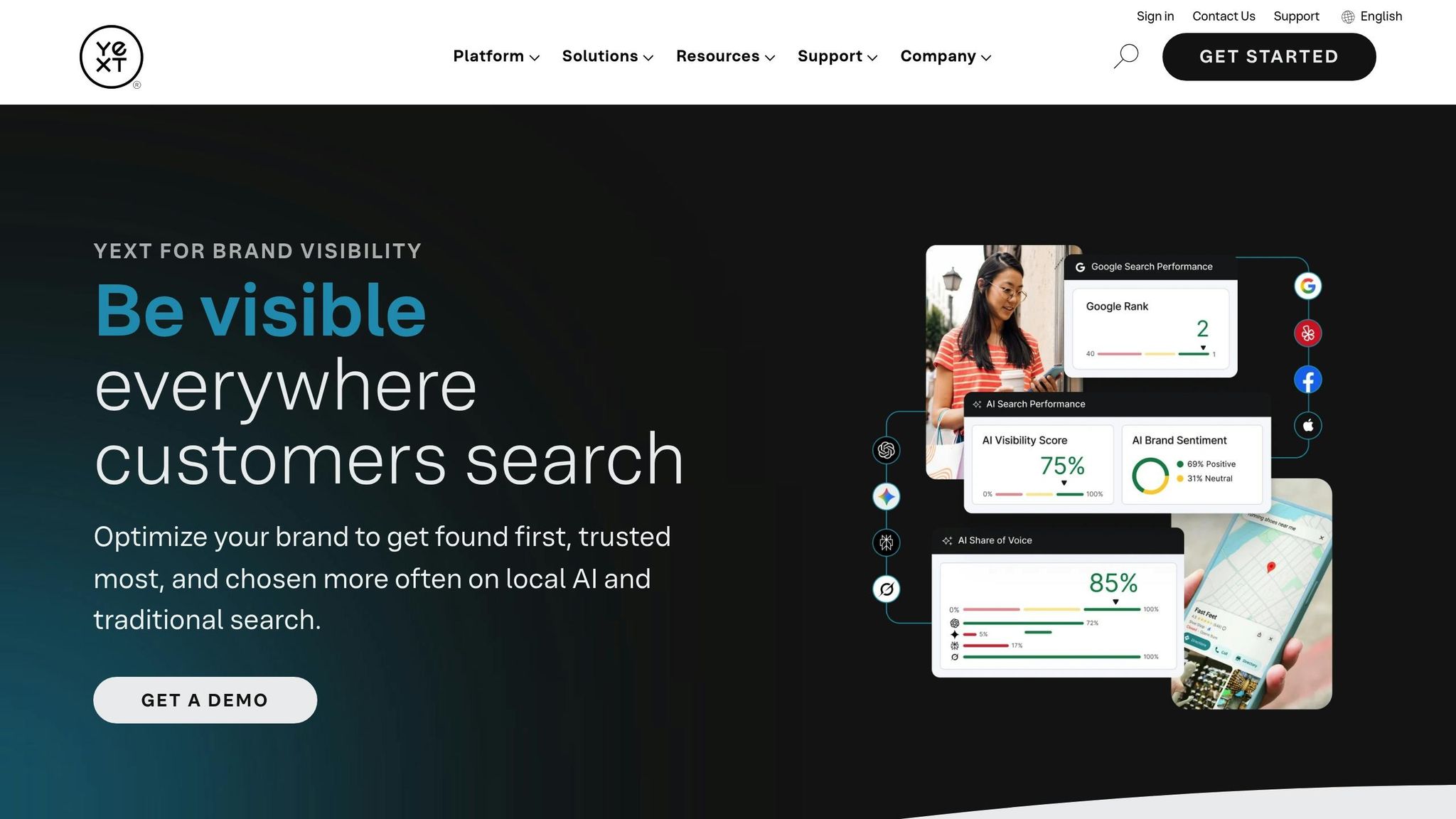
Yext is a digital knowledge management platform designed to simplify local SEO by automating business listing management. Instead of handling individual local SEO tasks, Yext acts as a central hub, allowing businesses to oversee their entire digital presence across hundreds of directories and platforms all at once.
One of its key strengths is its ability to push accurate business information - such as hours, phone numbers, and addresses - to major search engines, maps, and directories through a single update system. For example, if a business adjusts its holiday hours or updates its contact number, Yext automatically distributes these changes to platforms like Google, Apple Maps, Bing, Yelp, and various industry-specific directories. This eliminates the need for manual updates and streamlines local SEO efforts by leveraging automation.
Yext extends its automation capabilities to Google Business Profile management, enabling businesses to instantly update essential details like hours, addresses, and services for multiple locations from one interface. Whether it’s seasonal adjustments or temporary changes, updates appear immediately on Google Maps and local searches.
For instance, a retail chain with over 200 U.S. locations used Yext to centralize its listings. By automating updates for store hours and promotions, the company saw a 30% drop in customer complaints about outdated information and a 15% boost in local search visibility within three months [3]. This scalability is especially valuable for businesses managing multiple locations or franchises.
Yext also ensures consistency in business information across directories. It scans for and corrects discrepancies in Name, Address, and Phone (NAP) details, which are critical for local SEO rankings. Through direct integrations with major U.S. directories and by keeping up with platform-specific requirements, Yext guarantees that business details are correctly formatted and consistent everywhere, reducing the risk of errors that could hurt search performance.
Managing online reputation is another area where Yext shines. It consolidates customer reviews from platforms like Google, Yelp, and Facebook into a single dashboard. Automated alerts notify managers of new reviews, and AI-powered sentiment analysis helps identify trends or potential issues before they escalate. This allows businesses to respond promptly to feedback, improving star ratings and overall reputation.
Yext also provides detailed analytics on listing accuracy, impressions, clicks, and customer actions. These insights help businesses measure the effectiveness of their local SEO strategies and make data-driven improvements to optimize their presence continually.

Moz Local takes a straightforward approach to local SEO by prioritizing the essentials: citation management and maintaining consistent NAP (Name, Address, Phone) details. While some tools aim to cover every aspect of local SEO, Moz Local zeroes in on keeping your business information accurate - a crucial factor for improving local search rankings. Its focus on citation accuracy also lays the groundwork for efficient review management and offers an affordable pricing model.
At the heart of Moz Local is its robust citation management system. The platform integrates with major data aggregators like Acxiom, Infogroup, and Localeze to distribute your business details across a wide range of directories. Any updates - whether it’s a change in business hours, phone numbers, or addresses - are automatically pushed across these directories. Moz Local’s AI scans for inconsistencies, ensuring your information stays uniform everywhere it appears.
For instance, a multi-location retail chain used Moz Local to synchronize its details across more than 50 directories. Within three months, the chain saw a 30% increase in search impressions, more foot traffic, and improved review ratings. This automation replaced the tedious process of manually updating individual listings whenever store information changed [8].
In addition to citation management, Moz Local includes tools for review aggregation. It collects reviews from major platforms into a single dashboard and sends automatic alerts for new feedback. This allows businesses to respond quickly to customer reviews, helping maintain a strong online reputation - all without needing a separate review management tool.
Moz Local’s pricing starts at around $14 per location per month, making it accessible for businesses of all sizes, from small operations to large enterprises. Custom plans are available for agencies and brands managing multiple locations. For U.S.-based businesses with numerous locations, the time saved and improved search visibility often make the cost worthwhile, especially when compared to manually maintaining citations across directories.
This platform is particularly effective for franchises, retail chains, healthcare providers, and real estate agencies that need consistent information across multiple locations. While Moz Local doesn’t offer automation for Google Business Profile or advanced content optimization like some competitors, its laser focus on citation accuracy makes it a must-have tool for building a solid local SEO strategy.

SEMrush stands out as a powerful SEO tool equipped with AI capabilities tailored for local search optimization. It uses a data-focused approach to help businesses gain a competitive edge in their local markets through intelligent keyword research and competitor analysis.
SEMrush's AI-powered tools help businesses identify local opportunities by analyzing search volume, user intent, and competitor trends. This allows businesses to zero in on hyper-specific keywords, such as "organic skincare shop in [City]" or "best vegan cafe near [Neighborhood]" [3]. By focusing on geographic precision, SEMrush ensures campaigns are designed to reach audiences most likely to convert.
Its machine learning system continuously tracks ranking signals, making real-time adjustments to keywords and on-page elements as trends shift [4]. This dynamic approach allows businesses to create locally relevant content, such as web pages or blog posts tailored to specific neighborhoods, city attractions, or community events. This kind of hyper-local focus is crucial for building strong connections with local audiences [3].
SEMrush also offers tools like the Position Tracking feature, which monitors local keyword rankings across different geographic regions, and the On Page SEO Checker, which provides actionable suggestions for improving landing pages. These tools work hand-in-hand with SEMrush's robust monitoring system, combining keyword intelligence with strategic citation and competitor analysis.
While SEMrush doesn’t automate citation building, its site audit tools are highly effective at identifying and flagging NAP (Name, Address, Phone number) inconsistencies. These tools ensure businesses maintain accurate local information, while its competitor analysis helps uncover opportunities for new citations and strategic adjustments [4].
SEMrush’s competitor analysis capabilities are particularly noteworthy. By analyzing competitor strategies, user queries, and regional keyword trends, businesses can gain deeper insights into local search dynamics and refine their tactics for better results [3].
| Feature | SEMrush | Strengths | Limitations |
|---|---|---|---|
| Local Keyword Research | AI-driven analysis | Real-time insights, competitor data | Requires manual implementation |
| Content Optimization | On-page recommendations | Geographic targeting | No direct GBP automation |
| Citation Monitoring | Site audit tools | Identifies opportunities | Manual citation building |
| Competitor Analysis | Advanced insights | Data-driven market intelligence | Higher learning curve |
This table highlights SEMrush's ability to merge local keyword strategies with advanced competitor analysis and site auditing tools.
At $129.95 per month for the Pro Plan, SEMrush is pricier than tools like Moz Local, which are more focused on citation management. However, its extensive feature set makes it a worthwhile investment for businesses looking to succeed with data-driven local SEO [4].
For multi-location businesses, SEMrush's scalable analytics are invaluable, offering the ability to analyze multiple regions simultaneously while delivering actionable competitive insights [3].
Humble Help steps in where automation meets strategic guidance, offering a tailored solution for coaching professionals. Positioned as a standout in the local SEO automation space, it blends AI-driven tools with expert oversight to streamline local SEO for coaches. The result? Faster outcomes - up to 3–5 times quicker than traditional agencies - without losing the human touch that automated platforms often miss [1].
This platform focuses on what it calls "Google-Friendly Content" strategies, designed to boost local search visibility. This approach is particularly beneficial for coaches aiming to establish themselves as trusted authorities within their local markets.
Humble Help leverages AI to identify impactful local keywords like "business coach in Dallas" or "leadership workshops near me." Once these keywords are identified, the platform creates optimized landing pages, blog posts, and service descriptions that naturally incorporate them. This approach enhances local search rankings and draws in highly targeted leads [3].
For example, a business coach in Austin used Humble Help’s content optimization tools and saw impressive results in just three months. The coach experienced a 40% increase in Google Business Profile views and a 25% boost in website traffic from local searches, highlighting how automation can deliver measurable growth for local service providers [3].
The platform also analyzes search intent and competitor trends to ensure content resonates with local audiences. Beyond content optimization, it simplifies Google Business Profile management, helping coaches strengthen their local presence.
Keeping a Google Business Profile active and accurate is crucial for local visibility, and Humble Help makes this easy. The platform automates profile updates, scheduled posts, and customer responses, ensuring coaches maintain a consistent online presence without the hassle [4].
Users can schedule weekly updates about events, services, or blog posts, reducing manual effort while staying top-of-mind for potential clients. Additionally, the system tracks key metrics like profile views, keyword rankings, and website traffic from local searches, enabling continuous refinement of SEO strategies [3].
Managing reviews across platforms like Google, Yelp, and Facebook can be time-consuming, but Humble Help simplifies this too. Its AI tools monitor reviews, analyze sentiment, and flag negative feedback for immediate attention. It even suggests tailored responses, helping coaches maintain a positive reputation [5].
The Austin business coach mentioned earlier also benefited from this feature, achieving improved review ratings thanks to timely, personalized responses made possible by Humble Help’s automation [3].
| Feature | Humble Help | Key Benefits | Approach |
|---|---|---|---|
| Content Optimization | AI + Human expertise | Locally relevant, conversion-focused | Done-for-you + Done-with-you |
| GBP Management | Automated workflows | Consistent posting, quick responses | Smart automation with oversight |
| Review Management | Sentiment analysis | Proactive reputation building | AI flagging + human strategy |
| Keyword Research | Geographic targeting | High-impact local keywords | Data-driven with a coaching focus |
Humble Help’s combination of "done-for-you" and "done-with-you" models allows for personalized campaigns tailored to the unique needs of coaching professionals. This thoughtful mix of technology and human expertise avoids the pitfall of generic, uninspired content, ensuring it connects authentically with local audiences [3].
For coaches, Humble Help provides a way to tap into advanced local SEO tools while preserving the strategic insight needed to thrive in competitive local markets.
Finding the right AI tool for local SEO automation depends on factors like your business size, budget, and specific goals. Below is a table summarizing the standout features, pricing, and limitations of popular tools, followed by a closer look at their capabilities.
| Tool | Starting Price (USD) | Key Strengths | Main Limitations | Best For |
|---|---|---|---|---|
| BrightLocal | $39/month | Citation management, local rank tracking, affordable pricing | Limited content creation features | Small local service providers (e.g., plumbers, dentists) |
| Birdeye | $299/month | Review generation, customer feedback automation | High cost for small businesses | Multi-location retailers focused on reputation |
| Chatmeter | Custom pricing | Multi-location analytics, brand monitoring | Cost-prohibitive for small businesses | Franchises and enterprises with many locations |
| SEO.AI | Free tier, paid from $49/month | AI content generation, data-driven optimization | Requires human oversight for quality | Agencies needing scalable content |
| Jasper | $39/month | Fast, high-quality content creation | Needs supervision for local relevance | Businesses requiring bulk content |
| Surfer AI | $59/month | Actionable on-page SEO recommendations | May not cover all local ranking factors | E-commerce stores optimizing product pages |
| Yext | $199/year | Business information consistency across directories | Limited by supported directories | Businesses needing consistent listings |
| Moz Local | $14/month | Automated listing distribution, budget-friendly | Directory coverage limitations | Small businesses on tight budgets |
| SEMrush | $129.95/month | Comprehensive local keyword and competitor insights | Steep learning curve for advanced features | Digital marketing agencies |
| Humble Help | Custom packages | Expert-led automation blend with a coaching focus | Not suitable for self-service automation | U.S.-based coaches seeking strategic support |
Integration and Pricing: Most tools integrate directly with Google Business Profile, a must for local SEO. Pricing ranges from free tiers (like SEO.AI) to custom enterprise packages. Small businesses often gravitate toward budget-friendly options like Moz Local, while larger enterprises may need the tailored solutions offered by Chatmeter or Birdeye.
Multi-Location Management: Tools like Chatmeter, Birdeye, and BrightLocal shine when it comes to managing multiple locations. They offer centralized dashboards for tasks like review monitoring and maintaining NAP (Name, Address, Phone) consistency across directories in the U.S.
Content Automation: For businesses needing to scale content creation, tools like SEO.AI and Jasper deliver quick results but require human oversight to ensure relevance and quality. Surfer AI, on the other hand, specializes in on-page SEO recommendations, making it ideal for refining product or service pages. Humble Help takes a unique approach by combining AI-generated content with personalized strategy guidance.
Customer Support and Compliance: Support varies widely, with some tools offering robust online resources and others focusing on dedicated enterprise assistance. U.S. businesses must also prioritize tools that align with data privacy standards, especially when handling sensitive customer information.
The best tool for your business depends on your specific needs. Small local businesses might find Moz Local or BrightLocal ideal for affordable citation management. Agencies and growing businesses could benefit from the advanced keyword research and content capabilities of SEO.AI or SEMrush. Coaches can explore Humble Help for its mix of automation and strategic support, while enterprises managing numerous locations might lean toward Chatmeter or Birdeye for their analytics and review management features.
This breakdown highlights the strengths of each tool, helping you decide which one aligns with your local SEO goals.
AI is transforming local SEO by turning time-consuming manual tasks into quick, data-driven processes. Tasks like scanning hundreds of directories for NAP (Name, Address, Phone) inconsistencies or researching local keywords - once requiring days - can now be completed in minutes using tools like BrightLocal and SEMrush.
The real advantage comes from combining these tools effectively. For instance, SEMrush's AI can identify local keyword gaps, SEO.AI can craft targeted content, and BirdEye can automate review responses. This not only saves time but also allows your team to focus on customer engagement. Meanwhile, hybrid solutions like Humble Help combine AI automation with personalized human strategies, making them particularly useful for service-oriented businesses. Together, these tools streamline processes and reduce workload significantly.
AI tools can cut local SEO workloads by up to 70%, automating tasks like Google Business Profile management, citation updates, and content creation - all in a fraction of the time it used to take [2]. Beyond speed, these tools enhance precision by analyzing extensive datasets, such as competitor strategies, regional search trends, and user intent, to generate actionable insights [3]. For example, SEMrush's Local tool can identify high-intent keywords like "best vegan cafe near [Neighborhood]", ensuring your content aligns with what local searchers are looking for.
For businesses with multiple locations, AI simplifies managing Google profiles, citations, and online reviews. This ensures consistency across locations and boosts visibility in "near me" searches - all without a proportional increase in marketing effort [4]. These strategies build on earlier approaches pioneered by tools like Yext and Moz Local.
To maximize these benefits, businesses should start with a local SEO audit to identify gaps. From there, integrating the right AI tools and setting clear KPIs ensures seamless updates and measurable success.
However, while automation drives efficiency, human oversight remains critical. This ensures AI-generated outputs reflect local nuances and maintain the brand's voice [5]. Striking this balance between automation and human expertise reinforces the importance of pairing technology with thoughtful oversight.
Leveraging AI for local SEO today offers a powerful way to enhance efficiency while preserving the personal touch that fosters lasting customer relationships.
AI tools such as BrightLocal and Birdeye simplify the task of managing your business information across multiple platforms and locations. They ensure that key details - like your business name, address, phone number, and operating hours - stay accurate and consistent. This consistency not only builds trust with your customers but also boosts your local search rankings.
These tools go a step further by monitoring your online presence, spotting inconsistencies, and offering actionable steps to fix them quickly. By automating these processes, they save you valuable time and minimize the chance of errors, so you can focus on what truly matters: growing your business.
When choosing an AI tool for local SEO, it's important to weigh a few critical factors to make sure it fits both your business needs and your budget. Start by identifying your priorities - are you looking for support with Google Business Profile management, keyword research, or content optimization? Knowing exactly what you need will narrow down your options.
Next, think about scalability. If you're running a smaller business, go for a budget-friendly option that can expand alongside your growth. On the other hand, larger businesses might benefit from tools that offer more advanced features and integrations to handle complex demands.
Pricing is another key consideration. Some tools operate on a flat monthly subscription, while others use a pay-as-you-go model. Pick the one that aligns with your financial plan, but make sure it still includes the features you can't do without. Lastly, take the time to read user reviews and request demos. This will give you a clear idea of how user-friendly the tool is and whether it provides real value for the money you’re investing.
AI tools designed for local SEO make it easier to handle tasks like managing Google Business Profiles, researching keywords, and fine-tuning content to connect with local audiences. These tools dive into data such as user behavior, search trends, and location-specific keywords to craft strategies that align with specific markets.
By taking over repetitive tasks, AI not only saves time but also ensures consistency and accuracy. This gives businesses more room to focus on delivering tailored experiences. For instance, AI can tweak content in real-time to match local preferences, cultural nuances, and even seasonal trends, making it more relatable and engaging for the audience.
Discover strategies to elevate your business.