
Local partnerships are a smart way for small businesses to grow without spending big. By working with other local businesses, you can:
For example, a coffee shop teaming with a bookstore for events can attract more customers while splitting costs. Partnerships like these strengthen your local presence and boost credibility, helping your business thrive in the community.
Want to grow? Start small - find a local business with shared values and propose a simple collaboration like a joint event or referral program. It’s an easy, cost-effective way to grow together.
Local partnerships offer a practical way for small businesses to overcome common hurdles like limited budgets, a narrow customer base, and the need to establish trust quickly. By joining forces, businesses can achieve goals that might otherwise be out of reach. Let’s explore how these collaborations can expand your market reach, reduce costs, and build credibility.
Growing your customer base is essential for any small business. When you collaborate with another business, you gain access to their audience while introducing them to yours. This kind of mutual promotion leverages existing relationships and reputations without requiring additional advertising spend [4]. Tactics like cross-promotion and referral programs not only bring in new leads but also help build customer loyalty [1].
For example, teaming up with businesses that cater to similar customer groups but offer different products can be especially effective. Think of a yoga studio partnering with a health food store - both attract health-conscious customers, creating a natural synergy [3].
"By collaborating with local players, startups can leverage their reputation to gain the trust of customers, suppliers, and stakeholders." - Nicholas Robb, Founder, Design Hero [3]
One of the biggest perks of local partnerships is cost-sharing, which is crucial for small businesses operating on tight budgets. Whether it’s splitting the cost of advertising in mailers or online platforms, or co-hosting events to save on venue and promotional expenses, working together can significantly reduce financial strain [5][6]. For instance, offering package deals that combine services from both businesses not only adds value for customers but also lowers promotional costs [5].
Take the example of a neighborhood café and a nearby artisan bakery. In March 2023, they partnered to create unique menu items and advertised them through joint brochures. This approach helped both businesses cut marketing expenses while reaching new customers [6]. Partnerships can also reduce operational costs, such as sharing event spaces or teaming up with local suppliers to improve efficiency and product quality [6][1]. Beyond saving money, collaborating with well-regarded local businesses can enhance customer trust.
Working with reputable local businesses can fast-track your credibility. Customers often see partnerships as endorsements, which can significantly boost your brand’s trustworthiness [10]. A 2009 Edelman survey revealed that 91% of people aged 25 to 64 worldwide bought from companies they trusted, showing just how critical trust is in the buying process [9]. By aligning with trusted local partners, you can earn that trust faster, especially as customers increasingly prefer businesses with strong community connections over large, impersonal corporations [7].
"Trust is now local. We no longer trust traditional establishment authorities. It happens in and around my community, and I don't just mean physical community. This could be a kind of online community or those that I interact with, my employer, or my workplace." - Tom Robinson, CEO of Edelman Australia [7]
A great example of this is a partnership between a fitness studio and a healthy café. The café offered discount vouchers for fitness classes with qualifying meal purchases, and both businesses promoted the deal online and on social media. This collaboration not only delivered value to customers but also positioned both businesses as advocates for healthier lifestyles, reinforcing their credibility as wellness experts [10].
Additionally, partnerships that involve community engagement demonstrate social responsibility. Consumers are more inclined to trust and support businesses that actively contribute to their communities, helping you build a reputation as a business that values more than just profits [8][2].
Let’s dive into different partnership strategies that can help grow your business by combining efforts, sharing costs, and building trust within your community.
Cross-promotions and referral programs are a win-win for businesses, as they allow you to promote each other’s products or services. And they work - 48% of millennials prioritize word-of-mouth over TV ads, and referral marketing boasts response rates 3–5 times higher than other platforms [13].
The secret to success lies in choosing partners whose offerings and values align with your business. Look for businesses that serve a similar audience but don’t compete directly. For example, a local coffee shop might team up with a nearby bookstore, creating promotions that benefit both.
Referral programs can be designed in many ways to reward both the referrer and the new customer. For instance, referrers might earn points or gift cards, while new customers receive discounts [13]. But simplicity is key - complicated referral systems can deter participation. Since 82% of Americans turn to friends and family for recommendations before making a purchase [13], creating an easy process ensures your program fits naturally into existing habits.
To amplify your efforts, promote these collaborations through your website or social media channels [12]. Beyond referrals, consider co-hosting events with your partners to engage local audiences directly.
Joint events take collaboration to the next level by engaging the community while combining resources. These events attract shared audiences, create networking opportunities, and showcase your business’s commitment to the local area.
Work with other local businesses or organizations to host events that bring value to your community [12]. For example, a financial advisor and a real estate agent could host a workshop for first-time homebuyers, or a fitness trainer and a nutritionist might collaborate on a wellness seminar. These events not only educate but also strengthen ties with potential customers.
Make sure your events are accessible to everyone to maximize participation [14]. This inclusivity demonstrates a sense of social responsibility, which resonates deeply with today’s consumers. Plus, the connections made during these events often lead to future partnerships or referrals, as attendees see businesses working together in a professional and trustworthy way.
Getting involved in community projects or sponsoring local events is a fantastic way to build goodwill and strengthen your connection to the area. This approach matters - 66% of people believe companies should support causes, and that number jumps to 75% among millennials [16].
Sponsoring events or organizing activities like recycling drives, tree-planting days, or zero-waste workshops can make a big impact [14]. A great example is Visit Mesa’s "Live Life Limitless" campaign, which highlights the city’s efforts to be an Autism Certified City by hosting sensory-friendly events and promoting accessibility [14].
"For us, sponsorship is one of the most powerful opportunities a brand has to connect with the broader community and place the business within a meaningful context." - Piers Moore-Ede, head of digital at Company Debt [15]
Community involvement doesn’t just feel good - it makes business sense. Keeping dollars circulating locally benefits everyone [16], and 82% of U.S. consumers factor corporate social responsibility into their shopping decisions [17]. Whether you’re hosting fundraisers, donating to local charities, or sponsoring community projects, these efforts leave a lasting impression on your audience.
While these partnerships might not yield immediate financial returns, they build a foundation for long-term growth and trust within your community [11].
Now that you’ve seen the types of partnerships that can drive growth, it’s time to look at how to choose the right collaborators and manage these relationships effectively.
Creating strong local partnerships involves finding the right collaborators, setting clear expectations, and keeping track of progress. Here’s how you can do it effectively.
Start by identifying partners who complement your business. Take stock of your strengths and weaknesses to pinpoint what skills or resources you need in a partner. This approach ensures you can find businesses that not only fill those gaps but also benefit from what you offer.
"Choosing a business partner can be the best or the worst decision you make when starting a business." - LegalNature
Successful partnerships often happen when businesses share similar values but play different roles in the market. Tap into your existing network - former colleagues, industry contacts, or professionals you’ve met at events like trade shows or chamber of commerce meetings. Trusted advisors like accountants, lawyers, or bankers can also recommend reliable businesses seeking partnerships. Don’t overlook business incubators or co-working spaces; they’re often filled with ambitious entrepreneurs looking to collaborate.
When evaluating potential partners, consider their financial stability, willingness to commit time and resources, and ability to bring in new customers or connections. Look for partners who are not only resourceful but also share your vision and have strong problem-solving skills. For community-focused projects, local NGOs with aligned missions can be excellent partners - just ensure they’re properly registered and have solid communication and organizational systems in place.
Once you’ve identified potential partners, it’s crucial to establish clear goals and expectations from the start. This step prevents misunderstandings and ensures everyone is working toward the same objectives.
"A partnership without clear objectives is like wandering in the dark without a compass. By identifying your goals and value proposition, you can navigate the partnership landscape with confidence and purpose." - Jane Johnson, Strategic Partnership Expert
Define your goals using the SMART framework - Specific, Measurable, Achievable, Relevant, and Time-bound. For example, instead of saying "increase sales", set a concrete target like acquiring 50 new customers through cross-referrals within six months or co-hosting three local events by year-end.
Start with a SWOT analysis (Strengths, Weaknesses, Opportunities, Threats) to understand what each party brings to the table. Clearly outline roles, responsibilities, and the scope of your collaboration. Discuss key details like budget contributions, communication frequency, timelines, and decision-making processes. Formalize everything in a written agreement to ensure accountability and minimize potential legal risks.
Build trust by starting with smaller projects before diving into larger initiatives. Regular meetings and open communication channels are essential for addressing any issues early and keeping everyone aligned.
Monitoring the success of your partnerships goes beyond just looking at numbers - it’s about ensuring mutual growth and value. By 2026, Gartner predicts that 65% of B2B sales organizations will shift from intuition-based to data-driven decision-making, highlighting the importance of tracking performance [19].
Identify key performance indicators (KPIs) that align with your partnership goals. For instance, AvePoint boosted its channel revenue from 20% to 50% in two years by focusing on specific KPIs, with plans to reach 70%. Similarly, Palo Alto Networks saw a 40% quarter-over-quarter increase in partner engagement by tailoring their metrics [19].
"When we first started with Impartner, we were at 20% channel revenue. After two years, we're at 50% of our revenue touching the channel." - Sam Valme, Senior Director of Channel Experience at AvePoint
Use tools like Google Analytics to track metrics such as referral traffic, conversion rates, customer acquisition sources, and churn rates. Additionally, qualitative feedback from customer surveys can provide insights into how partnerships impact brand perception and customer satisfaction.
"It's really been pivotal in changing the way that our partners are able to co-market with us. We're seeing about a 40% quarter over quarter growth when I'm measuring partner engagement, which is fantastic." - Stephanie Zembal, Senior Manager of Channel Marketing at Palo Alto Networks
Schedule monthly check-ins with your partners to review progress, address challenges, and adjust strategies based on new insights. These regular reviews, combined with open communication, help ensure both parties remain aligned and committed to shared goals.
Use the data and feedback you gather to fine-tune your partnership strategy. If certain efforts aren’t delivering results, don’t hesitate to try new approaches. The goal is to build a partnership that evolves and strengthens over time.
Managing partnerships effectively means using tools that can automate tasks, track outcomes, and scale marketing efforts. Since local partnerships play a big role in growth strategies, having the right tools ensures these collaborations deliver measurable success. Interestingly, 75% of marketers are either experimenting with or fully implementing AI in their workflows [23]. This shift has made advanced technologies, once reserved for large corporations, accessible to small businesses.
The trick is to choose solutions that not only handle routine tasks but also provide the strategic insights needed to grow partnerships. Many modern platforms combine artificial intelligence with human expertise, offering quicker and cost-effective results.
Let’s explore how specific platforms and AI-powered tools are driving partnership growth.
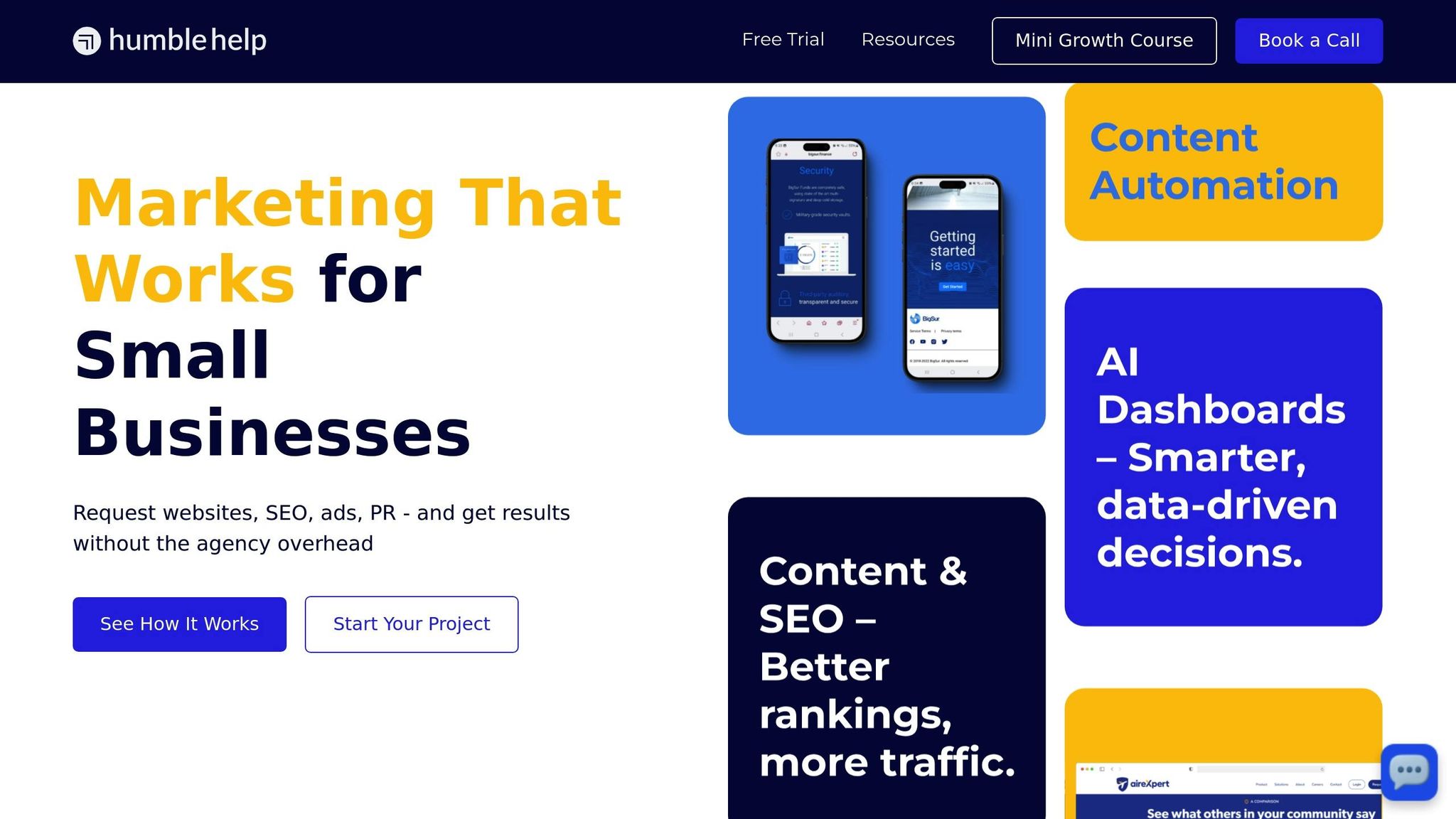
Humble Help is a platform designed to help small businesses scale their partnerships. It blends AI technology with human expertise, offering what they call "Marketing Expertise + AI Speed = Real Results" [24].
Humble Help provides several features aimed at partnership growth:
The results speak for themselves. A bakery owner, Amina J., shared, "Humble Help's dynamic website doubled my bakery's online orders in just weeks" [24]. Business leader Dan G. added, "The Humble Help team has been a godsend. They are responsive, knowledgeable, and we can always rely on them to deliver" [24]. These success stories show how improved online performance can make businesses more appealing as partners while boosting cross-promotional efforts.
Humble Help also claims to deliver outcomes 3–5 times faster than traditional agencies [24]. Its flexible pricing model, which includes both monthly subscriptions and one-time services, allows businesses to customize solutions based on their partnership goals.
In addition to dedicated platforms like Humble Help, AI-powered tools are reshaping how businesses manage and grow their partnerships.
AI tools are revolutionizing partnership management, with over 80% of marketers reporting positive revenue impacts from their use [23]. These tools excel at automating repetitive tasks, such as scheduling social media posts at optimal times [23] or responding instantly to customer inquiries via chatbots [23]. They also use advanced analytics to identify trending topics and optimize content, making partnership marketing campaigns more effective.
The combination of AI automation and human expertise creates a strong advantage. While AI handles data-heavy tasks and analysis, experts can focus on building relationships, crafting creative strategies, and solving the more complex challenges partnerships often present.
Take email marketing as an example. With an average ROI of $42 for every $1 spent [21], it’s already a powerhouse. When AI is used to segment audiences and personalize messages for partnership campaigns, the results can be even better. Considering that 81% of businesses say email is key for customer acquisition [21], AI-enhanced strategies can significantly amplify these efforts.
AI-powered CRM systems are another game-changer. They consolidate customer data, personalize interactions, and make it easier to track which customers come through specific partnerships [22]. These insights help measure the success of collaborative efforts. Additionally, with omnichannel integration - spanning social media, email, search, and websites [20] - AI platforms can coordinate partnership marketing across multiple channels.
When selecting AI tools for partnership management, look for platforms that offer workflow automation. This frees up small teams to focus on strategic priorities rather than getting bogged down by repetitive tasks [20].
Local partnerships can be a game-changer for small businesses, yet they often remain overlooked. Studies show that businesses with strategic partnerships enjoy a 27% greater growth potential, and 57% of partnered businesses report gaining new clients [25].
These collaborations don't just increase sales - they also widen your customer base and build trust within your community. As Tiffany Verbeck, Digital Marketing Copywriter at Nav, puts it:
"When customers see multiple local businesses recommending and supporting each other, they are more likely to trust and continue doing business with them." [1]
Trust is a big deal, especially when 96% of small business owners say community involvement fuels their success, and 66% believe local partnerships strengthen customer engagement and community support [25]. With such clear benefits, the next step is figuring out how to make these partnerships happen.
Start by identifying potential partners at local networking events or through organizations like your Chamber of Commerce. Look for businesses that share your audience but don’t directly compete with you. Propose joint promotions or co-hosted events to establish an initial connection.
Once you’ve found the right partner, formalize the arrangement with a written agreement. Clearly outline goals and expectations to avoid misunderstandings. As Jane Johnson, a Strategic Partnership Expert, advises:
"Without clear objectives, a partnership flounders. By identifying your goals and value proposition, you can navigate the partnership landscape with confidence and purpose." [18]
While these partnerships may not deliver instant results, their long-term benefits - like cost savings and enhanced credibility - are undeniable [11]. Track key metrics like engagement, sales, and social reach to measure the success of your efforts.
Why not start today? Reach out to a local business that shares your values and propose a joint event or promotion. Taking this first step could open the door to lasting growth and stronger community connections.
To connect with local partners that match your small business's values and objectives, begin by pinpointing businesses that cater to a similar audience or offer services that complement yours. Focus on shared principles, like prioritizing sustainability or actively engaging with the community, and ensure their goals align with your vision for growth.
Take time to research potential partners, examining their reputation, mission, and the services they provide. Set clear goals for the partnership and think about how their strengths can enhance your business. Strong local partnerships can boost your visibility, draw in more customers, and build trust within the community.
To gauge how well a local partnership is performing, keep an eye on essential metrics like local search rankings, referral traffic, and customer engagement levels. These indicators provide valuable insight into how the partnership is influencing your visibility and interactions.
It's also crucial to track measurable outcomes such as increased revenue, customer retention rates, and new client acquisition. These numbers paint a clearer picture of the partnership's overall impact on your business.
By regularly reviewing these metrics, you can pinpoint what’s working and where adjustments are needed to get better results. Over time, this consistent tracking will help you develop stronger and more impactful relationships with your local partners.
To ensure local partnerships remain strong, small businesses should focus on maintaining open lines of communication and consistently touch base to confirm that shared goals are being achieved. Building a partnership is one thing, but nurturing it requires effort and attention.
Another key element is to actively contribute to each other's success. This could mean exchanging referrals, offering valuable resources, or sharing expertise. These small acts of support can go a long way in strengthening the bond.
It’s also wise to assess the partnership's effectiveness on a regular basis. Take the time to review its impact and be open to revisiting terms or strategies as needs and circumstances change. By staying adaptable and working together, the relationship can continue to benefit both sides in the long run.
Discover strategies to elevate your business.